


Contact us
401 W. Kennedy Blvd.
Tampa, FL 33606-13490
(813) 253-3333
A student-faculty biology team is studying the simultaneous effect of sulfoxaflor and rising temperatures on bumblebees.
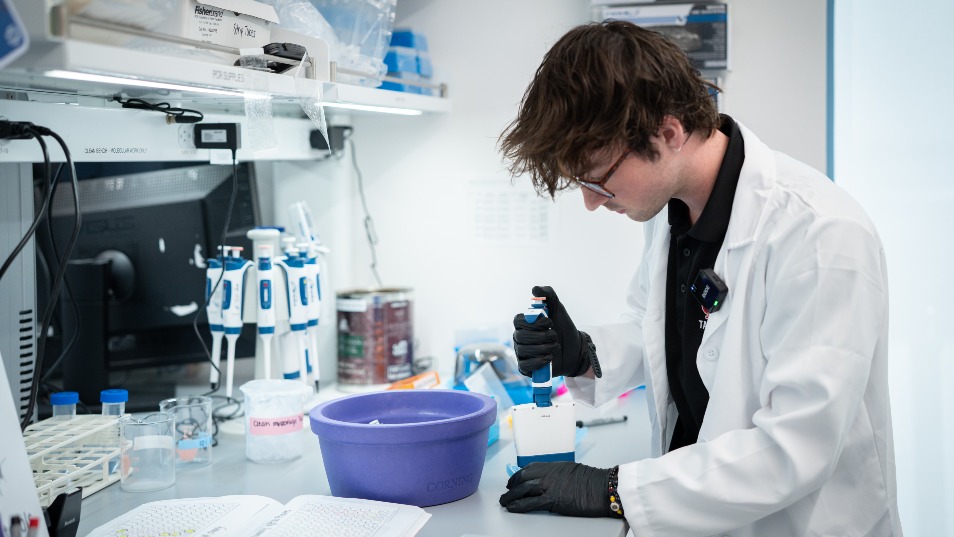
Greg Britt '28 studies the health and genetic makeup of the bees through dissection and RNA extraction. Photo by Jacob Cochran
Nearly two months into their summer research project, Greg Britt and Sarah Orr have avoided getting stung by any of the dozens of bees they’ve been studying.
Britt, a rising junior majoring in biochemistry, and Orr, assistant professor of biology, are researching how bumblebee health is affected by pesticides and rising temperatures with a Summer Undergraduate Research Fellowship grant.
The project is an extension of Orr’s postdoctoral research at Georgia Institute of Technology, completed shortly before she started at UTampa last August. She analyzed how varying doses of the pesticide sulfoxaflor — used to kill sap-feeding pests in crops like soybeans and corn — affects the reproductive health of bumblebees, finding that high doses were fatally toxic, while low doses can alter their genetics, specifically in ovarian tissues. Because of the molecular changes in their reproductive system, she concluded that continual exposure to sulfoxaflor could lead to reduced population over time.
At UTampa, Orr expanded the project to include an additional variable with potential to threaten bumblebees: heat stress.
In the first phase of the project, Orr and Britt set up eight treatments in the lab for the bees to receive. In clear boxes about the size of a ream of paper, the bees were given one of four different doses of sulfoxaflor and set under one of two temperatures, with the control temperature at 80.6 degrees Fahrenheit and the heat stress at 91.4 degrees. Three to five bees were placed in each box with pollen and sugar water and were monitored for 12 days.
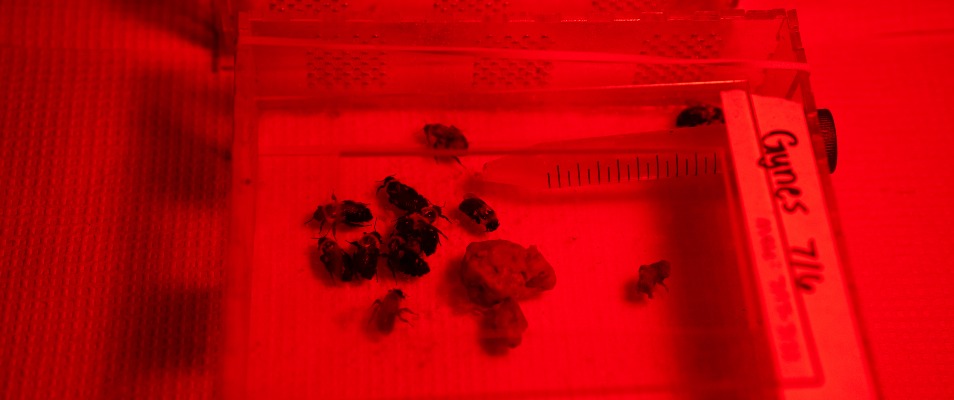 To wrangle the bees in and out of the boxes without getting stung, Orr and Britt handled them in a dark room with red lighting. Bees can’t perceive the color red, and if they can’t see, they can’t sting. So in the red room, they are blinded and, therefore, harmless.
The bees’ reactions to the heat weren’t what they expected.
“We’ve found that the heat stress was not that stressful; it actually was beneficial for them,” said Orr. “We’re seeing that the warmer temperature seems to increase reproductive output.”
There was more nest building and egg laying in the groups with the higher temperature, which Orr guesses is due to an increased metabolism. However, Britt noted that the larvae born in the higher heat level are likely to be less healthy.
“Because they were produced faster, I think they’ll also mature faster and might not grow to their maximum size,” he said.
The researchers are now in the phase of dissecting and extracting the bees’ body tissues to see how their genetics might have changed. They’re specifically looking at the brains, ovaries, abdominal fat and larvae that was laid in the nests.
Britt studies the health and genetic makeup of the larvae by extracting their RNA in the lab. The procedure starts with freezing the larvae, then grinding them up with a pestle, adding chemical reagents, then using a centrifuge to rapidly stir the solution until it becomes pure, liquid RNA.
It’s too early to know results yet, said Britt and Orr.
Britt transferred to UTampa last fall specifically for the undergraduate research opportunities that UTampa offers, and he connected with Orr in a genetics class. He’s interested in toxicology, so the two spent the spring semester in an independent study reading academic articles to prepare for this summer’s bee research. After the fellowship ends in August, Britt will present their findings at the annual SURF Symposium.
Orr will likely continue to build on the study after the summer, gradually tweaking the variables, such as introducing more extreme temperatures, both hot and cold. She noted that most of the studies of this kind are performed on honeybees, even though they are native to Asia and were imported to the Western Hemisphere. Bumblebees, which are native to North America, are often overlooked and understudied, despite being equally important to the ecosystem.
“My goal is to find a balance where we can use pesticides to protect our crops from pest insects but also find formulations that aren’t going to harm these really important pollinators that we rely on for food production,” she said. “With the temperature aspect, (we want to) understand how things might change as the climate changes, and as temperatures get warmer, is that going to be good, bad, neither?”
More UTampa News


© 2024 The University of Tampa. All Rights Reserved.
Subscribe to News and UTampa Life

Contact us
401 W. Kennedy Blvd.
Tampa, FL 33606-13490
(813) 253-3333
© 2024 The University of Tampa. All Rights Reserved.
Subscribe to News and UTampa Life