


Contact us
401 W. Kennedy Blvd.
Tampa, FL 33606-13490
(813) 253-3333
Marine biology majors Tori Burghardt ’26 and Connor Hipp ’28 are collaborating on two research projects this summer.
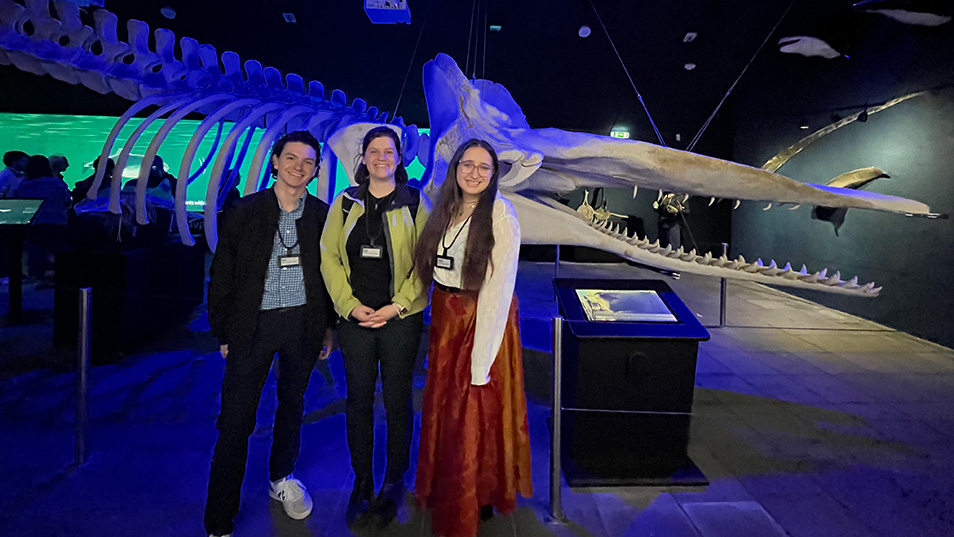
Tori Burghardt '26, right, and Rose Hilmo, assistant professor of biology, middle, previously presented this research at a conference in Denmark. Photo courtesy of Hilmo
Marine biology majors Tori Burghardt ’26 and Connor Hipp ’28 are studying the songs of blue whales in the Pacific Northwest using grants from the University’s Summer Undergraduate Research Fellowship program. Burghardt is looking for what the songs might indicate about the whales’ mating behavior, while Hipp is looking at how the songs have changed over time.
They’re working with a data set from a 2013 study by the Ocean Observatory Initiative that deployed seismometers off the coast of Washington and Oregon to be used as earthquake sensors. Rose Hilmo, assistant professor of biology and Burghardt’s research advisor, used data from the seismometers during her doctoral studies at University of Washington, when her focus was more on marine geology than biology. After sifting through all the acoustic data recorded by the seismometers, Hilmo switched her dissertation topic to look at how geophysical instruments are used to detect whales.
Hilmo started teaching at UTampa in the fall of 2024 and didn’t initially plan to oversee student research.
“I didn’t think I was really going to have time until my second year,” she recalled. “I was sitting in my office working on class prep, and Tori showed up. She sat down and she pulled out a literature review. … She showed some real depth of background knowledge, even just in that first meeting.”
Burghardt has a second major in psychology and wanted to bring her interest in whales’ pod behavior and family structures to Hilmo’s research. That fall, Burghardt started by analyzing one year’s worth of songs recorded by the seismometers. Hipp joined the team as a freshman to filter through the data, then got hooked on the subject and started his own SURF project this summer.
Blue whales, the largest animal on the planet, sing at a frequency so low that it is imperceptible to human ears. But because of their massive size, Burghardt explained, the noise shakes the ocean floor like an earthquake, triggering the seismometers' sensors. So, when she and Hipp are studying the notes of the songs, they’re not listening to recorded tracks, but instead looking at spectrograms, or snapshots of soundwaves, recorded in 15-minute intervals.
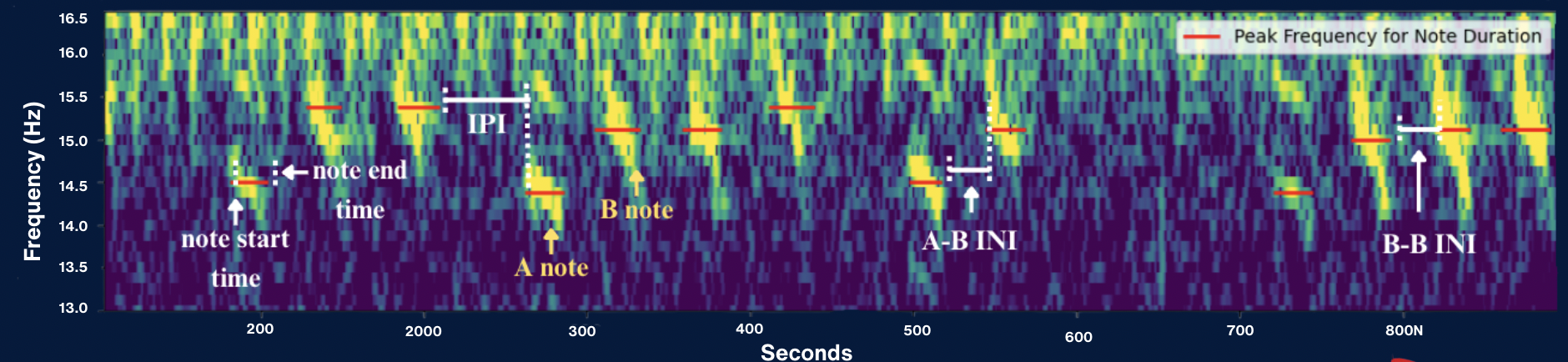
By looking at the notes on the spectrogram, the students can see how much energy the male blue whales put into the songs. The more effort they put into making a “pretty song,” said Burghardt, the more the females understand that they will provide strong offspring.
“By having songs that have short rests, lots of notes and low frequency, it’s telling females that he has a lot of energy to give and that he’ll be in good shape,” said Burghardt.
The seismometers also give Burghardt and Hipp insight into how the blue whales’ reproduction cycle aligns with their annual migrations. During the summer, Pacific blue whales are close to Alaska, feeding on up to 16 tons of krill per day as they prepare to mate. Then, in the fall, they start moving south and gradually stop eating. Burghardt said the seismometers pick up the most activity during November and December, which suggests that is the peak mating season for the species. After that, the blue whales keep moving to Costa Rica, giving birth along the way.
For the most part, the patterns Burghardt has seen in their migration habits and energy spent on the songs were as she predicted. But that doesn’t mean she hasn’t found surprises in the past couple years of conducting this research, including having once noticed a whale that “stutters,” she said.
Hipp, instead of analyzing data from a single year, is studying how the song patterns may have changed since the seismometers were placed in the Pacific 13 years ago.
So far, Hipp has looked at songs from 2019-2022. Any findings he has now are preliminary, but he has noticed that the notes move closer together over time. Hipp also noted a trend of the blue whales’ songs coming earlier in the year, which indicates that they are migrating south earlier than they used to.
“I’m jumping to a couple conclusions here, but I would guess they’re migrating earlier because the ocean is warming,” he posited.
Once Hipp reaches an official conclusion, he and Burghardt will present their projects at the SURF Symposium on campus in September and the Conference on the Biology of Marine Mammals in Puerto Rico in October.
Burghardt will graduate in December and plans to continue her research on whale behavior in a doctorate program. Beyond an interest in pod dynamics, she is passionate about spreading awareness of whales’ contributions to the planet.
“Blue whales are so large that they can store up to 63 tons of climate-changing carbon throughout their lifespan,” Burghardt said. “Then when they die, (the carbon) sinks to the bottom, feeds bottom-feeding animals, and is stored in the sediment, unable to re-enter the atmosphere for centuries.”
Burghardt hopes that more research on their reproduction habits can lead to greater protection for the endangered population of blue whales across the world.
More UTampa News


© 2024 The University of Tampa. All Rights Reserved.
Subscribe to News and UTampa Life

Contact us
401 W. Kennedy Blvd.
Tampa, FL 33606-13490
(813) 253-3333
© 2024 The University of Tampa. All Rights Reserved.
Subscribe to News and UTampa Life