

Contact us
401 W. Kennedy Blvd.
Tampa, FL 33606-13490
(813) 253-3333
Event was a highlight of Career Service’s Internship Week.
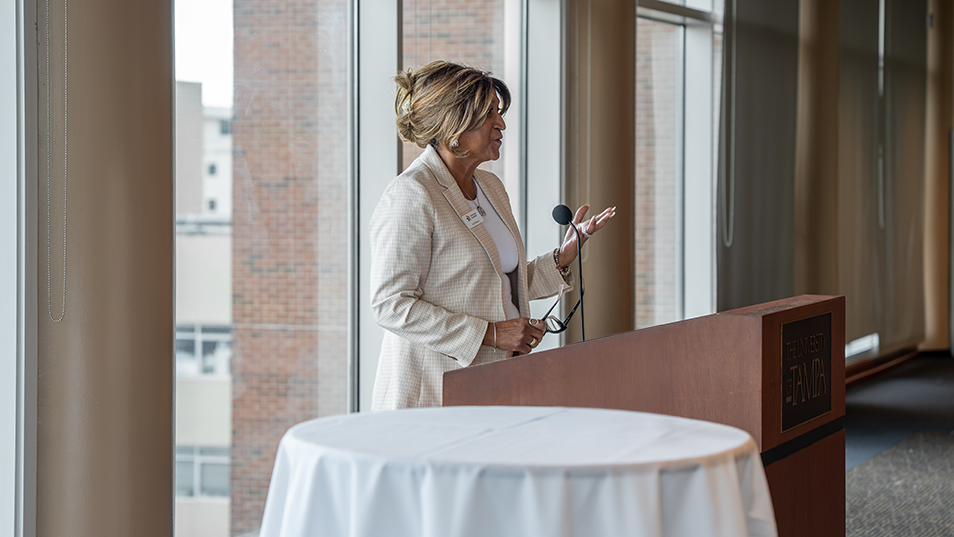
Avril Stinson, who works on leadership development at the Tampa Bay Chamber, was the guest speaker at the University’s annual etiquette dinner. Confidence is key and is “trusting that you belong in the room even when you're still learning how to navigate it,” she said.
When Monika Alesnik was rejected for a job last year, she could have walked away embittered.
Instead, she reached out to the woman who interviewed her and turned the connection into a professional relationship — and, eventually, a personal friendship.
Though that's not a common outcome for a missed job opportunity, the lesson translates across industries and generations: connections can happen anywhere.
“Not every conversation will lead you to where you think it's going to take you, and not every opportunity will look the way you expect it,” said Alesnik, whose job search ultimately landed her at UTampa, and she now coordinates leadership and competency development for the University’s Career Services. “But every interaction is an opportunity to build a relationship.”
Alesnik shared that wisdom with students, hosting her former interviewer and now friend Avril Stinson at UTampa’s 25th annual etiquette dinner, part of the University’s Fall Internship Week. The week, sponsored by Career Services, included a résumé clinic and speed networking event and an opportunity for students to shop for free business casual clothes donated by staff and faculty at a campus boutique.
 The etiquette dinner, which has historically focused on table manners, flatware usage and other fine dining protocols, was expanded this year to include how to cultivate conversational connections and make a positive lasting impression during a business meal.
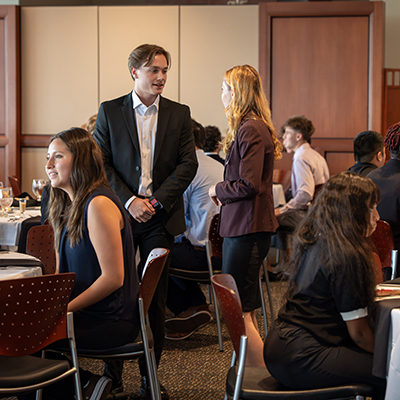
About 100 students attended the event, each paired with a table host who was a working professional. Each course of the meal included prompts to facilitate discussion among diners, including how to make a good first impression, how to balance eating and talking during a business dinner, which topics are most appropriate for dinner conversation and how to enter a conversation or bring someone else into one.
Confidence is key to it all, Stinson said. It’s a principle that is often misunderstood.
“There was a time when I believed confidence meant having all the answers and saying exactly the right thing and never appearing nervous,” she said.
But confidence is not perfection, she said. Instead, it’s “trusting that you belong in the room even when you're still learning how to navigate it. What you need to start doing is entering with intention and connecting with curiosity and contributing with confidence.”
Stinson asked if anybody in the room had ever felt like they did not belong at a networking or conference, calling for a show of hands.
With every hand raised, Stinson agreed. Even the most seemingly confident people can feel insecure. Getting over that is crucial.
“When you hear that little voice inside and it makes you feel a little nervous, give yourself an internal hug and say, ‘I belong in this room. I wouldn't be there if I wasn't supposed to be,’ and take that confidence in with you,” she said.
“Belonging does not begin when someone validates you. It begins when you decide not to shrink.”
More UTampa News


© 2024 The University of Tampa. All Rights Reserved.
Subscribe to News and UTampa Life

Contact us
401 W. Kennedy Blvd.
Tampa, FL 33606-13490
(813) 253-3333
© 2024 The University of Tampa. All Rights Reserved.
Subscribe to News and UTampa Life