
Contact us
401 W. Kennedy Blvd.
Tampa, FL 33606-13490
(813) 253-3333
Michael Coon, associate professor of economics, joined a panel of community leaders to discuss ways the region can prepare for economic change.
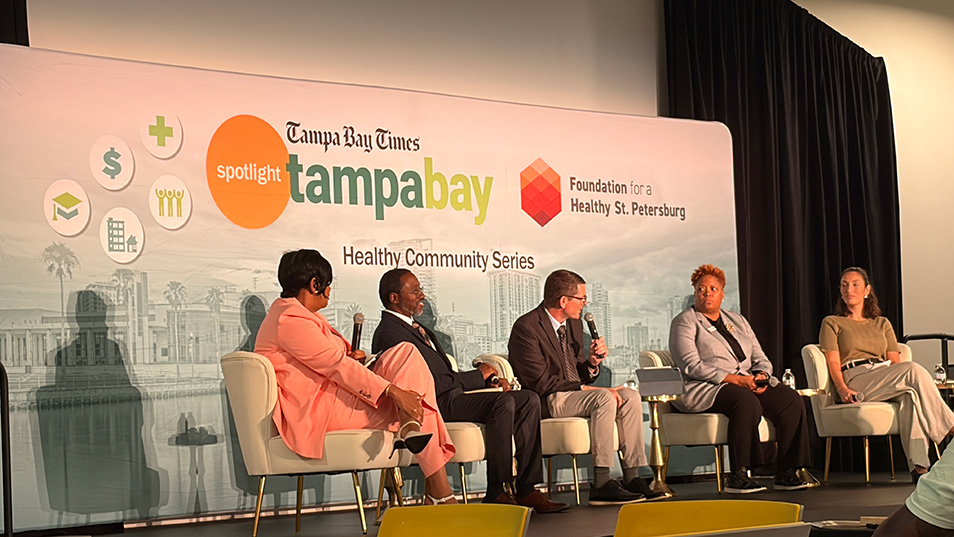
The theme of the evening was “Tampa Bay’s Economy in 2036: Preparing for a Thriving Future.”
When asked if they could’ve predicted the economic change that the Greater Tampa Area has experienced in the last 10 years, none of the panelists at a community forum on economic development foresaw how large and fast the Tampa Bay region would grow.
The panelists discussed the area’s growth and its future at a panel hosted by the Tampa Bay Times in St. Petersburg Wednesday with the theme “Tampa Bay’s Economy in 2036: Preparing for a Thriving Future.”
The panelists leading the discussion came from a variety of industries, allowing them to each show their own unique perspective on what they think will happen with the local economy over the next 10 years. Rebecca Liebson, real estate reporter for the Tampa Bay Times, moderated the discussion between Michael Coon, associate professor of economics at UTampa; Cynthia Johnson, director of Pinellas County Economic Development; Ashon Nesbitt, CEO of Florida Housing Coalition; and Bemetra Simmons, president and CEO of Tampa Bay Partnership.
Today, Coon considers Tampa Bay’s economy to be healthier than average because of its diverse industries. Many Florida cities heavily rely on tourism revenue, while Tampa Bay has also seen significant growth in technology, finance, sciences and other sectors.
Looking ahead to the next 10 years of economic growth, Coon and the other panelists agreed that artificial intelligence is the biggest wild card, with the ability to either benefit the community, hurt it, or both.
“There are a number of different ways that new technologies affect the economy,” said Coon. One way, he said, is that it can replace jobs.
He used the example of tractors in the early 20th century replacing farm workers. But he also argued that new technology could also create new jobs, similar to those farm workers moving into the manufacturing industry to support the new technology of the time.
“We would have to retrain for a new skill set, … so AI could create more jobs in the industry that starts using it,” he said.
UTampa’s new minor in AI applications through the Sykes College of Business is a way to teach students entering the workforce how to use the technology ethically, responsibly and productively, he said.
Another popular topic of conversation over the last few years in Tampa is the increasing population of transplants that flowed in from other states and countries following the pandemic.
Coon noted that Tampa was ranked No. 1 by the Financial Times’ list of best places for foreign investment, largely because of the high quality of life that it offers.
“There are all these high-net-worth individuals from other states moving here,” said Liebson. “How can we make sure that people who are from this area can afford to stay here and benefit from all the great changes that we’re seeing?”
As an expert in the economics of immigration, Coon has extensively studied that question.
He said that the myth of new people moving into a community and taking jobs assumes that the number of jobs in an economy is fixed, but that’s rarely the case.
“If you actually look at the research of what happens when populations grow,” he said, “it doesn’t displace the people who are natives. It actually increases employment for pretty much everybody in the economy.”
Two of the biggest issues that Tampa should address in the coming years are public transportation and homeowners’ insurance, Coon said. Those should be priorities to ensure economic equity, he said.
He and the other panelists agreed that affordable housing is not often located near areas with good-paying jobs, leading to daily commutes and higher transportation costs. And even in neighborhoods with affordable housing, homeowner association fees have significantly increased over the last several years, driving out residents without even increasing mortgage rates or utility costs.
“In the last five years that I’ve owned my condo, our monthly association fees have doubled; 95% of that increase is insurance costs,” said Coon. “A lot of my neighbors are retirees on a fixed income, and they’re now looking to sell.”
Coon lives in St. Petersburg, but comes to the UTampa campus near downtown Tampa every day for work. He said he barely recognizes downtown Tampa today after moving to the area 10 years ago, but thinks the rapid growth has mostly been managed well.
“There are always ways to do things better,” Coon said. “But just the amount of growth is a testament to what this economy and this area has to offer the rest of the world.”
More UTampa News


© 2024 The University of Tampa. All Rights Reserved.
Subscribe to News and UTampa Life

Contact us
401 W. Kennedy Blvd.
Tampa, FL 33606-13490
(813) 253-3333
© 2024 The University of Tampa. All Rights Reserved.
Subscribe to News and UTampa Life