Contact us
401 W. Kennedy Blvd.
Tampa, FL 33606-13490
(813) 253-3333
Nine students spent two weeks in Italy to view artwork connected to chemistry concepts learned in the classroom.
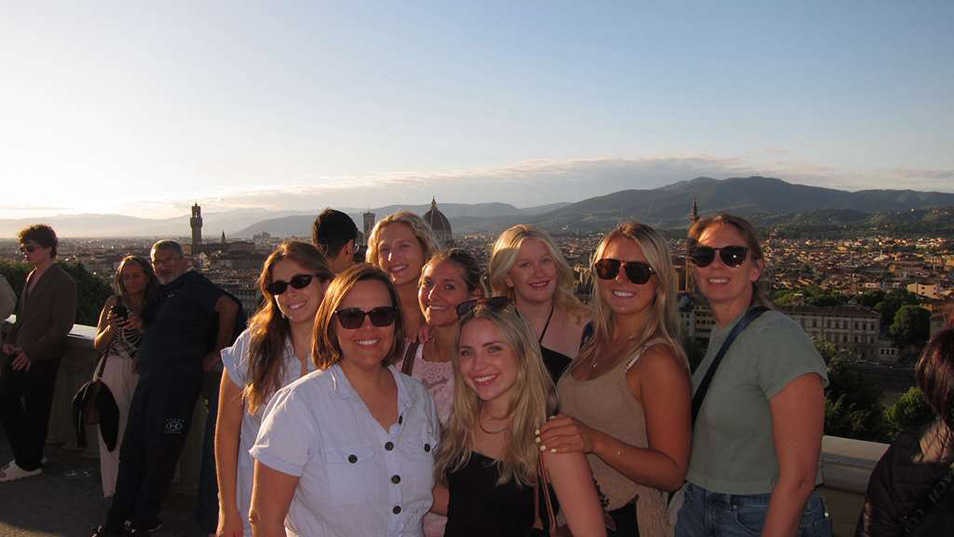
The class visited Venice, Bologna, Florence, Rome and the surrounding areas. Photo courtesy of Tanya Luniewski '27
The painted ceiling of the Sistine Chapel often prompts viewers to think deeply about everything that contributed to its creation: the history of Renaissance-era artwork, perhaps, or the skilled technique of Michaelangelo.
When students and faculty from UTampa visited the chapel in May, they were thinking about the chemical makeup of the mural.
Chemistry and Art, a course taught by Christine Theodore, associate professor of chemistry, is designed to teach introductory chemistry to non-science majors by using art to demonstrate the concepts. At the end of the spring semester, the class visited Venice, Bologna, Florence, Rome and the surrounding areas to see the chemical processes behind iconic artworks that they learned about in class. Part of the course is on the chemistry of frescoes, of which the Sistine Chapel is one of the best-known examples.
A fresco is a mural painting where water-based pigments have been directly applied to freshly laid plaster. “There is a lot of chemistry that is involved,” said Theodore. “Part of why they last so long is the pigments get incorporated in the solid matrix of the fresco, and so we talk a lot about it when we talk about chemical reactions.” During the fresco lesson last semester, students made their own fresco paintings to understand the process firsthand.
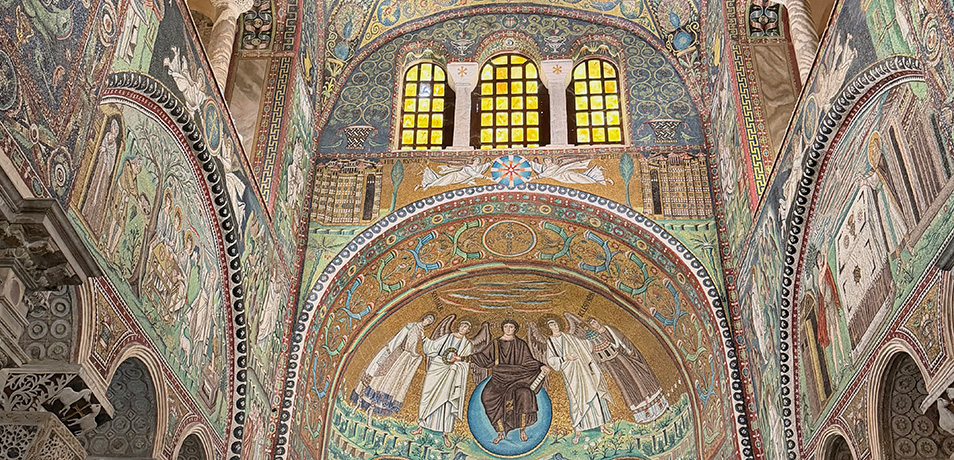
In another lesson, students learned how glass interacts with certain metals to create different colors, which they then got to see in person on a day trip to Ravenna, known for its large-scale glass mosaics.
“For example, cobalt produces a deep blue, and copper produces a turquoise,” said Adison Czerniak ’26. “We also touched on gold mosaics and how a sheet of gold is placed between two layers of clear glass to protect it from oxidation, which allows it to stay bright over centuries.”
Czerniak took the class after taking organic chemistry with Laura Henchey, assistant teaching professor of chemistry, who accompanied the group as a second faculty advisor. As a biology major, Czerniak said she wanted to study abroad, but couldn’t spend an entire semester away from the lab. The course allowed her to see new parts of the world while gaining course credit in a way that fit into her schedule.
Tanya Luniewski ’27 is also a biology major and got to learn from her other classmates in the interdisciplinary course. She said the science majors had a slight upper hand in the classroom since they were already familiar with the chemistry terminology, but the advantage changed hands when they got to Italy.
In Venice, the group attended the Bienniale Arte, an international art exhibition. Czerniak and Luniewski were grateful for the art majors in the class who could explain the significance behind the contemporary works they saw from around the world.
“It’s really fun to have a diverse set of viewpoints in a class,” said Theodore. “It also gives me a chance as a professor to interact with students that I don’t normally interact with.”
Theodore’s technical expertise is in spectroscopy, which can be used for art conservation and restoration as well as forgery detection. For the final week of class, she incorporated her specialty by giving the students two versions of the same painting, and they used spectroscopy techniques to figure out if the paintings were made in the same time period by the same artist.
“Preservation work and forgery detection all has to start by analyzing the painting because they can’t figure out how to protect it or determine where it came from unless they know what makes it up — and that’s all chemistry and spectroscopy,” explained Theodore.
Czerniak and Luniewski did not identify any forgeries during the trip but said it was surreal seeing the pieces in person that they’ve seen pictures of in textbooks since they were in elementary school.
“I can’t even explain the rush,” said Czerniak.
More UTampa News


© 2024 The University of Tampa. All Rights Reserved.
Subscribe to News and UTampa Life

Contact us
401 W. Kennedy Blvd.
Tampa, FL 33606-13490
(813) 253-3333
© 2024 The University of Tampa. All Rights Reserved.
Subscribe to News and UTampa Life