
Contact us
401 W. Kennedy Blvd.
Tampa, FL 33606-13490
(813) 253-3333
Students who participated in a Summer Undergraduate Research Fellowship presented their research projects on Friday.
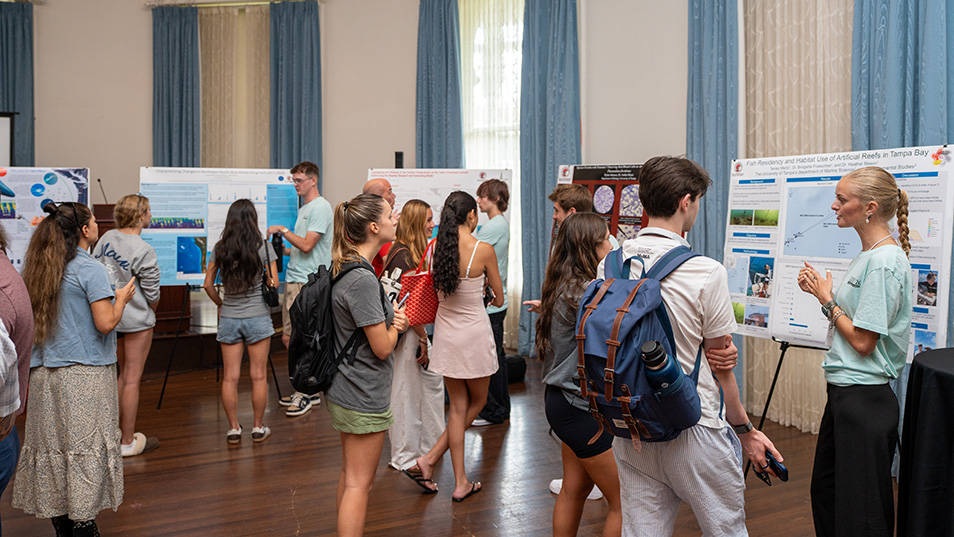
The annual SURF Symposium in Plant Hall’s Grand Salon featured 14 poster presentations of student research projects.
This year’s Summer Undergraduate Research Fellowship Symposium featured a live sea slug, a simulated recording of a blue whale’s mating call, and several poster presentations of students’ summer research projects. The SURF program allows students to helm their own research projects from hypothesis to conclusion with assistance from a professor.
When Greg Britt ’28, a biochemistry major, set out to study how bumblebees are affected by the combination of pesticides and heat stress, he predicted that the two variables would negatively impact their reproduction rates. Instead, he found that the heat seemed to increase reproductive output, although he guessed that the sped-up reproduction cycle could stunt their growth as the offspring mature.
Britt said all the other studies that he and his advisor, Assistant Biology Professor Sarah Orr, read before they started the project either looked at one stressor at a time, or looked at that combination of stressors on different species. Even though the summer is over, Britt said the two of them hope to expand their study using the leftover bumblebee specimens.
In all, 14 students presented their work and answered questions from curious fellow students, professors and others who attended the annual event in Plant Hall’s Grand Salon.
Delaney Halverson ’27 collected the specimens for her project from a convenient location on campus: the stream that runs through Plant Park. Halverson, a marine biology major, looked at the population of invasive Mayan cichlid fish in the stream and how they alter the ecosystem. She said the Mayan cichlids, which are highly adaptable to any environment, have not only been stealing food sources from the native fish, but they’ve also been eating the native fish themselves. Using data sets from previous students from 2008 and 2015, she was able to see the decrease over time in the population of killifish, mosquitofish and minnows, attributed to the overcrowding by the Mayan cichlids.
Tori Burghardt ’26 and Connor Hipp ’28 are using data from slightly farther away. The two marine biology students are studying the songs of blue whales in the Pacific Northwest using public data collected by seismometers, originally deployed on the coast of Oregon to detect earthquakes. Burghardt looked for what the songs might indicate about the whales’ mating behavior, while Hipp looked at how the songs changed over time.
By the end of the summer, Burghardt found indications that November and December are the peak mating months of the Pacific blue whales, as that was when the most activity was detected by the seismometers. Burghardt analyzed data from a single year, 2013-2014, while Hipp looked through activity from 2017-2025. Over the years, Hipp noticed that the intervals between notes of each song got longer as time went on. He said this could mean that the whales need more time to rest between notes, as their low-frequency but high-volume songs take massive amounts of energy.
Many of the SURF projects will continue, and some students will start making the rounds of academic conferences, including Burghardt and Hipp, who will present their findings next month at the Conference on the Biology of Marine Mammals in Puerto Rico.
More UTampa News


© 2024 The University of Tampa. All Rights Reserved.
Subscribe to News and UTampa Life

Contact us
401 W. Kennedy Blvd.
Tampa, FL 33606-13490
(813) 253-3333
© 2024 The University of Tampa. All Rights Reserved.
Subscribe to News and UTampa Life