
Contact us
401 W. Kennedy Blvd.
Tampa, FL 33606-13490
(813) 253-3333
The researchers set out to determine the potential impacts that invasive species are having on native fish species in the spring-fed stream.
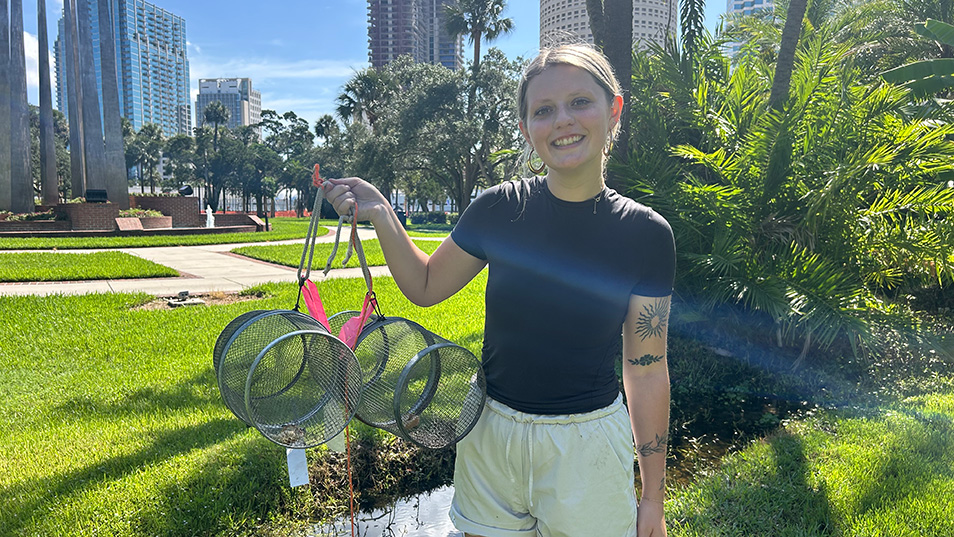
Delaney Halverson '27 sets baited minnow traps at different locations and distances from the Hillsborough River, with the goal of identifying which species are living in the stream. Photo courtesy of Halverson
Marine science-biology major Delaney Halverson ’27 is working with Associate Professor of Biology Mark McRae to study the ecology of native and invasive fish in the stream that runs through Plant Park on campus.
They set out to determine the potential impacts that invasive species are having on native fish species in the spring-fed stream.
Halverson collects data from the stream up to three times a week.
She sets baited minnow traps at different locations and distances from the Hillsborough River. The goal is to identify what species are living in the stream and how different species are using different locations in the stream for habitats. After collecting the fish and determining their species and sex, she releases them back into the stream and then takes measurements of the water temperature and salinity at the specific locations where they were captured.
She started the project last August, so she has now collected samples in every season.
“I've been able to see the migration patterns, and their little, micro-communities — who's with whom and why,” she said.
Certain species have been known to be found at certain stations depending on the season, she said. She typically samples from six set locations along the stream.
She can always count on seeing invasive Mayan cichlids, an olive-brown, oval-shaped fish with vertical stripes that colonized the Plant Park stream in 2012. Those observed in the stream have ranged from about an inch and a half to 7 inches.
“He's not supposed to be there, but unfortunately, he's there every single time I sample,” she said. “I think the most I've ever caught of him in one sample was upwards of 45 specimens in one day, which is really disheartening.”
The Mayan cichlid is native to South America and has a wide-ranging diet. They eat anything in the stream, from small native fish to mosquitoes or invertebrates, she said, eating many of the food sources native species rely on. As an isolated ecosystem, there’s not a lot coming in or out of the stream, foodwise, Halverson added.
Halverson has data sets from 2008 and 2015, when McRae advised other students in similar projects. With the data, they plan to conduct a comparative analysis of each species.
“It’s rare in ecological studies to have something to look back on,” she said. This will help determine how the fish community has changed since Mayan cichlids were introduced, “not just from guesses, but concrete data.”
She also has been able to collect a lot of data on an invasive species that can be found in pet stores. The species, green swordtail fish, is related to the guppy.
“They were very widespread as pets, especially back in like the '70s and 1980s, and this population of green swordtails, as far as I can tell, has been in that little upper section of Plant Park creek for a long time,” McRae said.
Most other wild green swordtails in Florida have recently escaped from tropical fish farms, McRae said, and their populations fluctuate widely over time. The population in Plant Park, however, has remained stable, allowing Halverson time to collect valuable data.
Halverson emphasized the importance of not releasing invasive fish into the environment.
“I like to talk about the effects that they have on ecosystems,” she said. “Something as small as a tiny minnow can cause a lot of problems.”
For example, in the datasets that have been collected this year, Halverson and McRae have identified multiple native fish species that have disappeared from the stream since 2008, an observation believed to be due to the introduction of invasive fish.
“A lot of people look at something so small and think, Oh, there can't be anything bad going in there. But what people don't realize is every ecosystem has very specific sets and things going on that you may not see, but they're still incredibly important,” Halverson said.
Halverson received a Summer Undergraduate Research Fellowship grant for her project. She will present her findings at the SURF symposium on campus in August.
More UTampa News


© 2024 The University of Tampa. All Rights Reserved.
Subscribe to News and UTampa Life

Contact us
401 W. Kennedy Blvd.
Tampa, FL 33606-13490
(813) 253-3333
© 2024 The University of Tampa. All Rights Reserved.
Subscribe to News and UTampa Life