Contact us
401 W. Kennedy Blvd.
Tampa, FL 33606-13490
(813) 253-3333
Students visited London and Italy to learn centuries’ worth of healthcare history.
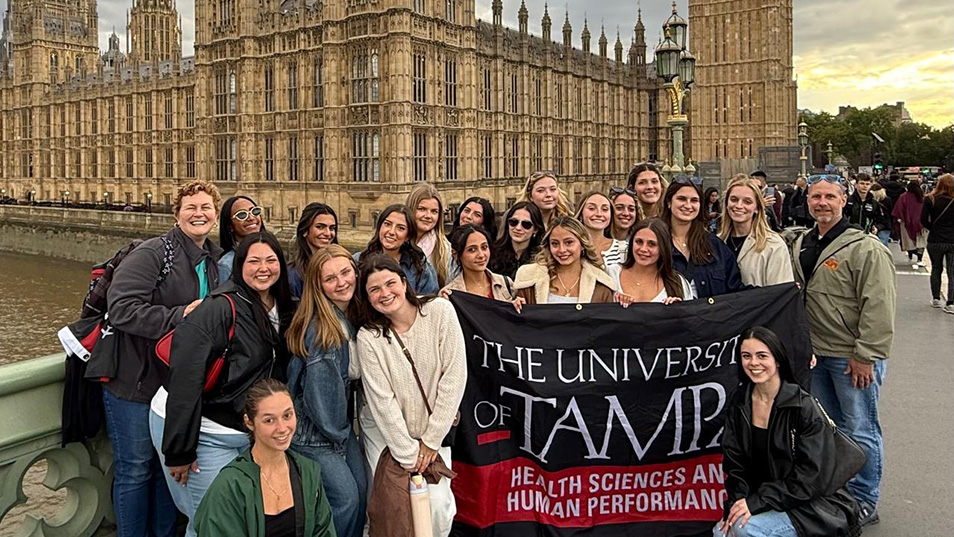
Students and faculty of the Medical History travel course represent UTampa in London. Photo courtesy of Molly Hudson '28
In the mid-1640s, a series of human dissections by an anatomy professor and his assistant created the famed Evelyn Tables, a set of four anatomical preparations that each display different parts of the human body. Thought to be the oldest of their kind in Europe, each wooden table features a system of nerves, veins and arteries laid in their natural arrangement and preserved under several coats of lacquer.
The tables are now housed at the Hunterian Museum in London, where UTampa students visited earlier this summer as part of a medical history travel course. The first portion of the course took place in a classroom on campus — where students learned about historical facts and figures such as the Evelyn Tables — before getting to see the real specimens in person.
After the Hunterian Museum, the group viewed artifacts from the next couple centuries at London’s Gordon Museum of Pathology, like a femur with a bullet hole from the Seven Years’ War in the 1700s and preserved human heads from the 1800s with hair and skin still intact, down to “how fine their pores were,” described Bella Roman ’28.
“When we were sitting in a classroom, just listening to what the professors are saying, it was kind of hard to put a name to a face,” said Roman. “When we got to the Gordon Pathology Museum and saw the human remains, we were like, ‘Whoa, this is the most insane thing ever.’”
“I’ll literally never put that out of my head,” added Morgan Garlick ’27. In a good way, she meant.
The classroom portion of the medical history course was team-taught last semester by Heidi Borgeas, lecturer of health sciences and human performance, and Abe Miller, chair and associate professor of health sciences and human performance. Teaching simultaneously allowed them to each bring their own expertise to the room, which made the content delivery more dynamic than a typical lecture class.
Miller said the curriculum takes students through all the major developments in the history of healthcare and medicine, starting in ancient Greece and Egypt and working up to present day. They chose to visit London because of the museums, like the Hunterian and Gordon, that have extensive collections of oddities, then Italy because of the many advancements in technology created there during the Renaissance era.
This was the second time the duo had taught the travel course, and both times Borgeas and Miller could visibly see the enrichment the students got from seeing objects from their books right in front of their eyes.
“That physical connection is vital, especially to today’s learner,” said Borgeas. “(In class), they’re like, ‘Yeah, I hear you, you’re showing us pictures, I get it.’ Then when they’re right there and they’re staring at this wax model of this heart inside of the body, they understood how we got there.”
Borgeas explained that with many of the wax models they saw in the museums, “it took about 100 dead people to form the full final product.” With no AC back when the models were being developed, there was a short window of time for scholars to study the donated cadavers before they would start to decay. Each generation of doctors and students would build on the knowledge of their predecessors, and seeing how the models evolved was a powerful learning tool for the UTampa students.
While everyone gained a deeper appreciation for the classroom material by seeing the specimens up-close abroad, the learning continued at modern hospitals they visited in Italy. In Florence, the group went to a children’s hospital and observed the care administered to pediatric cancer patients.
“We hear about other countries and free healthcare often, but to see how it actually works in a hospital was one of the most interesting things we did on the trip,” said Garlick, an allied health major on a pre-occupational therapy track.
Roman, also an allied health major, emphasized that learning new material outside of the classroom kept everyone engaged, rather than repeating the same information they had already gone over on campus. Plus, the recent experience at the historical museums provided a richer context for viewing the modern-day practices, giving the students an even deeper perspective.
Beyond the course curriculum, Molly Hudson ’28, who is studying allied health on a pre-OT track, said that a major highlight for her was the camaraderie she developed with the students and faculty on the trip. Most of the students didn’t know each other before the class, but traveling overseas and experiencing a different culture together naturally formed a unique bond among the group.
Hudson and Garlick had just transferred to UTampa in the fall of last year, which made the new connections formed on the trip extra meaningful. Roman agreed that the friendships gained was one of the most special parts of the trip, and encourages anyone who’s curious to take the course, even though it can seem daunting to travel with new people.
“Traveling with people really creates that bond that you don’t get otherwise,” said Garlick.
More UTampa News


© 2024 The University of Tampa. All Rights Reserved.
Subscribe to News and UTampa Life

Contact us
401 W. Kennedy Blvd.
Tampa, FL 33606-13490
(813) 253-3333
© 2024 The University of Tampa. All Rights Reserved.
Subscribe to News and UTampa Life