
Contact us
401 W. Kennedy Blvd.
Tampa, FL 33606-13490
(813) 253-3333
The minors were created to meet increasing student interest and demand.
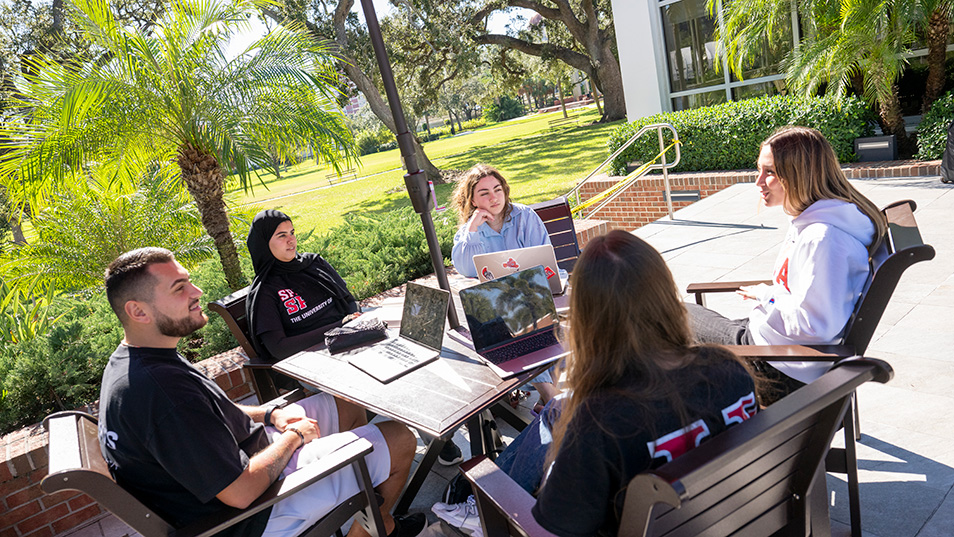
Both new minors feature a variety of interdisciplinary classes that will give students an advantage when applying for jobs or grad school.
The College of Arts and Letters and the College of Natural and Health Sciences each launched a new minor this fall — one in peace, justice and conflict resolution and the other in Earth systems science, respectively.
Peace, Justice and Conflict Resolution
The minor in peace, justice and conflict resolution is housed in the philosophy department and directed by Marcus Arvan, chair and professor of philosophy and religion.
“Having students think about how peace, justice, and conflict resolution can be mutually supportive, but also pull in different directions, I think, is a really interesting part of a program,” said Arvan. “And in putting it together, we really wanted to create a minor that students could make their own.”
Students can choose from a wide swath of classes to meet the requirements for the minor, allowing them to tailor the program to best suit their goals and interests. Arvan said that when he developed the program with Kristen Foltz, associate professor of communication, they aimed to include as many disciplines as possible. Curriculum varies from communication, French history, literature, philosophy, political science, sociology and more.
“One of the strengths of this minor is its interdisciplinary nature,” said Foltz. “Questions of peace, justice, and conflict cannot be understood through a single lens as they require different perspectives and ways of thinking. That kind of learning helps students become more thoughtful problem-solvers and better prepared to work with others in complex environments.”
Earth Systems Science
Nick Grondin, assistant professor of environmental studies, created the new minor in Earth systems science after noticing there wasn’t a program at UTampa dedicated to the physical functioning of the environment. He saw through advising students that there was a smattering of classes that fit into that field of study, but they were spread across several departments.
Now, students pursuing the geosciences, oceanography or another Earth science can add a new credential when applying for jobs and graduate schools.
The goal of the minor is to focus on classes that relate to the functioning of the solid earth, the atmosphere, and bodies of water. While the program is intended for science majors, there are also required classes in computer science and data science to build the foundational skills for academic research.
“One thing I really push are transferable skills,” said Grondin. “A common thread was skills not only teaching science, but also skills used by those that work in the physical Earth sciences. Every research project I’ve ever worked on has required me to write code.”
Grondin described the new program as a passion project of his and said that one of his research students has already added the minor.
More UTampa News


© 2024 The University of Tampa. All Rights Reserved.
Subscribe to News and UTampa Life

Contact us
401 W. Kennedy Blvd.
Tampa, FL 33606-13490
(813) 253-3333
© 2024 The University of Tampa. All Rights Reserved.
Subscribe to News and UTampa Life