Contact us
401 W. Kennedy Blvd.
Tampa, FL 33606-13490
(813) 253-3333
UTampa faculty weigh in on the upcoming film adaptation of the ancient epic poem.
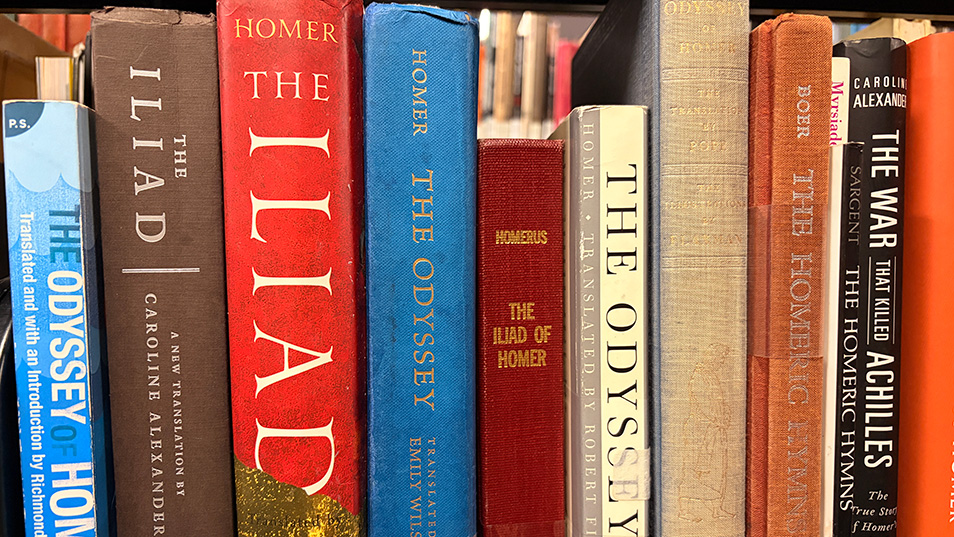
The collection of Homer titles at the Macdonald-Kelce Library on campus.
“Tell me about a complicated man.”
When this opening line was published in Emily Wilson’s 2018 translation of The Odyssey, the first of the epic poem by a woman, it came under harsh scrutiny for her modern word choices that were argued to be oversimplified and inaccurate.
It was also one of Hollywood filmmaker Christopher Nolan’s favorite lines when reading the Wilson translation, which he cited as a major inspiration when writing the script for his film adaptation releasing next week. When the first official trailer came out, Nolan was also accused of writing dialogue that was too modern and unfaithful to the original text.
“People who want to double down on that kind of language don’t know anything about translation or adaptation studies,” said Amanda Firestone, associate professor of communication.
Firestone is the director of UTampa’s communication and media studies program, where course curriculum frequently touches on the subject of adaptation. As a fan of Nolan’s work, she’s looking forward to seeing the film in IMAX and respects the painstaking craft of adapting a revered piece of literature for the big screen.
Because of The Odyssey’s rich history, Firestone thinks of it differently than most other page-to-screen adaptations. With origins dating back more than 2,500 years, the story already morphed from oral storytelling and stage productions to written text hundreds of years before the medium of film even existed.
“We’re not moving it from one kind of text to another, but we’re taking that manuscript and we’re telling it again,” she said. “Essentially, you need a person who is attuned and attentive — a historian, linguist and culturist all at one time — to be able to tell the story again.”
On top of having to pick certain subplots and scenes that work best on film and eliminating others, as is typical with adapted screenplays, Firestone noted that Nolan also had the task of telling this story in a way that is accessible to the general public. The wordier, Victorian-era English translations of The Odyssey that traditionalists favor might not get through to modern audiences and aren’t considered by most scholars to be more accurate than the original Greek.
“All translations are modernizations,” said Daniel Wollenberg, associate professor of English and writing. Wollenberg primarily studies medieval literature and said that even the translations of The Odyssey that came out during that era were contemporary interpretations for wider audiences of that time. In fact, he said that using language that is current and easy-to-understand honors the original tradition of Homer telling the tale of Odysseus to listeners of all ages and intellects.
Further, Wollenberg pointed out that Wilson and Nolan had to capture both what the world looked like for Odysseus and what that world would look like to readers and watchers of today. For instance, he referred to one of the most famous changes in phrasing that set Wilson’s translation apart from the generations of male translators before her: her labeling of the women working in Odysseus’ home as slaves instead of servants.
“A servant for us means someone who can just get up and leave, but they couldn’t,” he said. “It seems to me like she is not just modernizing things for the sake of modernizing things; she is being clear about what is happening.”
Wollenberg is interested to see if Nolan’s film will portray all the many sides of the “complicated man,” Odysseus. In the most basic description, he is thought of as a war hero who wants to go home. But on the page, there is much more nuance to his characterization.
“He’s not really a hero, but he can also be a really human, problematic guy, just like all of us,” he said.
Firestone echoed his sentiment and feels that Nolan’s take on The Odyssey will be a fitting addition to his Oscar-winning film catalog.
“I think that his movies ask us to really think about the complexity of the human condition,” she said. “I appreciate that when I walk out of a Nolan film, not only do I typically want to know more about the world that I’ve just spent three hours in, but also that I want to think harder about my own subjectivity.”
More UTampa News


© 2024 The University of Tampa. All Rights Reserved.
Subscribe to News and UTampa Life

Contact us
401 W. Kennedy Blvd.
Tampa, FL 33606-13490
(813) 253-3333
© 2024 The University of Tampa. All Rights Reserved.
Subscribe to News and UTampa Life