

Contact us
401 W. Kennedy Blvd.
Tampa, FL 33606-13490
(813) 253-3333
The transformational academic facility will advance science education, research and student career preparation. Construction is set to begin this spring, with the Science Center scheduled to open in Spring 2029.
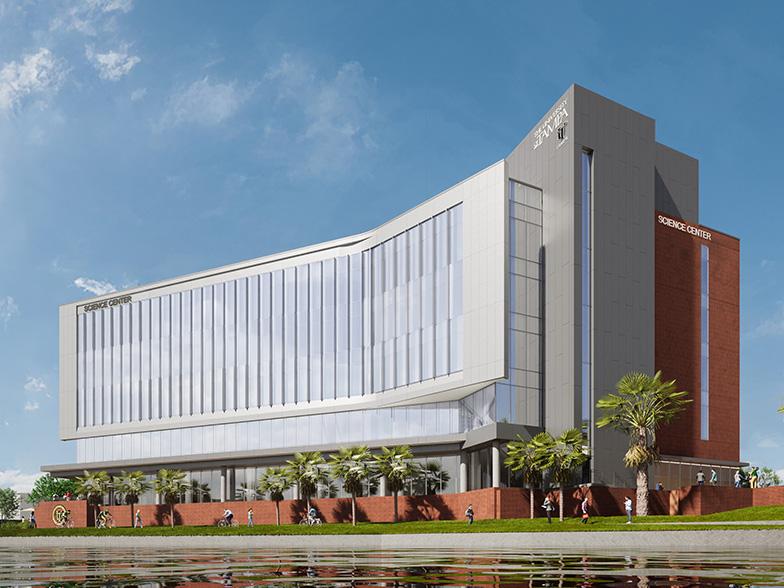
Architecturally, the building will reflect UTampa’s historic and modern campus character.
The University of Tampa will soon begin construction on a new, cutting-edge Science Center designed to support the University’s growing prominence in science education and research. Located along the Hillsborough River on UTampa’s downtown campus, the five-story facility will feature state-of-the-art teaching and research laboratories that foster collaboration, interdisciplinary learning and discovery.
The Science Center represents the most significant academic facility investment in the University’s 94-year history. At 153,000 square feet, the building will serve as the central academic hub for the College of Natural and Health Sciences while supporting science-based coursework across the University. By centralizing science teaching and research spaces that are currently spread across campus, the new facility will enhance connections among students, faculty and disciplines.
Designed with flexibility and future-focused learning in mind, the Science Center will directly prepare students for careers in high-demand fields such as healthcare, sustainability, biotechnology and related sciences. It will house the departments of biology and chemistry and biochemistry, along with programs in forensic science and marine science. The building will also support allied health, computational science, environmental science and other science-driven fields that are critical to today’s workforce.
Mike Stephenson, UTampa provost and chief academic officer, said the new facility builds on the University’s long-standing strengths in scientific teaching and learning. “The Science Center is a transformative, forward-facing facility that represents a major step forward for UTampa’s science programs and for the University as a whole,” Stephenson said. “It will enhance our ability to attract talented students and faculty and provide a collaborative environment where teaching and research can thrive.”
Construction of the Science Center is supported in part by a significant generational gift from the family of Dr. Stephen F. and Marsha Dickey, longtime supporters of the University. The Dickey family are also the namesakes of the Dickey Health and Wellness Center, which opened in 2011. Dr. Dickey is a trustee emeritus of the UTampa Board of Trustees and was founder, president and CEO of Tampa-based Doctor’s Walk-In Clinic.
Dr. Dickey said the family was drawn to the project’s adaptability and long-term vision.
“The design reflects an understanding that science, technology and how we teach and learn will continue to evolve,” he said. “This facility will strengthen the University of Tampa’s ability to attract high-quality students and faculty and will benefit the entire University community.”
UTampa President Teresa Abi-Nader Dahlberg described the Science Center as a defining investment in the University’s academic future. “We are deeply grateful to the Dickey family for their longtime support of UTampa and their significant investment in this project,” Dahlberg said. “This Science Center will expand opportunities for our students and faculty and strengthen the University’s impact in the sciences for generations to come.”
The building’s riverfront location highlights UTampa’s strong academic and research ties to the Hillsborough River and Tampa Bay, while its views of downtown Tampa underscore the University’s close and enduring relationship with the city.
Paul Greenwood, dean of the College of Natural and Health Sciences, said the building will enhance outcomes for both students and faculty.
“This Science Center will make our students more competitive for internships, graduate school and employment, while also enabling faculty to remain leaders in their respective fields,” Greenwood said. “It reflects UTampa’s sustained commitment to academic quality and investment in the sciences.”
A groundbreaking ceremony is planned for the spring semester. Construction is set to begin this spring, with the Science Center scheduled to open in Spring 2029.
BUILDING FACTS
The new Science Center will feature a modular, adaptable design that supports evolving scientific research and teaching needs. Key elements include:
Architecturally, the building will reflect UTampa’s historic and modern campus character. The west-facing side will feature red brick to complement Plant Hall and surrounding campus buildings, while the east-facing side will incorporate glass and contemporary angles to maximize views of the river and downtown Tampa.
The Science Center will include three distinct outdoor spaces:
HDR Architects is designing the building, with Barr and Barr serving as the construction contractor. The project will be a candidate for U.S. Green Building Council LEED certification and will incorporate sustainable features and accessible design.
More UTampa News


© 2024 The University of Tampa. All Rights Reserved.
Subscribe to News and UTampa Life

Contact us
401 W. Kennedy Blvd.
Tampa, FL 33606-13490
(813) 253-3333
© 2024 The University of Tampa. All Rights Reserved.
Subscribe to News and UTampa Life