
Contact us
401 W. Kennedy Blvd.
Tampa, FL 33606-13490
(813) 253-3333
Research started as a Summer Undergraduate Research Fellowship project.
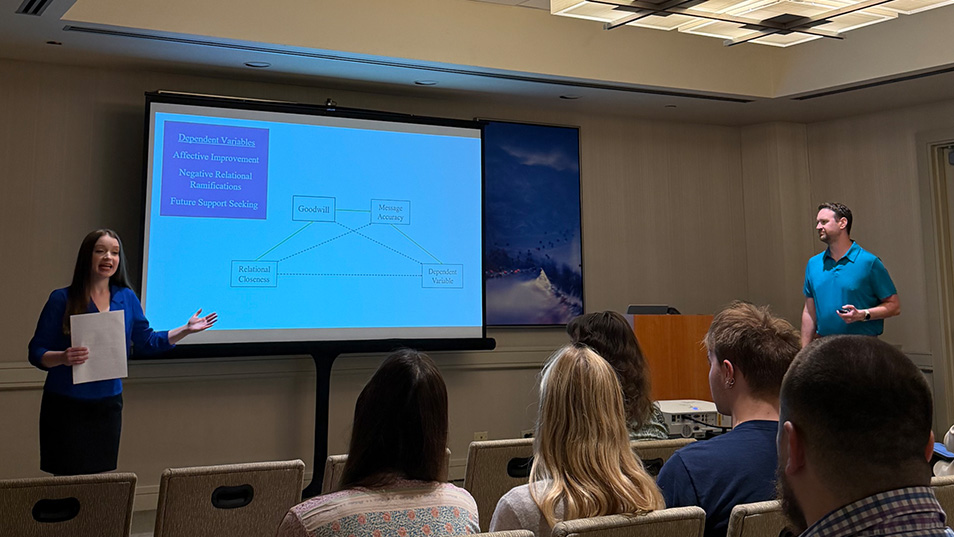
Holly Rushing ’26 and her mentor and co-author, Colter Ray, presented their award-winning research at the Western States Communication Association annual convention in San Diego.
Last month, Holly Rushing ’26, a communication and speech studies major, earned a Top Four Paper Award at the Western States Communication Association annual convention in San Diego, alongside her co-author, Colter Ray, director of the communication and speech studies program and assistant professor of communication.
The paper validates and revises what is called the “low person-centered message effectiveness model.” Using qualitative data, the study aims to understand the conditions under which LPC emotional support messaging, commonly considered a “tough love” approach, is perceived as appropriate and effective.
LPC messages are typically seen as ineffective because they can be understood as blaming or lacking in emotional support. However, Rushing and Ray’s study suggests the story is more complex.
Their analysis revealed five key themes that help explain when tough love is more likely to be received positively. Three themes were part of the original model and were validated by their data: tough love is more likely to be effective when it comes from someone the recipient is close to, when the source is seen as credible, and when the message feels truthful.
But the study also expanded the model by introducing two new themes: expectations and what researchers describe as a “no one boundary.” Expectations refer to whether the recipient anticipates this type of direct communication from the person delivering it, which can increase how well the message is received. The “no one boundary” highlights an important limitation —some individuals are unlikely to accept tough love under any circumstances, regardless of who delivers it or how it is framed.
“For me, it was amazing to have our work recognized,” Rushing said. “This started as my Summer Undergraduate Research Fellowship (SURF) project, so seeing it grow into an award-winning paper was incredibly meaningful.”
Rushing’s path into research began unexpectedly. Initially an elementary education major, she discovered her interest in research while taking an interpersonal communication course. A class presentation on loneliness led to a connection with Ray, whose research focuses on loneliness and the communication strategies lonely individuals can use to build strong relationships.
At the time, Ray was looking for a research assistant — an opportunity that sparked a collaboration resulting now in multiple publications and conference presentations.
“I’ve learned that I can do hard things,” Rushing said. “Even as an undergraduate, you don’t have to wait to make an impact.”
At the San Diego conference, Rushing also presented another one of their research projects that offers practical tips to anyone wishing to support an individual struggling with loneliness.
The most effective advice? Suggesting individuals volunteer and give back to their community. Encouraging supportive communication — such as seeking affection from friends and family or openly discussing feelings of loneliness — was also shown to be helpful. In contrast, responses that dismiss the issue, like telling someone to “just be social” or “deal with it,” were found to be ineffective and should be avoided.
In addition to the conference, Rushing also participated in the Connection Lab, a workshop focused on improving communication between young adult cancer patients and their support networks — an initiative organized by Ray, the nonprofit cancer organization b-Present and the Center for Communication, Health and the Public Good at San Diego State University.
For Ray, mentoring students like Rushing is one of the most rewarding aspects of his work.
“At this point in my career, I get just as much joy out of helping students bring their ideas to life,” he said. “Holly has taken on complex research questions and exceeded every expectation.” Rushing credits the Office of Undergraduate Research and Inquiry, which sponsors the SURF program, for making experiences like this possible. The benefits, she says, extend far beyond the classroom.
“Research opportunities are not just about presenting — they’re about networking, meeting people in your field and discovering what’s possible,” Rushing said.
That mindset has already shaped her future. This fall, Rushing will begin a Master of Science in Communication at Texas Christian University. She will hold a graduate teaching assistantship, allowing her to teach two sections of an undergraduate public speaking course. She hopes to eventually earn a doctoral degree and become a professor, continuing the cycle of mentorship that shaped her own path.
Her advice to other students is simple: get involved early.
“Don’t wait until you graduate to do something meaningful,” she said. “Put yourself out there, connect with your professors and explore what interests you.”
More UTampa News


© 2024 The University of Tampa. All Rights Reserved.
Subscribe to News and UTampa Life

Contact us
401 W. Kennedy Blvd.
Tampa, FL 33606-13490
(813) 253-3333
© 2024 The University of Tampa. All Rights Reserved.
Subscribe to News and UTampa Life