Contact us
401 W. Kennedy Blvd.
Tampa, FL 33606-13490
(813) 253-3333
Three University of Tampa students traveled to the Florida Capitol on Tuesday to present their research at an event organized by the Florida Undergraduate Research Association.
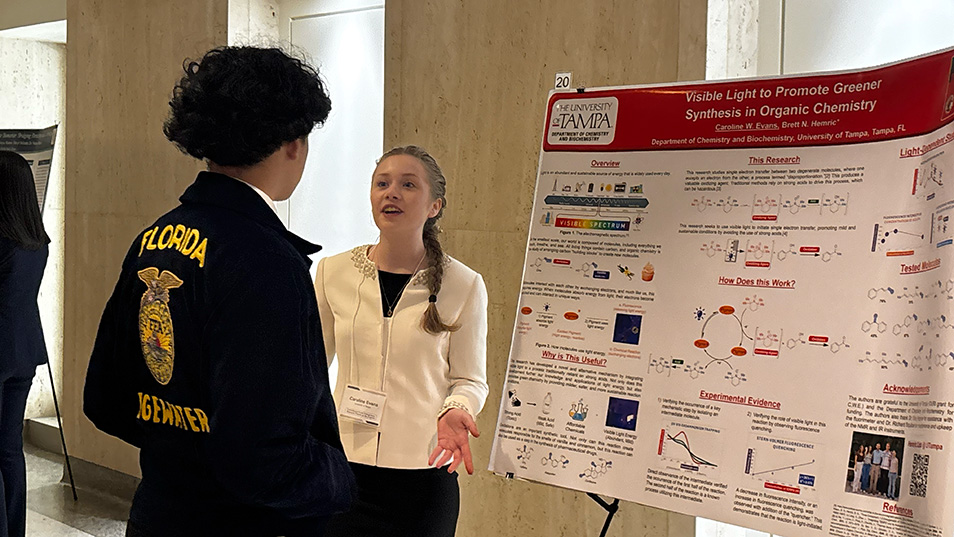
Three UTampa students presented their research posters in Tallahassee at the Capitol. Photo courtesy of David Reamer
Three University of Tampa students traveled to the Florida Capitol on Tuesday to present their research at an event organized by the Florida Undergraduate Research Association.
The event is held every other year to create state-level awareness of the research undergraduate students are working on across Florida. More than 40 presenters showcased their research.
Andrea Cifelli ’26, psychology; Caroline Evans ’26, chemistry; and Liza Walker ’28, marine science-biology, were the UTampa students at the event. The three are a part of a group of 43 students who received grants from the Office of Undergraduate Research and Inquiry to pursue their selected topic. They were chosen by a faculty committee to travel to Tallahassee to present their posters.
Cifelli is studying self-kindness as a protective factor against mental illness stigma. Evans is looking into the incorporation of oxygen via photocatalyzed disproportionation. Walker’s research is on the identification and description of a parasitic trematode worm recently recovered from Tampa Bay fish hosts.
Cifelli described the opportunity to present at the Capitol as a “unique experience” unlike other research conferences. She was inspired to apply, in part, by first lady Casey Desantis’ resiliency initiatives. The parallel, Cifelli said, shows that self-compassion goes hand-in-hand with boosting psychological resilience.
“Seeing she was taking initiative to use that kind of preventative skill-based knowledge as a means to improve kids’ mental health and quality of life made me feel super empowered,” she said.
Walker, too, spoke highly of the opportunity.
“Parasitology is often overlooked by the general community because it's ‘weird’ or ‘gross,’” said Walker. “Being able to guide others away from that stigma and help them see the importance of my work was an eye-opening experience.”
David Reamer, director of the Office of Undergraduate Research and Inquiry said, “All research has public implications, but it’s important to be able to talk to laypeople about why your work matters.”
More UTampa News


© 2024 The University of Tampa. All Rights Reserved.
Subscribe to News and UTampa Life

Contact us
401 W. Kennedy Blvd.
Tampa, FL 33606-13490
(813) 253-3333
© 2024 The University of Tampa. All Rights Reserved.
Subscribe to News and UTampa Life