Contact us
401 W. Kennedy Blvd.
Tampa, FL 33606-13490
(813) 253-3333
Lab course included a liveaboard experience in Australia.
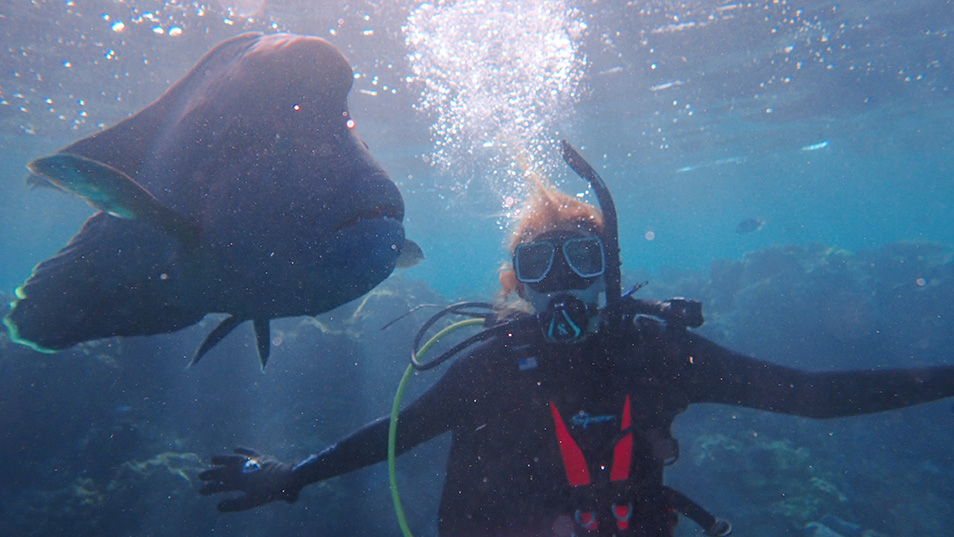
Alison Kellenberger ’27 said she wanted to see the Great Barrier Reef while it was still healthy. Photo courtesy of Brooke Marti '27
A coral reef lab course offered this May term had at least one specialized prerequisite: students were required to be SCUBA-certified.
The students enrolled would spend five days of a two-week field trip to Australia on a liveaboard ship on the Great Barrier Reef, where they would be diving “non-stop,” day and night.
“Waking up in the morning and looking out your window, you just see this vast reef system. It was a surreal feeling and one of the most unforgettable experiences,” said Brooke Marti ’27, a marine biology major and one of the 14 students in the class.
“If you weren’t a good diver before the trip, you probably were better after because it was nonstop dives,” she added.
Last spring, students took a biology lecture course that prepared them for the Australia trip. Then, once abroad, they focused on the reef as a living lab, learning techniques for identifying common reef organisms, in addition to techniques for measuring the physical and biological aspects of reef ecosystems. They heard from local conservation experts and learned about safeguarding coral biodiversity.
All that was put into play on the boat and in the water.
“We learn a lot in the classroom, but there is so much that you can only learn firsthand. By visiting a coral reef, students experience the reef up close, observe the interactions between organisms, and begin to really appreciate just how special these ecosystems truly are,” said Associate Professor of Biology Michael Middlebrooks, who led the class on the trip.
“There is nothing that can approximate the awe and wonder of your first time on a reef, and I am very fortunate to get to share that with our students.”
At night, “they give you these big lights to use, and it attracts sharks that follow behind you and use your light to hunt,” said Alison Kellenberger ’27, another marine biology major on the trip. “So you had to be really careful to keep moving your light around the reef, so you didn’t accidentally kill any little fish.”
At night, too, the crustaceans come out, she went on to explain, and when lights shine on the reef, their copper-colored eyes light up.
She said she wanted to take the class to be able to see the Great Barrier Reef while it was still “relatively healthy.” Both she and Marti said they were surprised to see it a lot healthier than what is depicted on social media.
Another favorite part of the trip for Kellenberger and Marti was seeing sea slugs, as they are both researchers in Middlebrooks’ lab, which is focused on the animals.
“I was not expecting to see so many,” Marti said.
“It was like a game to see who could find the most,” Kellenberger added.
Middlebrooks enjoyed helping to identify the species the students found, they said. Every night, a few people would sit with him with their ID books, hoping to identify everything they took a picture of during their dives that day.
“People would find a nudibranch, and they would immediately run to him and show him the picture. He was very excited to see it all too, so it was fun,” Marti said.
More UTampa News


© 2024 The University of Tampa. All Rights Reserved.
Subscribe to News and UTampa Life

Contact us
401 W. Kennedy Blvd.
Tampa, FL 33606-13490
(813) 253-3333
© 2024 The University of Tampa. All Rights Reserved.
Subscribe to News and UTampa Life