Contact us
401 W. Kennedy Blvd.
Tampa, FL 33606-13490
(813) 253-3333
This fall, students at UTampa are bringing creative TV writing and producing ideas to life in their communication courses.
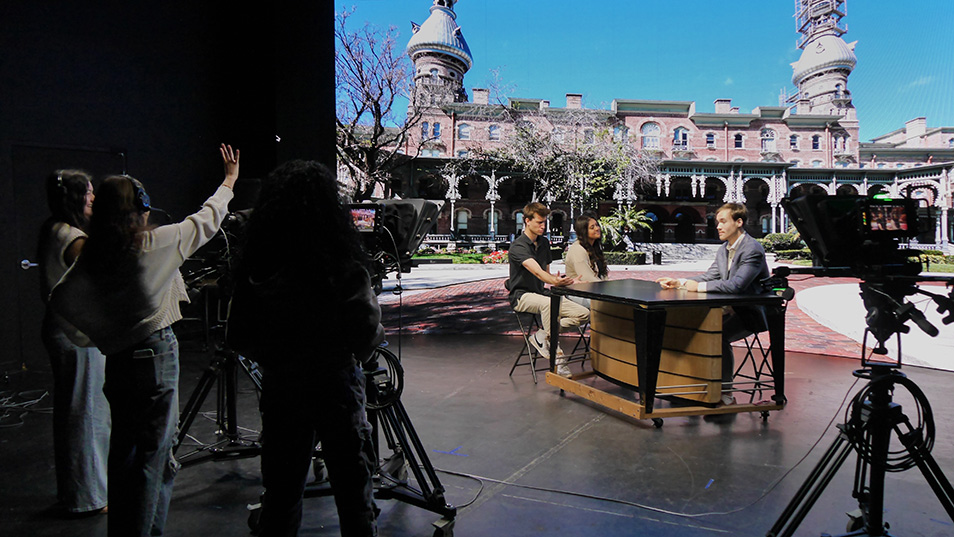
Students in “Studio TV 1” count down to the start of their live talk show segment inside UTampa’s virtual production room. Photo by Juliana Musap '25.
In the Cass Communication Building, lights beam across a virtual set, cameras angle toward the host, the floor director signals “action,” and the room snaps into the controlled chaos of live TV production.
Just up the stairs, students craft punchlines, build character arcs and polish their scripts before pitching holiday-episode sitcoms to classmates acting as network executives.
At UTampa, associate professor of communication, Paul Hillier, is giving students the tools and confidence to bring their creative ideas to life through the courses “Studio TV 1” and “Writing the Situation Comedy.”
Whether behind the camera or the keyboard, Hillier’s students are learning what it takes to create television that entertains and connects. Both courses are open to students of any major, though most students are from communication and film.
In “Studio TV 1,” students learn the fundamentals of multi-camera production. They are introduced to real-world broadcast production, complete with countdowns, cue calls and a control room buzzing with collaboration.
Rather than focusing solely on news broadcasting, Hillier’s approach emphasizes the diversity of live television.
“The vast majority of live TV isn’t news — it’s comedy skits, game shows and talk shows. I want students to see that diversity,” Hillier said. “By the end of the semester, students will create and direct their own live studio broadcast skit, game or talk show.”
Communication major Cianan Reiter ’27 values how the course lets him explore different sides of TV production. “Getting to create different types of live TV and work with all the various pieces of equipment has been awesome,” he said. “You don’t get this experience anywhere else — it has helped me build my portfolio.”
In a recent class, students staged a live sports show where everyone had a role: hosts, talent, camera operators, directors, floor managers, teleprompter operators and graphics and audio engineers. Some worked in the virtual production room where the host and talent held a live conversation about the latest football upsets and predictions in front of UTampa’s state-of-the-art virtual production wall. Meanwhile, other students worked behind the scenes in the TV studio.
“I’ve loved rotating through all the jobs,” said Lindsey Gimbert ’25, a communication major. “It’s helped me understand every part of production, giving me experience that I can take straight to a studio job after graduation.”
Hillier believes having these tangible skills pays off immediately. “This class gives students direct experience and transferable skills. Whether it’s running a city’s YouTube, managing a corporate livestream or operating in a newsroom, the opportunities are abundant,” he said.
The YouTube page for “Studio TV 1” can be found here.
While “Studio TV 1” gives students a look at how TV is made, “Writing the Situation Comedy” shows them how it is written.
From concept to final draft, students learn how to develop original sitcom scripts. The class teaches students how shows are pitched, sold and produced, allowing them to understand what makes a show marketable in today’s entertainment industry.
“I hope students never look at TV the same again,” Hillier said. “They are going to see narrative structure everywhere — how stories are built, how comedy works and even why some shows succeed or fail. It truly is an eye-opening experience.”
Students spend the semester writing sitcoms from prompts like “the holiday episode” or “the breakup scene,” allowing them to sharpen their creative skills before wrapping the course with a final project where they pitch and write an original sitcom episode.
For many students the class is as inspiring as it is practical.
“The class environment is very encouraging,” said communication major Madeleine Testaverde ’25. “It is a safe space for everyone to pitch their ideas, no matter how out there they may be.”
Kristina Hawk ’26, a film major, said the class has helped her build confidence and a professional portfolio. “It’s the perfect class for anyone who wants to step out of their comfort zone and have practical experience writing scripts.”
What connects Hillier’s classes is their hands-on environment.
“These are both practice classes,” Hillier said. “Students create, perform, produce and write. It’s all about bringing their creative ideas to life.”
Whether students are directing a live sports segment or pitching the next big sitcom, Hillier’s students leave with more than just practical experience, they leave with confidence and deep appreciation for storytelling.
More UTampa News


© 2024 The University of Tampa. All Rights Reserved.
Subscribe to News and UTampa Life

Contact us
401 W. Kennedy Blvd.
Tampa, FL 33606-13490
(813) 253-3333
© 2024 The University of Tampa. All Rights Reserved.
Subscribe to News and UTampa Life