Contact us
401 W. Kennedy Blvd.
Tampa, FL 33606-13490
(813) 253-3333
Last summer, Kaen Freeman ’25 researched how artificial intelligence could be used to enhance student learning in psychology.
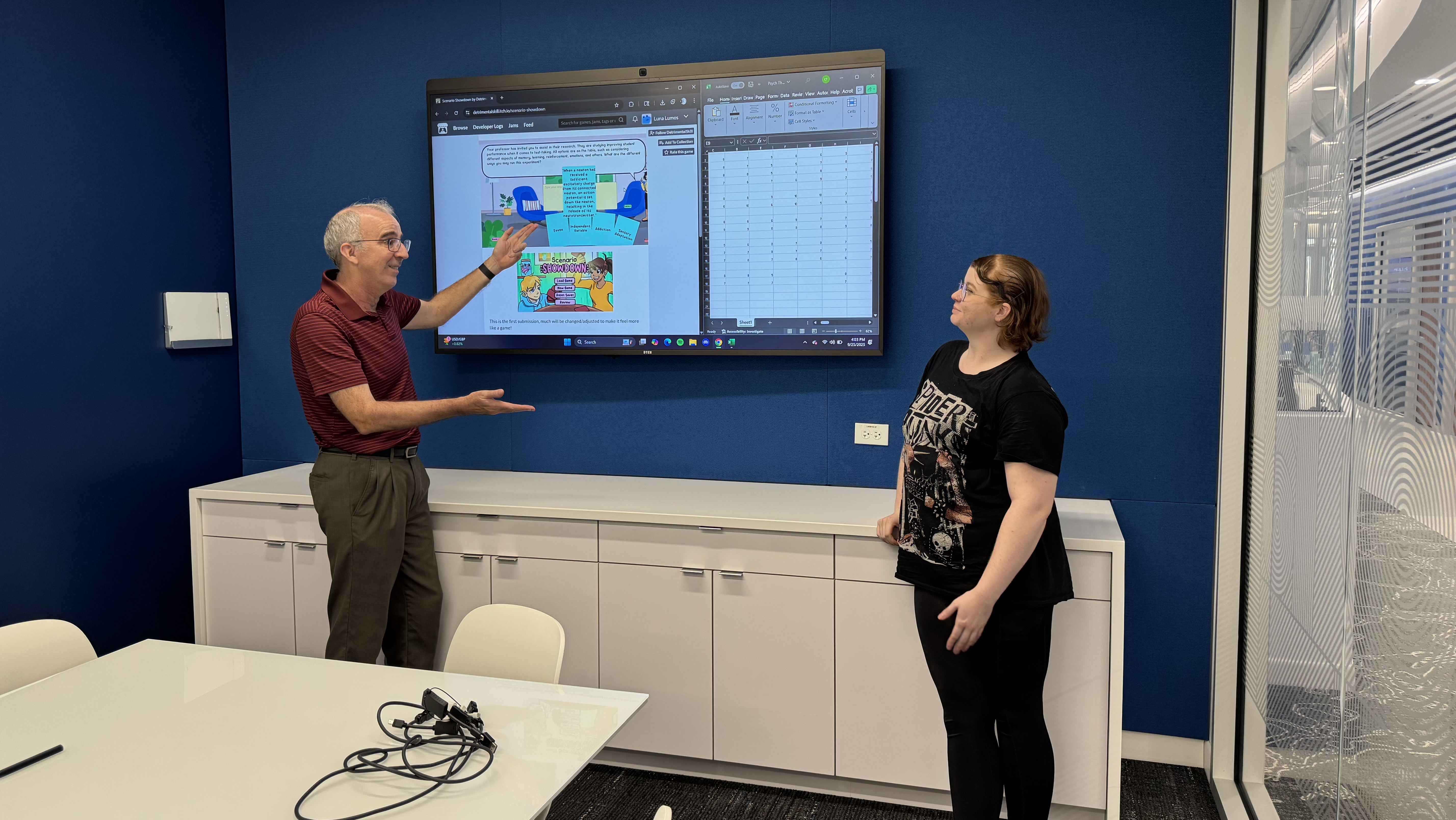
Kaen Freeman ’25 and Professor Stephen Blessing review their digital card game as part of their SURF research project on AI in psychology learning. Photo courtesy of Blessing
Kaen Freeman ’25, an art therapy and psychology double major, created a digital card game called Scenario Showdown that uses AI to reinforce terms and concepts from introductory psychology courses.
The project, funded by the Summer Undergraduate Research Fellowship (SURF), built on a previous physical version of the game created with Freeman’s mentor, Stephen Blessing, professor of psychology.
While the original game allows only in-person play and lacks immediate feedback, the AI-enhanced version provides instant responses that help players understand if they are on the right track. This AI-version was programmed by Computer Science major Matt Dauria, ’26, under guidance from Lori Jacques, assistant professor of computer science.
“This project lets us explore how AI could make the game more dynamic, personalized and useful to students — essentially turning it into a study tool,” Freeman said.
By combining game mechanics with AI-driven guidance, Freeman aims to increase engagement and improve retention of key theories. “Our goal is to understand how students use the words and concepts in this digital version versus the physical card game,” Freeman said.
To play Scenario Showdown, each player begins by receiving a scenario card that describes a realistic situation involving thoughts, emotions or behaviors. Players also are given five concept cards, which they must use to create a written response that accurately applies all five concepts to the scenario. AI then analyzes their answer and provides instant feedback.
In one sample scenario, a character named Thomas feels anxious about work deadlines. Players must use their given concept cards — positive reinforcement, limbic system, attachment, dependent variable and neutral stimulus — to explain Thomas’ behavior. AI replies by highlighting correct connections and suggesting related ideas the player might have missed.
Players go through several interactive rounds, improving their understanding of psychology concepts with every response.
Despite students on campus being few and far between in the summer, Freeman successfully gathered eight participants for the study. Those who responded were tested individually in 30- to 45-minute sessions by Freeman.
One student, Yu Ying Hu ’26, joined the study later during the fall semester.
Hu believes the AI version added a valuable new dimension to the learning experience.
“Playing the AI game was very helpful regarding feedback, something that I did not get from the physical version.”
The research is continuing this fall to compare outcomes with the original physical game in preparation for the Society for Information Technology and Teacher Education conference in Philadelphia in March.
Blessing sees broader potential. “We’re trying to find ways to use AI to help students, not harm them,” he said. “If our digital card game proves effective, it could be a model for other courses at UTampa and beyond.”
For Freeman, SURF has been more than a summer project. She plans to apply to doctoral programs for clinical psychology and says the project has sharpened her research skills.
“This project has been a résumé booster,” she said. “Getting a grant, completing the research process and presenting has given me a taste of graduate-level work and confirmed that I want to keep research as part of my future.”
More UTampa News


© 2024 The University of Tampa. All Rights Reserved.
Subscribe to News and UTampa Life

Contact us
401 W. Kennedy Blvd.
Tampa, FL 33606-13490
(813) 253-3333
© 2024 The University of Tampa. All Rights Reserved.
Subscribe to News and UTampa Life