Contact us
401 W. Kennedy Blvd.
Tampa, FL 33606-13490
(813) 253-3333
This fall, environmental studies students are partnering with Florida Botanical Gardens to create interactive learning displays for children.
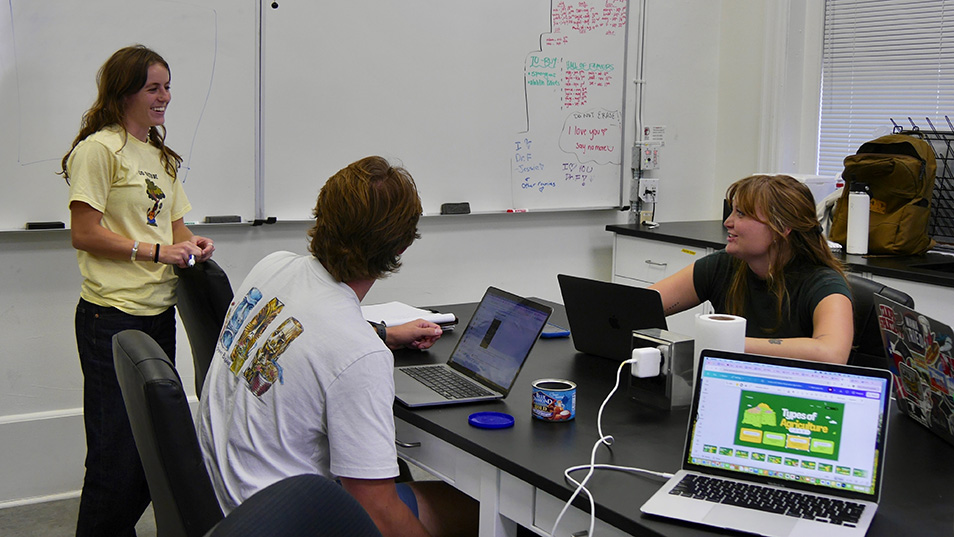
Environmental studies students brainstorm ideas for their capstone project — educational displays that aim to teach children about the environment in engaging ways. Photo by Juliana Musap ’26
In the environmental studies capstone course at UTampa, learning does not just stay within four walls, it grows roots in the community. This semester, students are partnering with Florida Botanical Gardens in Largo to design hands-on, educational displays that aim to teach children about the environment in meaningful and engaging ways.
The collaboration is part of a long-term effort to blend academics with professional practice, said Daniel Huber, chair and professor of environmental studies.
As part of the project, teams of students are given a theoretical $6,500 budget to enhance a portion of the Majeed Discovery Garden, a collection of themed children’s play areas in the botanical gardens. They develop their designs as if they were working with real funds and submit their concepts to the Pinellas County funding board, in hopes of receiving the actual budget to implement their display.
Students began the project by visiting the garden to explore the existing play areas and brainstorm ideas for their displays.
“Students are identifying the environmental concepts behind each space and designing hands-on displays that make those ideas enjoyable and educational — the kind of displays you might see at a museum,” Huber said.
While the current structures offer strong foundations for imaginative play, students immediately noticed that many areas lacked detailed explanation or context. Seeing everything in person sparked an outpouring of ideas for how simple additions, including signage, hands-on components and visual storytelling, could help children better understand the environmental lessons behind each space.
Environmental studies major Adam Wysokowski ’26 said his group chose the “Trunk Jump,” a play area that tests balance and strength, for a challenging adventure of jumping and climbing.
“It was really important we go to the gardens and see everything in person,” he said. “We need to consider things like weather resistance in addition to communicating the environmental theme of our area. For the Trunk Jump, that theme is wetland habitats.”
Wysokowski explained that since this play area invites children to jump from tree trunk to tree trunk, his group incorporated a movement-based activity into their interactive signage, encouraging children to jump like a frog — an important indicator species in wetland environments.
In addition to community engagement, Wysokowski believes this project offers real-world career experience.
“We’re creating something tangible that can educate the next generation about the environment. I am very happy and grateful to be a part of something so impactful” he said. “We’re also managing a real client and learning about how to bring an idea from concept to completion while staying within our budget.”
Huber believes that this experience offers more than the opportunity to create a rendering — identifying real materials within budget is great training for project management and professional collaboration.
Environmental studies major Victoria Walker ’26 said that this project’s real-world application has helped shape her career goals.
“This project combines everything I’ve learned in the environmental studies program — science, creativity and outreach,” said Walker, who also has a concentration in environmental communication. “This experience is allowing me to see how environmental communication can help the community.”
Huber said it’s rewarding to think that students may one day revisit the gardens after graduation and find their designs installed, a moment that perfectly captures the power of experiential learning.
“The classroom has a lot of creative energy in the air right now,” he said. “Seeing students’ projects come together to benefit the community has been amazing to watch.”
More UTampa News


© 2024 The University of Tampa. All Rights Reserved.
Subscribe to News and UTampa Life

Contact us
401 W. Kennedy Blvd.
Tampa, FL 33606-13490
(813) 253-3333
© 2024 The University of Tampa. All Rights Reserved.
Subscribe to News and UTampa Life