- Program Highlights
- Curriculum
- Get Answers
- Accreditation Status
Program Highlights
- It is in the beautiful Tampa Bay area, known for its beaches, arts, music scene, museums, sports, business communities and year-round outdoor activities.
- Faculty are experienced educators with a diversity of clinical experiences.
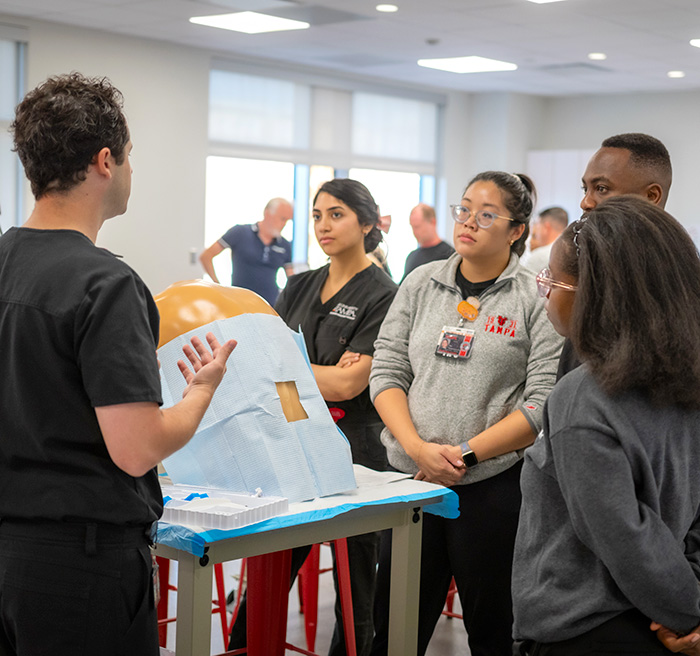
- Low faculty-to-student ratio in lab courses that allows for personalized attention and mentoring during experiential learning.
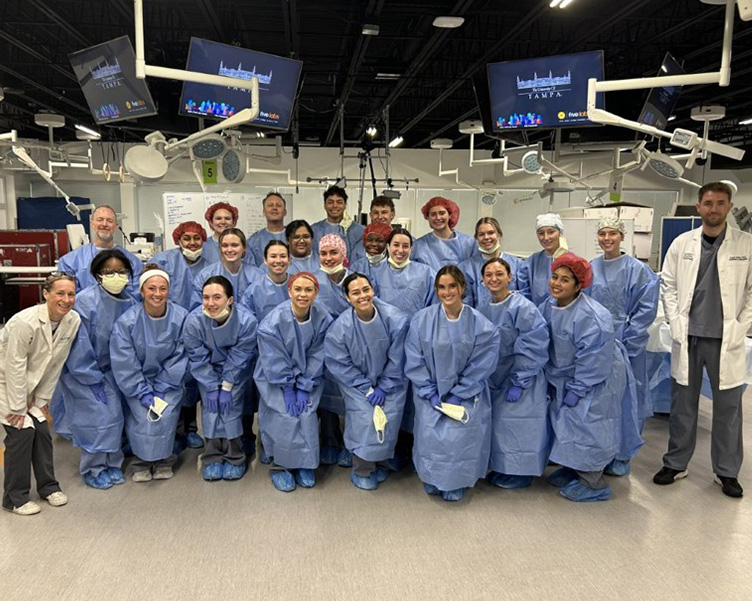
- Curriculum includes hands-on human cadaver dissection at the Florida InnoVation and Education (FIVE) Labs. FIVE Bioskills Lab, located just 10 minutes from campus, is an innovative training facility designed to educate health care professionals and to foster creativity for the development of technologies for health care’s biggest challenges.
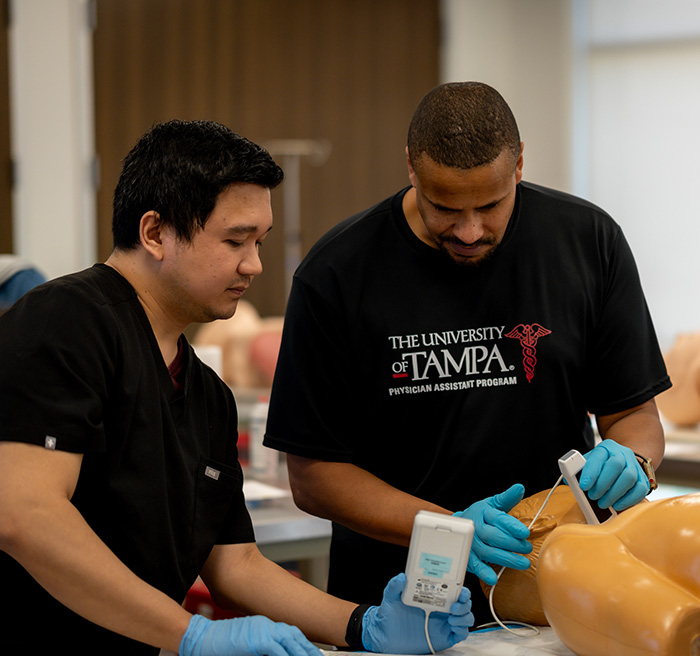
- Additional virtual dissection and advanced radiology training using high-tech Anatomage table and SynDaver cadaver.
- Clinical rotations are located within the Central Florida region.
- This 30,000-square-foot state-of-the-art PA facility was opened in Fall 2018.
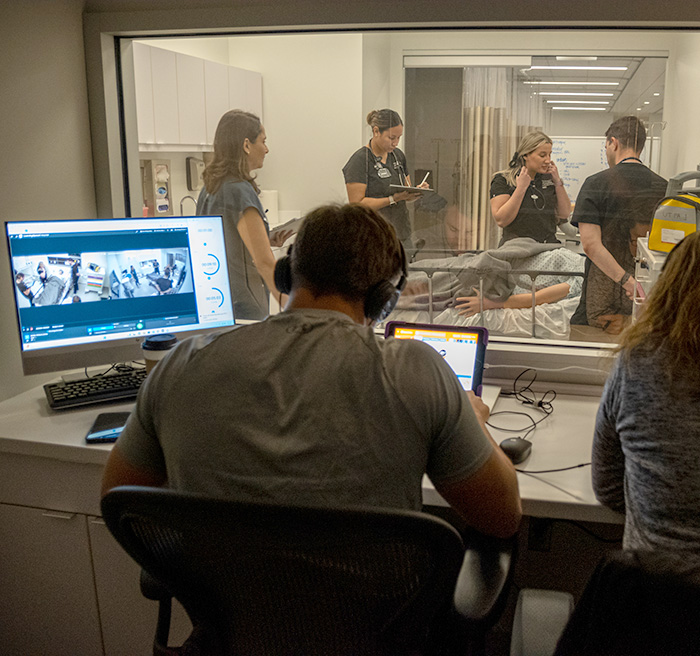
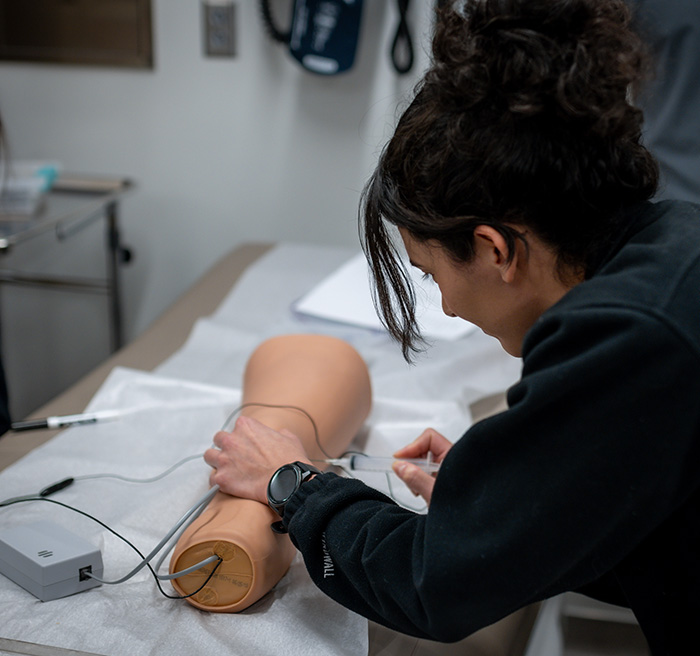
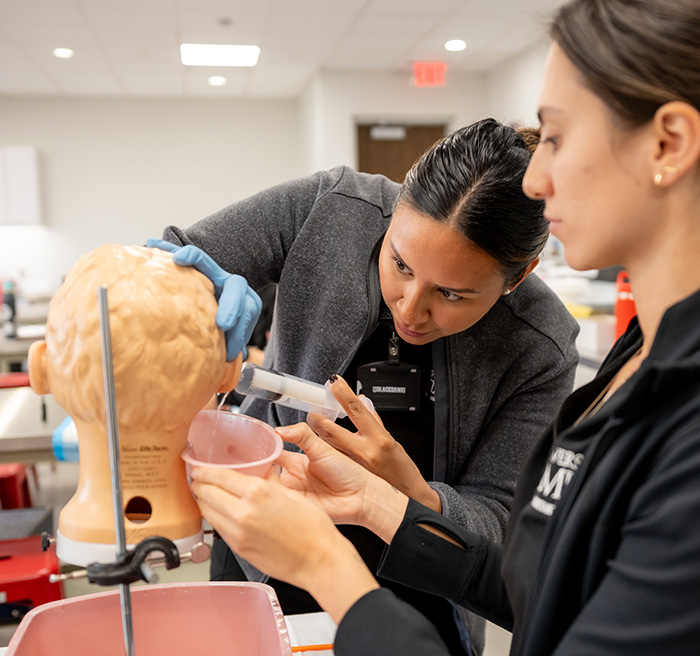
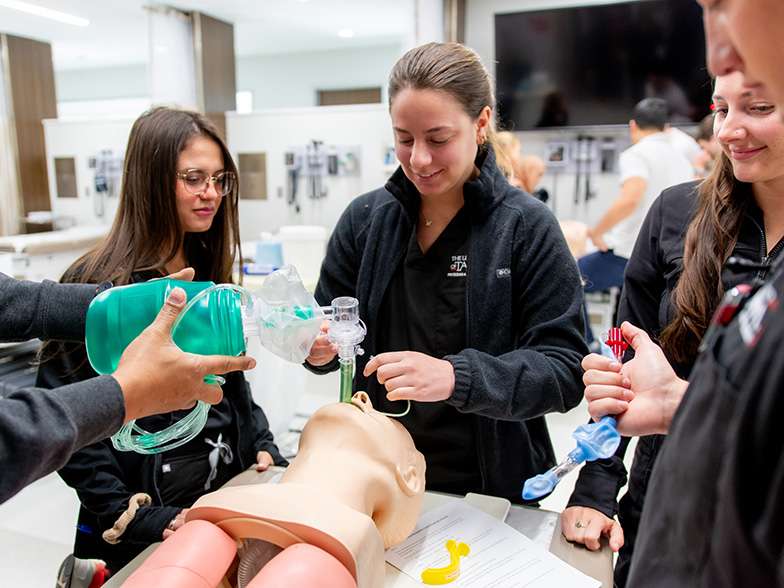
- The PA facility includes a simulation center with both high-fidelity simulators and standardized patients.
UTampa’s 27-month, 112-credit program admits one fall cohort per year. Students complete four didactic semesters followed by three clinical semesters, graduating in December with the Master of Physician Assistant Medicine (MPAM). Detailed syllabi are provided to enrolled students.
Resources
Course of Study (PDF) - Prior to August 2026 Matriculation
New Course of Study (PDF) - Post August 2026
Required Curricular Components
- Didactic phase (4 semesters): Integrated biomedical and clinical sciences, patient evaluation, therapeutics, diagnostics, public health, EBM, simulation, and professional practice.
- Clinical phase (3 semesters): Seven required supervised clinical practice experiences (SCPEs) per accreditation standards:
1. Family Medicine
2. Internal Medicine (delivered as Inpatient Medicine)
3. Pediatrics
4. Women’s Health
5. General Surgery
6. Behavioral/Mental Health
7. Emergency Medicine
Students also complete two electives in areas of interest, subject to availability.
For professional licensure information, see Professional Licensure.
Ready to get started on your PA journey at the University of Tampa's Physician Assistant Medicine Program? Whether you're a prospective applicant or a current student, this page is your resource for the most important information about our program. Use the buttons below to find the specifics on everything from admissions and program costs to curriculum and student handbook.
Contact the Office of Graduate and Continuing Studies
If you need further assistance after reviewing the resources compiled above, email pam@ut.edu or call (813) 253-6249.
Accreditation Status – Program – ARC-PA
The Accreditation Review Commission on Education for the Physician Assistant, Inc. (ARC-PA) has granted Accreditation-Continued status to The University of Tampa Department of Physician Assistant Medicine Program sponsored by The University of Tampa . Accreditation-Continued is an accreditation status granted when a currently accredited program is in compliance with the ARC-PA Standards .
Accreditation remains in effect until the program closes or withdraws from the accreditation process or until accreditation is withdrawn for failure to comply with the Standards . The approximate date for the next validation review of the program by the ARC-PA will be March 2034 . The review date is contingent upon continued compliance with the Accreditation Standards and ARC-PA policy.
The program’s accreditation history can be viewed on the ARC-PA website at https://www.arc-pa.org/accreditation-history-university-of-tampa .
Accreditation Status – University – SACSCOC
In November 2017, UT was notified that the board of trustees of the Southern Association of Colleges and Schools Commission on Colleges reviewed the materials seeking approval of the Master in Physician Assistant Medicine. It was the decision of the board to approve the program and include it in the scope of the current accreditation.
Becoming a PA
Physician assistants (PAs) are nationally certified and licensed medical professionals who work on health care teams with physicians and other providers. The PA profession has been named by top media outlets, including Forbes and USA Today, as one of the most promising jobs in America.
The University of Tampa’s graduate-level physician assistant program leads to a Master of Physician Assistant Medicine (MPAM) degree. The program follows the traditional medical model of training, providing in-depth analysis of disease processes, diagnosis and treatment. Students engage in full-time study for seven semesters, earning their degree in 27 months.
Career Opportunities
According to the Bureau of Labor Statistics (BLS), from 2011 to 2014 the demand for PAs increased more than 300%. The BLS projects strong job growth for this profession, with an expected 20% growth between 2024 and 2034, much faster than the average for all occupations. The most recent median annual wage reported by BLS for physician assistants is $133,260, based on data from May 2024.
Mission, Standards and Recognitions
Key Information
- Program Policies
- Mission, Vision and Values
- Program Spotlight
Select PA Program Policies
Select PA program policies are posted here. This is not an all-inclusive list. Students are encouraged to refer to the clinical student manual for information related to the clinical phase and the UTampa catalog for information regarding UTampa institutional policies.
Mission
The University of Tampa Physician Assistant Medicine Program prepares practice-ready PAs through rigorous, competency-based education that develops clinical reasoning, professionalism, evidence-based practice, and patient-centered team care.
Vision
The University of Tampa Physician Assistant Medicine Program is committed to developing exceptional PAs who lead with clinical excellence, integrity, compassion and dedication to improving the health of the communities they serve.
Core Values (ASCEND)
ASCEND: The values that guide our program and prepare students to become practice-ready PAs.
A: Accountability
We own our learning, actions, decisions, and outcomes.
Accountability reflects our responsibility for preparation, performance, communication and professional behavior. It includes dependability, follow-through, honesty about limitations and responding appropriately when mistakes occur.
S: Scholarship
We use evidence, curiosity, and disciplined study to guide clinical decision-making.
Scholarship reflects the academic and intellectual foundation of our program and PA practice. It includes evidence-based practice, scientific reasoning, clinical curiosity and a commitment to lifelong learning.
C: Compassion
We care for patients and one another with respect, empathy and professionalism.
Compassion reflects the human side of healthcare and our responsibility to treat patients, families, colleagues, learners, faculty, staff, preceptors and healthcare teams with dignity and respect.
E: Excellence
We pursue high standards in knowledge, clinical reasoning, technical skill, education and patient care.
Excellence reflects our commitment to continuous improvement and high-quality performance. It includes academic preparation, effective teaching and learning, clinical competence, procedural skill and safe patient care.
N: Navigate
We adapt, problem-solve and apply sound judgment in changing situations.
Navigate reflects our ability to manage uncertainty, respond to new information, prioritize competing needs and make thoughtful decisions in dynamic educational and clinical environments.
D: Dependability
We are prepared, reliable, responsive, and worthy of trust.
Dependability reflects the trust placed in our program and its members by patients, learners, colleagues, healthcare teams, clinical partners and the community. It includes punctuality, preparation, communication, consistency and professional reliability.
Related pages