
Contact us
401 W. Kennedy Blvd.
Tampa, FL 33606-13490
(813) 253-3333
Peer coaches offer attention and support to help navigate everyday stressors.
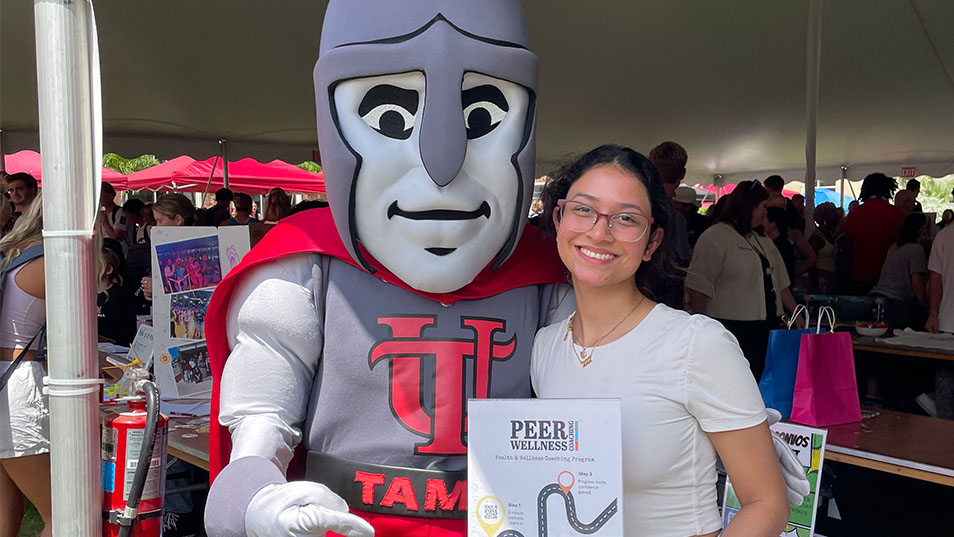
Peer wellness coach Divya Parray, with Sparty, at the 2026 Involvement Fair in January.
Psychology major Divya Parray ’26 was immediately interested when she noticed an opening for a peer wellness coach with UTampa’s Wellness Services. She saw the role as more than a typical on-campus job. It offered hands-on experience supporting students through challenges she remembered facing herself as a first-year student.
She applied and went through training and now helps students explore the eight dimensions of wellness: social, physical, emotional, occupational, spiritual, intellectual, environmental and financial. The free service for UTampa students is a non-clinical, peer-to-peer support program designed to help students reflect, set goals and navigate everyday stressors.
Assistant Director of Wellness Tiffany Nelson helped develop the peer wellness coaching program to complement UTampa’s counseling services.
“Peer coaching helps reduce barriers to care by offering students support in a way that feels approachable and relatable,” Nelson said.
The program is intended to be an accessible entry point into wellness for students who may not need therapy or who feel more comfortable speaking with someone closer to their own age and experience. Since its launch last August, the program has steadily expanded its reach. The five peer wellness coaches have so far conducted 210 sessions with UTampa students.
Coaches begin their training with a three-day orientation, led by Nelson, where they learn what wellness coaching is and how it differs from counseling. For Abigail Levine ’27, a psychology major, those first days laid the foundation for the role.
“We spent time dedicated to learning the basics of what coaching is, what our sessions would entail, what our responsibilities include, what it means to be a coach, and the background of how the program came to be,” Levine said.
Coaches also were introduced to campus resources such as counseling services and academic support, reinforcing the importance of recognizing when a student may need a higher level of attention.
That introduction was only the beginning. Over the summer, coaches completed a 40-hour health and wellness coaching certification through Real Balance Global Health and Wellness Coaching, also led by Nelson. The course focuses on evidence-based practices where coaches are trained to guide students toward their own solutions.
“During training we learned many new coaching techniques such as motivational interviewing, active listening and active recall. We also learned how to implement different tools and exercises into our sessions to help gain a better understanding of our client and what they need,” said Parray.
One of those exercises played a central role in preparing coaches for real conversations. Coaches participated in “buddy coaching” sessions, working through goals and challenges with one another.
“We are all students, so it helped me gain insight into what struggles students may be experiencing, and how I, as a peer, can relate and help them through difficult times,” Parray said.
The “buddy coaching” exercise also stood out to Levine, who emphasized how it helped change how she communicates beyond her job.
“I learned a lot more about active listening, which is significant to the role of a coach, but it has also brought significance to my personal and academic life,” Levine said.
For Parray, the most surprising part of the training was realizing how flexible coaching must be. “Every client is different, and using the same technique for all may not work,” she said. “Learning to try different approaches made the work more challenging — and more rewarding.”
As coaches move from training into practice, growth becomes evident. Nelson said that initial nerves often give way to confidence as coaches begin to trust both the process and themselves. That shift is reflected in how Levine and Parray describe the impact of the role.
Levine said it is rewarding to see students leave sessions feeling more grounded, adding that the Wellness Services office often becomes a space where stressful days begin to feel more manageable. Parray noted that coaching has encouraged her own self-reflection by holding her to the same goal-setting standards she supports in others.
Looking ahead, Levine and Parray see strong connections between wellness coaching and their future careers. The communication, adaptability and empathy developed through the program closely align with their goals. Parray is interested in school psychology, and Levine said the role has helped her develop interpersonal skills applicable to any people-focused field.
Both coaches encourage students of any major to consider applying, emphasizing that patience, curiosity and a genuine desire to support others matter more than academic background.
For students seeking support, peer wellness coaching offers an approachable space grounded in shared experience — while still recognizing the importance of professional care when needed.
Peer wellness coaching is part of the UTampa Cares Quality Enhancement Plan. For more information, click here.
More UTampa News


© 2024 The University of Tampa. All Rights Reserved.
Subscribe to News and UTampa Life

Contact us
401 W. Kennedy Blvd.
Tampa, FL 33606-13490
(813) 253-3333
© 2024 The University of Tampa. All Rights Reserved.
Subscribe to News and UTampa Life