Contact us
401 W. Kennedy Blvd.
Tampa, FL 33606-13490
(813) 253-3333
In Chemistry Professor Eric Werner's opinion, a good research project never ends.
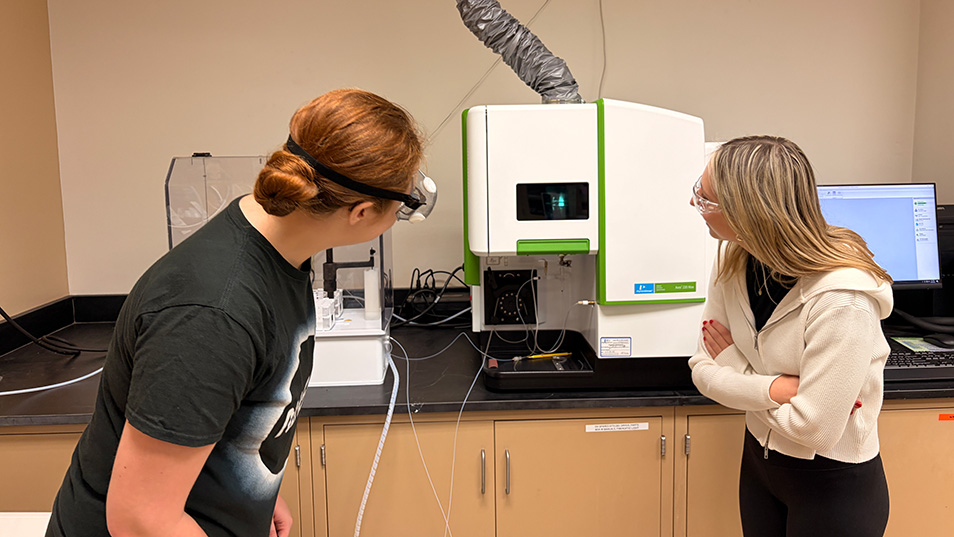
Juniors Savannah Knight and Thea Matter conduct inductively coupled plasma spectroscopy.
In the chemistry lab, the questions keep coming.
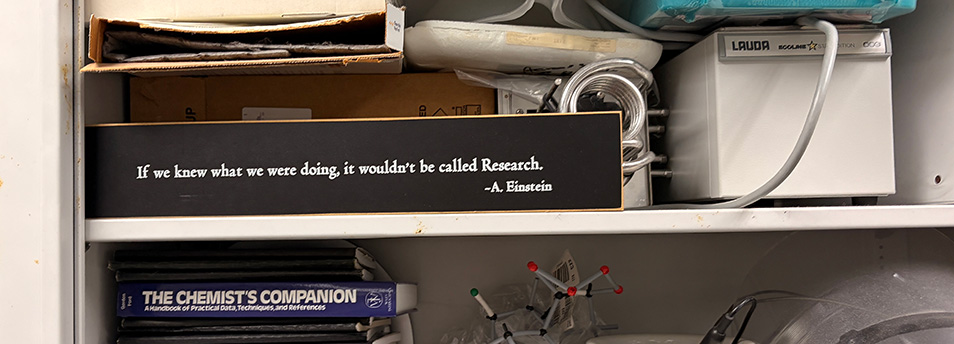
In Professor Eric Werner’s chemistry research lab, a quote attributed to Albert Einstein is placed prominently to remind faculty and students alike of the work at hand: “If we knew what we were doing, it wouldn’t be called Research.”
Werner employs several students to assist in lab research, and while they do know what they’re doing when it comes to their specific tasks and objectives, new questions are constantly appearing in their larger project.
“Since we started, there’s always something that goes wrong,” said Thea Matter, a junior chemistry major on the pre-med track. “Nothing is ever perfect, but that’s what helps us branch out to different niche topics of the protocol.”
The protocol Matter references is a method to improve the extraction of rare-earth elements, specifically metals from the lanthanide group, which are used in smartphones, electric car batteries, medical diagnostics and other technology. Current extraction methods are generally inefficient and wasteful, causing harm to the communities where companies are mining and testing the metals.
Each student involved is taking away different benefits from the project that are unique to their own specialties. Matter said that her work in the lab connects to her career goals in medicine even more than she originally expected. For example, one of the lanthanide metals they are working with, gadolinium, is used to enhance MRI scan images.
Junior Savannah Knight started shadowing in the lab last year after meeting Werner at a conference.
“She would be the first student ever that came to me and said, ‘I want to do nuclear chemistry for my career,’” said Werner.
Knight has now taken on her own independent part of the project, which applies the lanthanide extraction methods to other metals. She found that when varying the conditions slightly, the same extracting agent used for the lanthanides also works very well for uranium. Next month, she’ll present her uranium extraction research at the national conference for the American Chemical Society, one of the largest scientific societies in the world.
“In my opinion, a good research project never ends,” said Werner. “It just leads to more questions. You answer some along the way, and you’re adding knowledge to the world … but it also creates new paths and new questions for others to explore.”
Meanwhile, Christina Kilduff is involved simply because she finds it interesting. She took general chemistry with Werner in the fall of her freshman year and started coming around the lab that spring just to hang out and make solutions for the metal extraction studies. Now in her third year at UTampa, she’s graduating early this May and going to dental school in the fall.
“Some of my most productive research students over the years have been pre-med or pre-dental,” said Werner. “They don’t necessarily have to do research; they’re doing it because they like it and appreciate the critical thinking skills being developed that will help them in their careers. A lot of them tell me when they go to their med school interviews, that’s what catches their eye.”
The newest addition to the team is Alyssa De La Sala, a junior forensic science major with minors in chemistry and criminal investigation, who joined the extraction research project just a couple of weeks ago. So far, De La Sala has mainly been looking through papers on the subject and watching her colleagues at work, but eventually, the team is looking forward to hearing her interpretations of the results from a forensics perspective.
“I haven’t usually had forensic science research students before,” said Werner. “But there’s some overlap, because forensic scientists use a lot of these fancy instruments to characterize bomb residue or other materials. You can use those same tools to study our lanthanide complexes and structures and why they behave the way they do in extraction experiments.”
“Plus, I just love research,” said De La Sala. “I think it’s so cool.”
Further proving this hypothesis, Werner called one step in the protocol “maybe the coolest technique ever.” Matter and Knight nodded in agreement. To measure how much metal was extracted from a solution, a machine slightly larger than a microwave hooks up to the sample, then lights a flame inside that is approximately 10,000 degrees Kelvin (about the surface temperature of the sun). At this temperature, the metal is turned into a gas, and the light given off by these gas-phase metal atoms allows the team to measure the concentration of the solution.
The process is called inductively coupled plasma spectroscopy.
“For us to have (one of these instruments) that students can go upstairs and run at any point is pretty unusual,” said Werner. “Even at places that have big graduate programs, there might be a technician that you have to submit your sample to, but our students are doing it themselves.”
And occasionally troubleshooting it themselves.
“The machine can get an attitude,” said Knight. But as Einstein reminds them every day, if they knew what was going to happen all the time, it wouldn’t be research.
More UTampa News


© 2024 The University of Tampa. All Rights Reserved.
Subscribe to News and UTampa Life

Contact us
401 W. Kennedy Blvd.
Tampa, FL 33606-13490
(813) 253-3333
© 2024 The University of Tampa. All Rights Reserved.
Subscribe to News and UTampa Life