Contact us
401 W. Kennedy Blvd.
Tampa, FL 33606-13490
(813) 253-3333
Can how religious you are influence how much or whether you donate to charity?
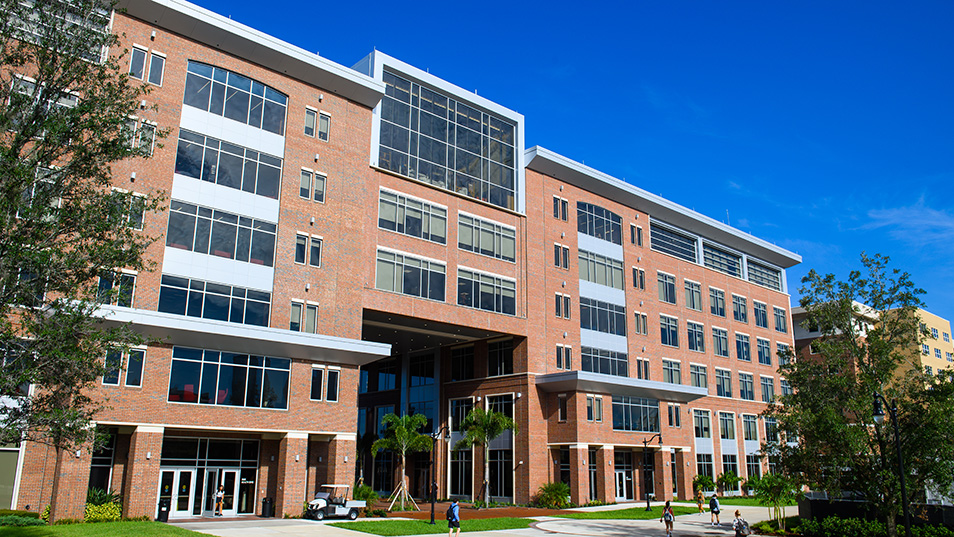
The talk was held in the Jenkins Health and Technology Building on campus.
Can how religious you are influence how much or whether you donate to charity?
Ryan Cragun, professor of sociology, spoke to a full room of students on Feb. 20 about this research question and his findings. Cragun, along with Alexandra Rodriguez ’19, published the paper “Religiosity is Declining but Giving is Increasing: Can the Nonreligious Really Be Less Generous?” in Secularism & Nonreligion Journal in January.
The research talk was one of a series by faculty in the Sociology Department.
Cragun challenged previously published claims that individuals who identify as religious are more likely to give to both religious and secular charities, compared with those who claim no religious affiliation.
But is there really a connection between religiosity and giving? Cragun asked.
During the presentation, Cragun referenced data detailing information on how much money survey respondents had, how much money they make, and how they spend.
“Here's my syllogism: If the nonreligious are increasing as a percentage of the U.S. population, and if charitable donations are increasing, then the nonreligious cannot be less generous than the religious,” Cragun said.
Cragun’s data showed that individuals who identify as nonreligious and atheist/agnostics are the least likely to give to religious organizations.
“No one should be surprised by this, right? This is completely obvious. They don't belong to those organizations,” he said.
Next, he showed the probability of individuals belonging to religious groups to donate to charities benefiting the needy. He found that religious affiliation had about a 1% effect on whether a person would donate.
“None of them are really giving more than others. If you look at the error bars, we’re explaining virtually none of the variation in giving,” he explained.
Sienna Otto ’27, who had taken Cragun's introductory data science class, followed along with the data sets presented.
“The talk brought attention to the importance of replicating data to ensure its authenticity,” she said.
The authors determined that religiosity is not a strong predictor of whether someone will donate or how much. Rather, religious individuals are more likely to donate to religious organizations, and the nonreligious are who give more to secular charities.
Up next in the sociology series: Katie Cooper, associate teaching professor, 11:30 a.m., April 3, in GHS 106. This is a student event.
More UTampa News


© 2024 The University of Tampa. All Rights Reserved.
Subscribe to News and UTampa Life

Contact us
401 W. Kennedy Blvd.
Tampa, FL 33606-13490
(813) 253-3333
© 2024 The University of Tampa. All Rights Reserved.
Subscribe to News and UTampa Life