Contact us
401 W. Kennedy Blvd.
Tampa, FL 33606-13490
(813) 253-3333
UTampa's first Bitcoin economics course was taught last semester.
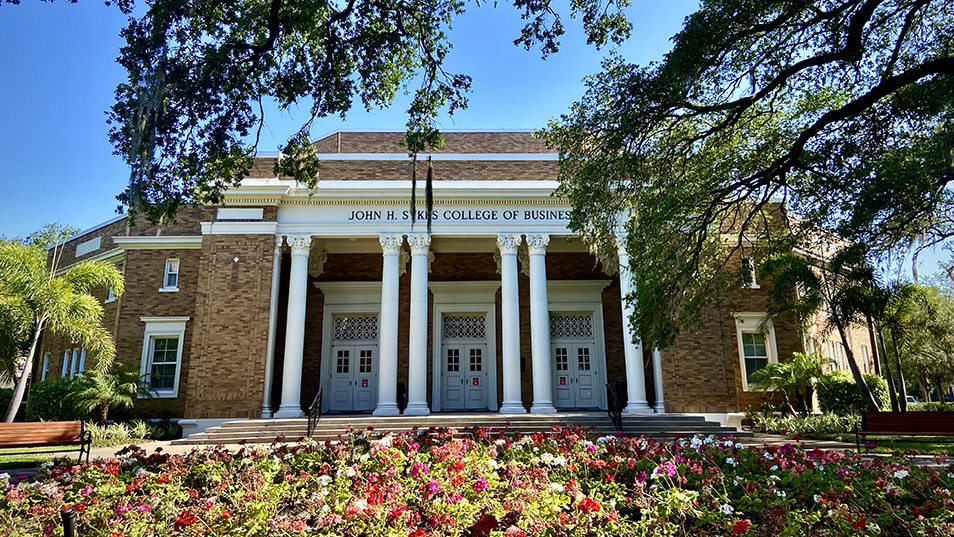
UTampa is the first university in the country to offer a Bitcoin economics course.
John Dorrell, assistant teaching professor of economics, won’t tell anyone to buy Bitcoin. But he will say to research it.
That’s exactly what several dozen students did last semester in his “special topics,” 400-level economics course, “Bitcoinomics.” It was open to students from all majors and had no prerequisites — except for curiosity about the world’s leading digital currency.
UTampa is the first university in the country to offer a Bitcoin economics course. Dorrell says Bitcoin usually is included as part of finance curricula, and rarely is an entire course dedicated to it, even with the potential for jobs in finance and tech and the general need and desire for better understanding of wealth-building strategies using the coin.
In its most basic definition, Bitcoin is a computer-coded currency that can be bought and sold like a commodity and sometimes can be used to purchase goods, especially online and across international channels. A finite amount of open-source code was written for Bitcoin and has been released by its blockchain, or “mined,” creating Bitcoin’s scarcity and therefore its value. Dorrell calls Bitcoin “digital gold.”
In class one night in November, Dorrell laid the foundation by first talking about the dollar as a social construct.
“What’s the dollar backed by?” he asked. “Nothing. Nothing.”
What followed was a discussion of the history of currency and what has counted as money over millennia: shells, spices, cigarettes, rai stones, gold, real estate … the list goes on.
“Not all money is created equal,” Dorrell told the class, “and the best money for each person isn’t necessarily the same thing.”
The late-semester lecture was a review for the students, most of them already well-versed in money and money systems, including Bitcoin and other cryptocurrencies. Many in the class also had showed up to at least some meetings of the campus Crypto Club, said Karli Ramey ’25, seated in the front row with Milania McNair ’27, president of the club, and fellow club board member Natalie Rennie ’25.
“It’s a lot (to learn), honestly,” Ramey said. “The books that (Dorrell) keeps waving, the black one, The Bitcoin Standard, that’s the baseline. I highly, highly recommend it. It’s really cool because, even if you’re not super finance-y or super techy …”.
“It’s more economics,” Rennie interjected.
“Yeah, it’s about the economics and the people, and it’s just a really good way of laying everything out,” Ramey said.
McNair, Ramey and Rennie all have their own Bitcoin accounts, which they consider more valuable than their “regular” accounts. They all laughed when asked whether they’d rather receive cash in a birthday card or a deposit into their Bitcoin wallets.
The three are among a small group of students who, with Dorrell, have created a Bitcoin consulting company, eCoinomics, to help firms, universities and families to implement Bitcoin strategies.
The economy is becoming more digital and needs a better digital money,” Dorrell said. “Cost of living is rising, and salaries can’t keep up. Individuals and companies are developing Bitcoin treasury strategies, even universities like Harvard. People that understand it will survive and drive the digital age. People that don’t understand it will fall behind.”
Back in class that night, Dorrell questioned his students: “What is Bitcoin? Tell me in one word.”
Scattered answers came from the group: “scarcity,” “finite,” “decentralized.”
But the first word, offered from the middle of room, was “freedom.”
More UTampa News


© 2024 The University of Tampa. All Rights Reserved.
Subscribe to News and UTampa Life

Contact us
401 W. Kennedy Blvd.
Tampa, FL 33606-13490
(813) 253-3333
© 2024 The University of Tampa. All Rights Reserved.
Subscribe to News and UTampa Life