

Contact us
401 W. Kennedy Blvd.
Tampa, FL 33606-13490
(813) 253-3333
UTampa lifeguards teach fellow students lifesaving skills.
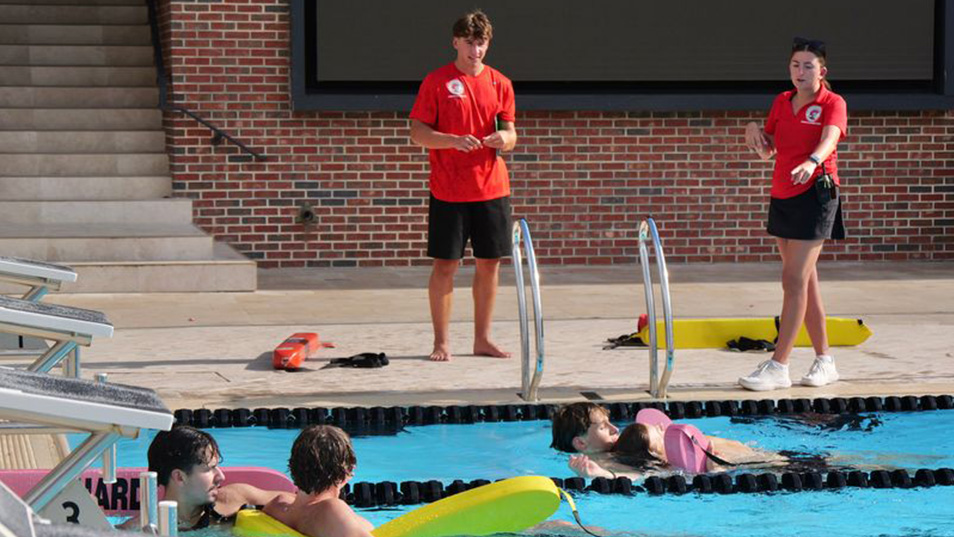
Joey Agresta ’28, standing at right, a pre-elementary education major and American Red Cross-certified instructor, led a lifeguard training course at the Riseman Aquatic Center last weekend. Photo by Juliana Musap '26
Joey Agresta ’28, a pre-elementary education major, plans to become a schoolteacher. But for now, her classroom is the Riseman Aquatic Center, and her students are learning how to save lives.
Last weekend, Agresta, an American Red Cross-certified instructor, led a shallow water lifeguarding course for UTampa students. This certification prepares participants with the knowledge and skills to prevent, recognize and respond to aquatic emergencies in shallow water as well as provide care for breathing and cardiac emergencies, injuries and sudden illnesses, until EMS personnel can take over.
The credential lasts two years, but the goal is more immediate: prepare students to step into a workforce that urgently needs them.
Across the country, pools and waterfronts have struggled to stay open due to a shortage of certified lifeguards. Training can be expensive and difficult to access, but UTampa’s model works to bridge this gap. By covering certification costs and running multiple trainings each semester, UTampa turns its campus into a steady source of trained lifeguards.
Agresta is a central part of that system.
She’s been involved at the aquatics center since her freshman year, gradually taking on more responsibility — not just guarding, but teaching certification courses.
“We try to bridge the gap and address the shortage by having as many hiring rounds and training opportunities as we can each semester,” Agresta said. “Also, people graduate, they move on, and then they’re able to go out and lifeguard somewhere else with those skills.”
That pipeline depends on more than just offering certifications — it relies on the people teaching them.
Leading a class means managing different learning styles, keeping students engaged through long training days and making sure every person meets the standard before they leave.
“It’s about finding different ways to explain things,” Agresta said. “Not everyone learns the same way, so you have to adjust.”
That mindset is one she plans to carry into her future classroom. For Agresta, the overlap between lifeguard instruction and elementary education is clear: both require patience, adaptability and the ability to build confidence in others.
“In the pool, that means breaking down a rescue step-by-step until it clicks,” Agresta said. “In a classroom, it might mean reworking a lesson until every student understands.”
She sees the results of her approach in her trainees. She often encounters students who enter the course quietly, keeping to themselves. By the end, they not only earned their certification but, within months, were promoted.
“Watching that growth is the best part of my role,” Agresta said.
One of Agresta’s trainees this past weekend, Marlon Dato Slattery ’29, a sports management major, believes the program’s most notable feature is its accessibility.
“When I saw it was free, I signed up,” he said. “Back home, it costs a lot more.”
That accessibility extends beyond the lifeguard courses. All student employees at UTampa’s Benson Alex Riseman Fitness and Recreation Center are trained and certified in CPR, AED use, and first aid — ensuring a baseline of emergency preparedness across the entire facility.
The combination of repetition and accessibility is what makes this lifeguard training program effective at UTampa and beyond. Students leave not only certified, but confident enough to work immediately, whether on campus, back home for the summer or in future roles after graduation.
That approach is intentional. Lifeguarding roles are structured like on-campus internships. Falling under UTampa’s “internships for all” initiative, positions at the Riseman Aquatic Center are designed to give students hands-on experience and leadership responsibility along with industry-recognized certifications. This year, there were 32 certified lifeguards on staff.
Students also have opportunities to advance through a tiered system — from lifeguards to head guards to managers — earning those roles by developing experience in communication, risk management and team coordination along the way. As responsibilities increase, so does the level of awareness and collaboration required on the job.
“It prepares you to be more aware and communicate with others, especially in situations where you have to work together and respond quickly,” Agresta said.
For Agresta, that structure has shaped how she sees both her current role and her future career.
Whether she is on a pool deck or eventually in an elementary school classroom, the core of the job stays the same: making sure people know what to do when it counts and feel confident enough to do it.
More UTampa News


© 2024 The University of Tampa. All Rights Reserved.
Subscribe to News and UTampa Life

Contact us
401 W. Kennedy Blvd.
Tampa, FL 33606-13490
(813) 253-3333
© 2024 The University of Tampa. All Rights Reserved.
Subscribe to News and UTampa Life