
Contact us
401 W. Kennedy Blvd.
Tampa, FL 33606-13490
(813) 253-3333
Faculty and staff participated in a simulation about the hurdles international students may experience before arriving at college.
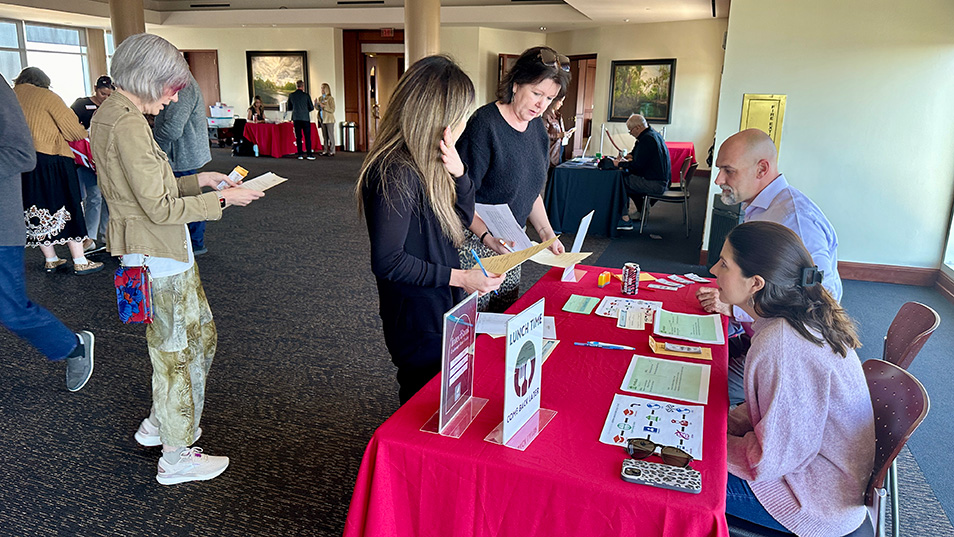
Participants faced challenges at the "bank," among other stops in the exercise.
Twenty faculty and staff members learned Wednesday what it’s like to walk in the shoes of an international student when they participated in a simulation of the steps taken before students even leave their home countries and arrive on campus.
The ninth floor of the Vaughn Center was set up with stations that represented the hoops students jump through, including exchanging money, obtaining a passport, taking an English test and checking in with the office of admissions, with the goal of making it to mandatory orientation at the university.
Upon entering the simulation, attendees were given instructions and an envelope of Monopoly money to spend like cash at the various stops. They then had 40 minutes to make it through the necessary steps.
“We are here to step into someone’s shoes,” said Jessica Ramirez, international student and scholar advisor in the International Programs Office. She added that participants may feel stressed or confused. “Hold on to that feeling,” she said. “That’s exactly what students feel every year.”
Participants were mostly calm at the start, but they were tested by obstacles.
At the bank: “Do you have the proper paperwork?”
At the passport office: “Have you exchanged your money?”
Participants moved quickly and increasingly frantically between tables, backtracking as needed to complete requirements in time. Some were tempted and fooled by a person set up next to the passport office selling knockoff passports and bogus plane tickets. This, three people would learn, would be a costly error, both in time and money.
As time dwindled, participants began to feel increased stress, asking others where to get certain paperwork to move on to the next station.
Isiah Williams, an academic programs specialist, said the experience was “eye-opening.” He had given his money to another staff member, after she bought a fake passport. “You never know who they’re leaving behind, or who they’re doing this for,” he said about international students.
The exercise “created patience and more understanding of the challenges they face to get here and the challenges to stay here,” he said.
Janice Carrion-Delgado, assistant director of annual giving, said she wanted to participate to learn what it was like to be an international student. “There’s so many steps and roadblocks,” she said, “which makes them so resilient.”
Carrion-Delgado admitted she didn’t feel stressed until time was running out and she missed the mandatory orientation.
Only one participant arrived on time.
This is the third year the International Programs Office hosted the event. “This exercise is (only) the first part to make it to the U.S., and none of you could,” said Henry Heredia-Spratling, assistant director of the International Programs Office.
Following the event, attendees participated in a debrief session. The English test was voted the easiest part, despite the cost to attempt the test and the challenging content. Sympathy was deemed the most important skill to have when working with international students.
“For you to be sympathetic, you have to put yourself in the international students’ shoes from time to time,” said Heredia-Spratling. “Just being a student at a university is complicated. Being an international student is 15 times so.”
More UTampa News


© 2024 The University of Tampa. All Rights Reserved.
Subscribe to News and UTampa Life

Contact us
401 W. Kennedy Blvd.
Tampa, FL 33606-13490
(813) 253-3333
© 2024 The University of Tampa. All Rights Reserved.
Subscribe to News and UTampa Life