Updated on August 17, 2026
The President’s Leadership Fellows (PLF) program is an intensive four-year leadership scholarship program launched in Fall 2008. Its name reflects the President’s commitment to leadership development and the prestige of the program. With roughly 30 first-year students selected to participate each year, we hope to identify the incoming students with the greatest passion and potential for leadership focused on creating positive social change.
Fellows move through each year of the program as a cohort. A cohort is a group – in this case, the group of students who start in the program as freshmen with you. Each cohort is given a number based on the number of years the program has been running. Since this is a four-year program, there are four cohorts in the program at a time. All four cohorts make up the PLF community.
PLF’s leadership philosophy is congruent with UTampa’s definition of leadership and is theoretically grounded in the Social Change Model for Leadership Development (HERI, 1996).
Mission Statement
The President’s Leadership Fellows aims to empower fellows to develop as ethical, responsible and collaborative leaders who positively impact the local and global community.
Vision
To cultivate ethical leaders who are individually, communally and globally minded and who work toward positive social change.
Social Change Model of Leadership Development
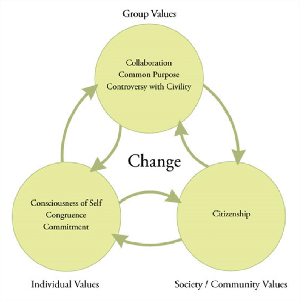 The Social Change Model of Leadership Development (SCM) was developed at the Higher Education Research Institute (1994). The model outlines the “EIGHT C’s” of leadership. Each “C” recognizes an important component of what every leader should encompass.
This SCM recognizes that a leader does not have to hold a formal position. Rather, we regard a leader as one who can effect positive social change for the betterment of others, the community, and society. All people are potential leaders. Moreover, the process of leadership involves collaborative relationships that lead to collective action grounded in shared values (Astin, 1996). It is our hope that by PLF graduation you will embody the SCM in your own leadership practice. We have intentionally designed a program that blends opportunities to learn about, practice and reflect on leadership.
Annual Learning Outcomes
Overview of the program:
| Year 1 | Year 2 | Year 3 | Year 4 | |||||
| SELF | TEAM | COMMUNITY AND CHANGE | LEADERSHIP IN A GLOBAL SOCIETY | |||||
| Semester 1 | Semester 2 | Semester 3 | Semester 4 | Semester 5 | Semester 6 | Semester 7 | Semester 8 | |
| Course and Retreat | LED 200 and Retreat | LED Elective | LED Elective | LED Elective | Y3 Retreat | LED 450 | ||
| Meetings | Community | Monthly | Monthly | Monthly | Monthly | Community | Monthly | Monthly |
| Involvement | Involved in 2-3 orgs. | 30 hours of involvement | 30 hours of involvement | 30 hours of involvement | Continue involvement | Continue involvement | Transition out of leadership roles | |
| Social Change Project | 8 Individual Volunteer Hours | 8 hrs. addit. Exploration and Selection | Project Implementation Phases I and II | Project Implementation Phases I and II | Finalize Project Phase III | Presentation and Sustainability | Senior Experience | Senior Experience |
| Reflections | 1 Reflective Journal | Journal to fulfill minor | Journal to fulfill minor | Journal to fulfill minor | 1 Reflective Journal | 1 Reflective Journal | 1 Reflective Journal | Final Reflection |
| Mentoring | Paired with Year 2 for 2+ meetings a semester | Paired with Year 2 for 2+ meetings a semester | Mentor Year 1. Paired with UTampa Staff for 4+ meetings | Mentor Year 1. Paired with UTampa Staff for 4+ meetings | 1+ meeting a semester with a person in dream career | 1+ meeting a semester with a person in dream career | 1+ meeting a semester with a person in dream career | 1+ meeting a semester with a person in dream career |
At the foundation of PLF, are intentional learning outcomes informed by the SCM and UTampa’s Spartan Ready® Competencies. Learning outcomes describe what we hope you will have learned at the end of each year through your engagement in the learning activities. What follows is the focus, learning outcomes and the required learning activities for each year.
Leadership demands that one be continually self-aware. Mindfulness of one’s thoughts and feelings, as well as knowledge of strengths and weaknesses gives leaders the foundation necessary to: enhance their relationships with diverse others, be open to multiple perspectives, create strong teams and engage in critical and sustained reflection.
By the end of year one, students who participate in the President’s Leadership Fellows program will be able to:
- recognize the importance of understanding oneself
- identify and deconstruct their individual strengths
- articulate their personal values and how these shape thei practice of ethical leadership, motivation and growth
- define congruence, how to achieve it and identify obstacles to overcome incongruence
- describe and examine their own cultural heritage, values and beliefs
- illustrate at least four current leadership theories
- recall the eight elements of the Social Change Model
- present on potential social change projects for a specific population
- perform an exploration of the non-profit organization and/or specific population
Learning Activities/Program Criteria for Year One:
- Complete LED 200: Introduction to Leadership Studies in Fall
- Participate in the PLF Year 1 pre-orientationleadership retreat
- Attend monthly cross-cohort community meetings
- Attend the cohort-based workshops in the Spring
- Meet with the program advisor once a year
- Meet three times a semester with your PLF peer mentor
- Declare the Leadership Studies minor in the Fall
- Actively participate in 2-3 student organizations of your choosing
- Complete eight hours of off-campus community service each semester
- Complete the Social Change Project exploration process in the Spring
- Complete one reflective journal each semester
Developing common purpose and working collaboratively with diverse others are important skills for today’s global leaders. Year two focuses on applying the self-awareness learned in year one to team life and on developing the type of relationships that will ultimately enhance a group’s capacity to solve the complex problems leaders face.
By the end of year two, students who participate in the President’s Leadership Fellows program will be able to:
- prepare a Social Change Project (SCP) proposal to create positive social change
- revise and create the action plan for the Social Change Project
- articulate a shared, common vision for their SCP
- work with others to integrate information about community concerns into the SCP
- effectively collaborate with others to complete the challenge course obstacles
- engage in meaningful dialogue and include it in the process of controversy
- articulate the benefits and risks of group conflict
- mentor a new PLF student by meeting with student at least six times
Learning Activities/Program Criteria for Year Two:
- Attend all cross-cohort community meetings and cohort-based workshops
- Meet three times a semester with your faculty/staff mentor
- Actively participate in and implement the Social Change Project
- Mentor a first-year student in the program and meet with them three times a semester
- Enroll in the LED Elective each semester
- Meet once a year with the program advisor
- Prepare and present on the Social Change Project updates
- Actively participate in at least one Open House and/or Fly-In recruitment event
- Complete one reflective journal each semester
The effectiveness of one’s leadership practice in organizations, community and world is often judged by the degree of positive social change achieved. Now that participants have developed a high degree of self-awareness and skill in working in a team – the team will have the chance to create the kind of lasting change needed in our communities.
By the end of year three, students who participate in the President’s Leadership Fellows program will be able to:
- successfully complete the Social Change Project in accordance with group’s action plan
- present on and critique the Social Change Project experience and outcome
- create a sustainability plan for the Social Change Project
- articulate their vision as change agents in their discipline and our broader society
- develop a leadership action plan to analyze and address an adaptive change
- analyze and reflect upon their personal leadership identity in relation to others
- critically interpret leadership theories, including strengths and limitations
- synthesize leadership theories into practice in individual, group, and community domains
- interpret the uses of power and nature of oppression in systemic societal issues
- form a positive and professional relationship with two chosen mentors
- present on the status of the group Social Change project
Learning Activities/Program Criteria for Year Three:
- Attend all cross-cohort community meetings and cohort-based workshops
- Participate in a weekend leadership retreat in the Spring
- Complete the LED 450 Capstone and Leadership Studies Minor
- Meet once a year with the program advisor
- Present on your Social Change Project and your experience in the PLF program
- Meet once a semester with at least one mentor in your professional field of interest
- Actively maintain a leadership position within at least one organization on or off-campus
- Complete one reflective journal each semester
Just as the leadership culture is different for different types of organizations (e.g., leadership looks and feels different in a corporate setting than in an educational environment), it also varies on a global level based on the history, norms and values of a particular culture. Therefore, the focus in year four is two-fold. The first is to examine how leadership is practiced in one’s chosen professional field, while concurrently learning about the relationship between societal culture and organizational leadership in other countries.
By the end of year four, students who participate in the President’s Leadership Fellows program will be able to:
- justify and defend their stance on human rights and civic responsibility in their final presentation
- understand the how their experience at UTampa translates to success in their chosen profession
- assess their own development throughout the PLF program
- form a positive and professional relationship with two chosen mentors
- formulate a plan for remaining an active global leader post-graduation
- evaluate and critique the PLF program
Learning Activities/Program Criteria for Year Four:
- Attend all cross-cohort community meetings and cohort-based workshops
- Meet once a year with the program advisor
- Meet once a semester with a mentor in your professional field of interest
- Complete a PLF Senior experience
- Complete one reflective journal each semester
Program Expectations
The PLF program is a prestigious scholarship program at UTampa. To maintain your annual $1,000 scholarship and participation in the program, program expectations must be met. Upon your acceptance into the program, you signed an online contract.
The President’s Leadership Fellows at The University of Tampa are dedicated to personal and academic excellence in addition to the development of leadership skills. Choosing to become a part of the Leadership Fellows program obligates each member to an honorable code of conduct. I recognize that my involvement is a privilege and as such my responsibilities will be always held in the highest regards.
As a Leadership Fellow I will:
- Practice personal and academic integrity,
- Respect the dignity of all persons,
- Willingly serve the community to the best of my ability,
- Promote leadership through participation in activities and organizations on campus,
- Strive to learn from differences in people, ideas, opinions and discourage prejudice,
- Demonstrate concern for others and their need for conditions which support their academic progress and personal development,
- Commit to actively participating in all four years of the President’s Leadership Fellow’s program,
- Complete all program criteria,
- Maintain a minimum of a 3.0 cumulative GPA and
- Remain in good standing with the Office of Student Conduct and Office of Residence Life.
PLF Motto for being present: 15 minutes is on time, on-time is late, and late is never acceptable.
Your signed contract is always available. Simply email your advisor. You will notice that many of these expectations are broad and encompass much more than the simple completion of all program criteria (although by completion of all program criteria, we do mean all). This is purposeful.
All Fellows are required to minor in Leadership Studies along with their cohort. Fellows may also take on additional minors – in fact many students do just that. During their first semester at UTampa, Fellows will declare the Leadership Studies Minor. Below are the degree requirements and course progression:
| YEAR 1 | YEAR 2 | YEAR 3 | |||
| Fall Semester 1 | Spring Semester 2 | Fall Semester 3 | Spring Semester 4 | Fall Semester 5 | Spring Semester 6 |
| LED 200 (4 credits) | LED Elective (0 credits) | LED Elective (0 credits) | LED Electives (0 credits) | Back-up Elective Option | LED 450 (4 credits) |
LED 200: Introduction to Leadership Studies
Once students accept their invitation to become a President’s Leadership Fellow, they will be registered in LED 200: Introduction to Leadership Studies (4 credit course) along with all their cohortmates. This in an experiential course and includes an overview of leadership theories and examining leadership from individual, group, organizational and global perspectives. The course will demonstrate the interrelatedness of an individual with the community/organization and the skills necessary for leading in a global society.
LED Elective: Experiences in Leadership Studies
The requirements for LED Electives are embedded into the PLF program. To complete these three elective courses, Fellows will:
- Meet with the program advisor at the beginning of semesters 2, 3 and 4 and define their LED partner course and 30-hour involvement experience
- Select a 4 to 6-credit Fellows are taking that semester that ties into the topic of Leadership Studies (i.e., a speech and communications course where a student develops certain leadership skills; a biology course where the student works in several team assignments or a women studies course examining the role of women in society and critical feminist theory).
- Select from one to three involvement opportunities each semester. Fellow will select experiences where they dedicate over 30 hours that semester to their leadership development (e.g., participating in an engaging seminar, volunteer work, internships, off-campus involvement and holding leadership roles in student organizations). Over these three semesters, Fellows must acquire 90 involvement hours to complete the minor requirements.
- Submit their LED Elective journal reflection for PLF at the end of Semesters 2, 3 and 4
- Fellows registered in LED Elective will receive a prompt to reflect on the course they selected, the 30 hours of involvement, and how these experiences connect to their development as a socially responsible leader.
- Register for LED Elective each of the four semesters (Spring of their 1st year, Fall and Spring of their 2nd year and Fall of their 3rd year at UTampa).
LED 450: Capstone in Leadership Studies
During their 6th semester at UTampa, Fellows will register and complete LED 450: Capstone in Leadership Studies as a cohort. Fellows must plan to take this course with their cohort that Spring to complete the Leadership Studies Minor and the PLF requirements.
Completion of program criteria including attendance at workshops, community meetings, and journals are tracked by the program advisor and the Student Coordinators of PLF. Please check with the Student Coordinators regularly to ensure its accuracy.
Since the workshops and community meeting are the glue of the program, you are only allowed one excused absence per semester. A sign-in sheet will be available at each workshop and community meeting. It is your responsibility to sign-in to ensure you receive credit for being present.
At the end of each semester, the program advisor will work with the appropriate offices to check your community service hours, GPA and conduct record.
At the end of each semester, the program advisor will verify that you have completed all program criteria, maintained a cumulative 3.0 GPA, and are in good standing with the Office of Student Conduct and Office of Residence Life. During the start of the new semester, you will receive a standing letter. If you have successfully completed all program criteria, the letter will verify this, and you will be able to maintain your scholarship for another semester.
If you did not meet all program criteria, it will list which criteria you failed to achieve and advise you if you are on probation, or if you are no longer eligible to participate in program. Additionally, if you are on probation, your standing letter will notify you of what you need to do to come off probation the following semester.
The probation system provides Fellows with the opportunity to learn from their mistakes.
Probation lasts for one semester. A Fellow may be on probation up to three times throughout the course of the four-year (eight-semester) program. However, a Fellow may not be on probation two semesters in a row.
To come off probation, the Fellow must successfully complete all program requirements listed below:
- Community Meetings and Workshops: Attend all community meetings and cohort workshops.
- Community Service: If you fail to complete the required number of service hours for each semester, you will be asked to complete double the number of hours you were short. For example, if you needed one more hour to successfully complete the requirement, you would be asked to complete two hours in addition to the requirement for successful completion the semester you are on probation.
- GPA: If you do not maintain the minimum cumulative GPA of a 3.0, you will be asked to set up a meeting with the program advisor. During that meeting you will discuss your academic progress, study habits, time commitments, etc. and put together a comprehensive academic plan (which may include meeting regularly with your professors, securing a tutor, etc.) to ensure you are able to raise your GPA to meet the minimum requirement the following semester.
- Mentoring: If you do not have the minimum number of meetings with your mentor you will be asked to complete the additional number of meetings with you mentor in the following semester.
- Conduct Check: If you are not in good standing with either the Office of Student Conduct or the Office of Residence Life you may be put on probation. It is up to the President’s Leadership Fellows program advisor to make this determination, and to decide what your additional requirements should be.
One of the most frequently asked questions about PLF is, “can I study abroad and still maintain my PLF scholarship?” It depends on the program and is determined on a case-by-case basis, but often we can turn this possibility into a reality. The same is true for aUniversity of Tampa approved internship for which you are receiving academic credit.
Philosophically, both experiences have the potential to support the intended learning outcomes of the President’s Leadership Fellows program and are encouraged.
In most cases, you will be able to maintain your scholarship while studying abroad or completing a UTampa-approved internship if:
- You are in good standing (e.g., not on probation) the semester you will be away,
- You will be gone no longer than one semester,
- You are receiving academic credit through UTampa for your experience, and
- You are willing to engage in other activities while away that reflect the uniqueness of your trip abroad/internship and that facilitates the learning you will miss in the program.
It is your responsibility to meet with the program advisor the semester before you will be away. This should be done at least a month prior to the end of the semester. During that meeting the program advisor will want to learn more about what you will be doing studying abroad or at your internship. A contract will then be drawn up. The contract will take into consideration which workshops you will miss, the other learning activities you are expected to complete during the year, and the context of your study abroad/internship experience. It will outline what you are expected to do while away to maintain your scholarship in PLF.
You must turn in a copy of the signed contract to the program advisor by the end of the semester prior to the one you will be away.
PLF workshops and community meetings are always held on Wednesdays from 4 - 5:30 pm. It is your responsibility to ensure you do not have a conflict during that time. If there is a class you are required to take that is only offered on Wednesdays during PLF time, you will need to see the program advisor as soon as possible to discuss your options. The program advisor will work with the Academic Advising Office, your academic advisor, and the Associate Provost’s Office to see if there is a workable solution. If approved, Fellows are required to complete additional requirements and meet with a Student Coordinators on a bi-weekly basis.
Students may not apply or be approved for class conflicts for two semesters in a row. Study Abroad counts as a class conflict since the Fellow will not be attending community meetings and workshops during that time.
Community Meetings and Workshops
Community meetings and workshops are held on Wednesdays from 4-5:30 p.m. Meetings start promptly at 4 p.m., so you are expected to arrive a few minutes early. Please sign in and remember that to be early is to be on time, to be on time is to be late, to be late is to be penalized. You are also required to stay throughout the entire duration of the meeting, unless you have contacted the program advisor before the workshop explaining your special circumstance.
Community meetings, where all four cohorts come together at once, occur once a month. The dates and locations of all community meetings will be emailed to you. Wear your PLF polo and your nametag.
The purpose of community meetings is to:
- Build community between cohorts.
- Give PLF members a venue in which to practice the skills they are learning in workshops.
- Provide space for the development of special projects and initiatives.
- Allow cohorts to spend time together planning.
- Share opportunities for involvement and/or leadership on campus and in the community.
- Celebrate the successes of fellow Fellows.
While the format of the meetings is not set in stone, generally PLF-wide business is taken care of first, then some time is given to any special projects PLF is involved in/working on, followed by some cohort time, and closed with any special announcements Fellows may want to share with one another.
Workshops are held with your cohort on a specific, relevant topic, typically once a month. Each workshop is designed to build upon the previous workshops, thereby increasing the depth and complexity at which you come to understand and practice leadership over time. The dates for the workshops will be emailed to you as well. Depending on your Social Change Project and other initiatives, your cohort may decide to meet more frequently than the scheduled workshops.
Committees and Involvement in PLF
Getting involved in PLF during your time in the organization through the opportunity to serve on a committee (Events, New Member, Marketing, Steering) through working as a student coordinator (three), or volunteering in service opportunities. The committees are made up of 3 – 5 PLF students, which apply for the positions and are voted upon by their fellow PLF students. Nominations for committee positions can be either self-nominated, or peer nominated. All peer-nominated PLF members, can either accept or decline the peer nomination. Each student nominated for a committee will hold the position from January through December. Elections for the committees will take place in November. Committee members will be required to meet their duties assigned to the committees (see below) and will be removed if they cannot or do not fulfill these responsibilities. Each committee member will be asked to attend PLF Committee Meetings, which will meet once per month of the academic year (August-May).
Events Committee
Events Committee is responsible for the creation of both community service and social events for PLF. This committee will plan two events per semester: one service-oriented event and one social event. Events Committee will be asked to assist in the planning of the Mentor/Mentee event for the New Member Cohort in the fall in collaboration with the New Member Committee.
New Member Committee
New Member Committee is responsible for the interviewing and selecting the New Member Cohort each spring, as well as the pairing each new PLF member with a mentor in the cohort above. Additionally, New Member Committee is tasked with attending all Admissions Events which PLF is invited (e.g., Admissions Open House, etc.), as well as creating an interactive booth to attract students to PLF. New Member Committee, in collaboration with each committee, will plan and roll-out a yearly motto which will frame the upcoming admission cycle for PLF.
Marketing Committee
Marketing Committee is responsible for the cultivation of the image of PLF on social media and across campus. Marketing Committee will present a consistent and coherent image agreed upon by the committee and Program Advisor. Marketing Committee will be asked to post on a weekly basis, to improve digital footprint, increase follower count, and illustrate involvement both on- and off-campus to the wider University community.
Steering Committee
Steering Committee is responsible for the overall steering and direction of PLF. Student Coordinators are automatically elected to serve on this committee for the duration of their duration as a Student Coordinator unless the choose to step down. Steering Committee is focused on assisting and overseeing each committee to assist with the decision making and processes of delegation. Steering Committee will also serve as the standard-keepers for PLF, ensuring all students are meeting the demands of PLF (e.g., service hours, attending weekly PLF meetings, mentor/mentee meetings, etc.).
Community Service and the Social Change Project
PLF has a strong emphasis on leadership that creates positive social change. Therefore, community service plays a large role in the program. Community service supports your learning in the program in two ways: (1) it is one avenue through which you can learn more about the Tampa community and the social issues it faces, and (2) it is an opportunity for you to observe leadership in action and to practice the skills you are learning in workshops.
In Year One of the program, you are asked to complete eight (8) hours of community service per semester. The goal is for you to begin to familiarize yourself with the non-profit organizations in Tampa Bay and to begin to discern what social issues are the most pressing in our community.
It is our hope that by your final two years in PLF you have developed a strong relationship with a community agency in Tampa and will actively continue work on your large-scale community change project and/or volunteer your time and talent with another community agency. While we expect you to continue your community engagement, we also recognize that you will have additional demands on your time with the job/graduate school search, so a set number of hours is not required.
One of the common pitfalls that keeps a PLF member from successful completion of the community service is confusing community service hours with campus service hours.
Campus service takes place on campus. It may be a fundraising event that takes place on campus (e.g., Relay for Life), a donation drive for a community agency (e.g., the Red Flag Campaign), and/or an event where a non-profit agency, and/or other community members come to campus (e.g., KidsFest). Regardless of the positive impact, if the event is on campus, it is still considered campus service. Since there is a heavy emphasis on leadership for positive social change, it is important that you venture off campus to become as familiar with the community and the social issues Tampa faces as possible.
Additionally, while philanthropy plays an important role in addressing social issues, it, also is not considered community service. Therefore, volunteering for fundraising events, even if they raise funds for a non-profit organization, are also not counted. Again, it is our hope that you will get involved in service opportunities that directly serve others.
If you are ever unsure if something will count towards the community service requirement for PLF, you are strongly encouraged to reach out to the program advisor prior to participating.
The Social Change Project (SCP) is the culminating, immersive community change project that begins in Year Two and wraps-up in the fall of Year Three. The goal of the SCP is for fellows to create sustainable, positive change in the Tampa Bay community. Fellows begin by exploring issues and potential projects in the local community, building relationships with non-profit partners, co-developing an action plan, implementing the project and finally developing a plan to sustain this positive change. Fellows also present on this experience and the project at several points throughout their PLF journey.
Social Change Project Exploration (SCP Exploration)
After being exposed to local non-profits in the Tampa Bay community during Fall of Year One, fellows enter the Social Change Project Exploration (SCP Exploration) phase of the program in Spring of Year One. The purpose of the SCP Exploration is to provide fellows with the opportunity to build 1) positive relationship with community members and non-profit leaders; 2) understand the needs of the community and of the non-profit; 3) investigate the viability of potential, sustainable projects that could become one of your cohort’s SCP options; and finally, 4) to present on the most viable SCP options within one selected organization to your cohort. Another goal of this process is to ask the community what they need versus tell the community and/or assume what they need.
Implementing the Project
As a result of the SCP Exploration, the cohort will break-out into smaller teams of 3-5 people. Fellows select their SCP teams based on the project type and/or the social issue. If there is interest and potential project options, there may be two teams focused on working with one non-profit, on separate but collaborative projects. After presenting to the non-profit agency and co-creating an action plan, Fellows begin working on the SCP at the end of Year One through Year Three in the program. From Years Two to Three, it is expected that Fellows spend at least eight hours engaged with the community agency in some way each semester. This may include direct service and/or meeting with an agency representative to work on the SCP.
Making a Lasting Mark with the SCP
During Year Three, Fellows present on the experience and work on creating a plan to ensure their SCP continues to assist the community even after they graduate. Through deep engagement with a non-profit agency and other community stakeholders, we hope Fellows will learn about a pressing social issue in the Tampa Bay area, the multiple perspectives that exist related to that issue and the complexity of finding a solution.