By Jeremy Guy
Location: West Side of Plant Hall
Representing the Positive Human Characteristic:
PERSISTENCE
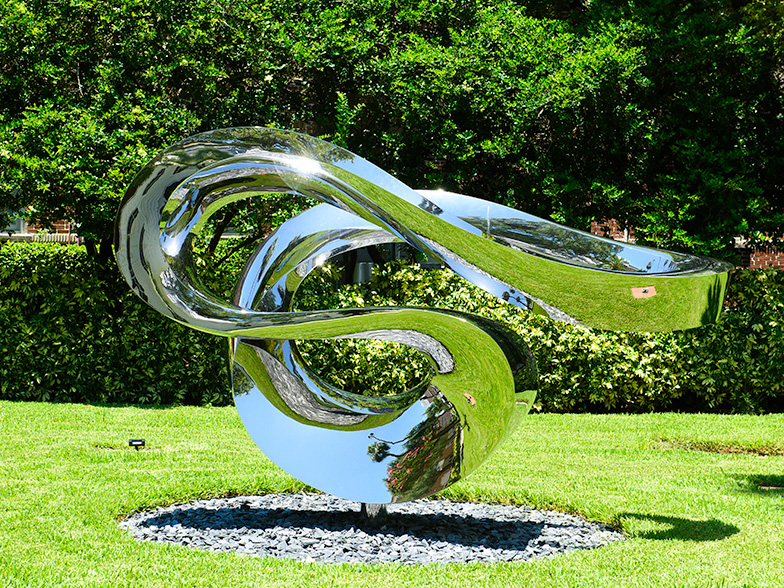
 Nestled by the Old Schoolhouse on campus, Zephyr is a larger-than-life creation that appears to be swirling around in the wind. Like a giant ribbon blowing in the breeze, the work seems to dance or sway to the tune of its own internal logic. Whether reflecting the gathering storm clouds or a stream of students walking to class, its mirrored and flawless surface reflects the ambient surroundings, which are continually in flux. “Zephyr” is named after the Greek god of wind.
As such, it evokes the awesome power of nature and the unstoppable force with which it is governed. Like nature, which is ceaseless, ever-changing and eternal, persistence is a positive attribute that is essential to the growth and development of all human beings. The characteristic of persistence is ultimately very necessary. It can be thought of as calm despite the storm, and the determination for balance when everything else is chaos and disorder. Zephyr reminds us to search for persistence in all aspects of our lives.
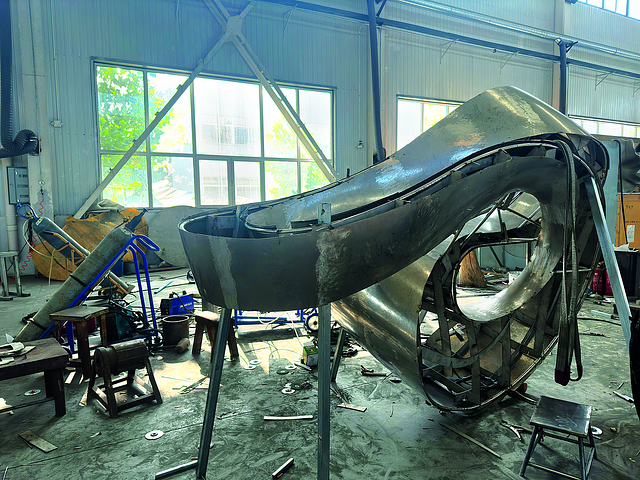
Like the wind itself, the sculpture is an ever-changing, continual presence that obstinately charts its course despite difficulty or opposition. Guided by an unceasing, internal force, Zephyr perfectly encapsulates the guiding principle of persistence. Although the artist has used a heavy, industrial material in Zephyr, the work nevertheless feels light and elegant, defying the medium and overcoming the odds. There is a sense of continual motion, with the forms swirling around in ceaseless activity. The artist was inspired by the naturally occurring patterns found in nature, from the flight patterns of starlings to the rippling surface of desert sand that’s been transformed by the wind. "Nature champions great design,” he has said.
(b. 1966)
Jeremy Guy
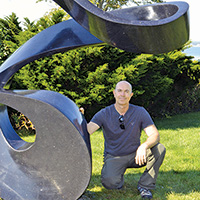 Best known for his abstract sculpture, the contemporary British artist Jeremy Guy continues to refine his own unique visual language, which is influenced by patterns found in nature.
Born in 1966, Guy predominantly creates large-scale abstractions in granite, marble and stainless steel. His childhood was spent in a small town near Yorkshire, in Northern England. This region has long been associated with the mining of coal and other minerals. As a child, Guy remembers being influenced by the sculptures of Henry Moore and Barbara Hepworth. This, coupled with a profound interest in the natural world, is what continues to inform his work.