By Jack Hill
Location: Beach Volleyball Complex
Representing the Positive Human Characteristic:
HUMOR
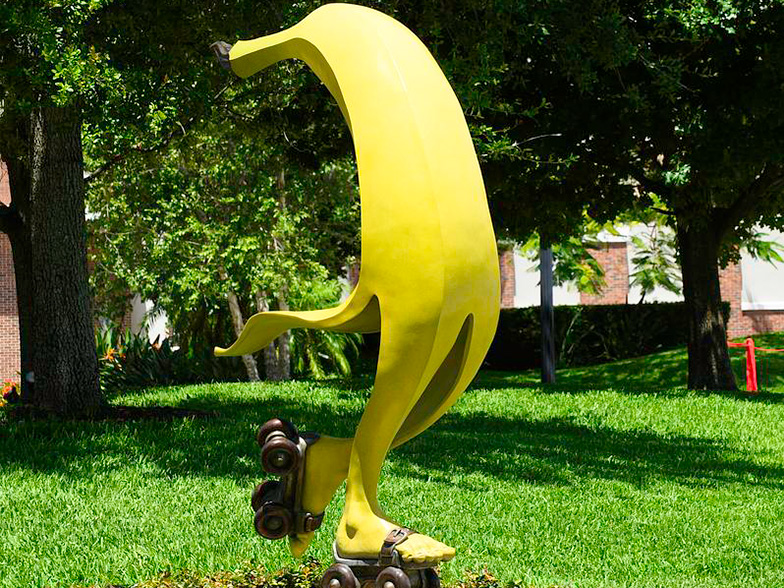
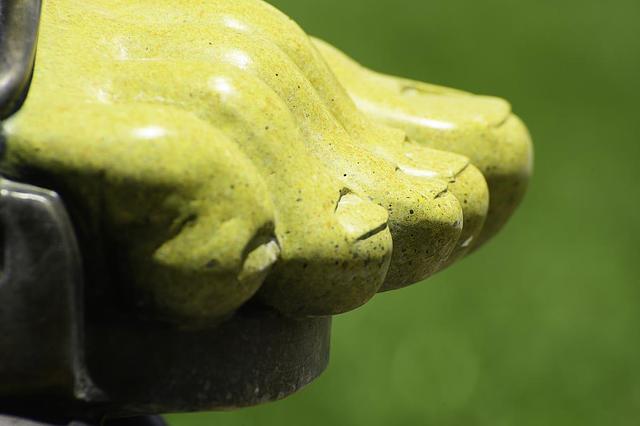 Humorous, whimsical and thought-provoking, Jack Hill’s On a Roll brings to life a seven-foot tall roller-skating banana. Barefooted, wearing a pair of old-fashioned, metal roller skates, the banana is seen mid-roll, with its peel flapping gracefully in the wind. The attention to detail in this remarkably life-like creation adds yet another level of hilarity to its meaning. Carefree and clearly enjoying life, the banana glides effortlessly toward the future.
On a Roll demonstrates the ability to laugh at ourselves, making it an excellent example of the principle of humor in the McNichols Sculpture Trail. If we all take ourselves a little less seriously, the impossible just might be possible.
On a Roll is arguably Hill’s most recognizable sculpture. Created in 2020 during the early years of the COVID-19 pandemic, On a Roll was intended to bring humor and joy to an otherwise dark time. “These ideas are born from observation of the human existence,” Hill said, “in all its splendor and absurdity.”
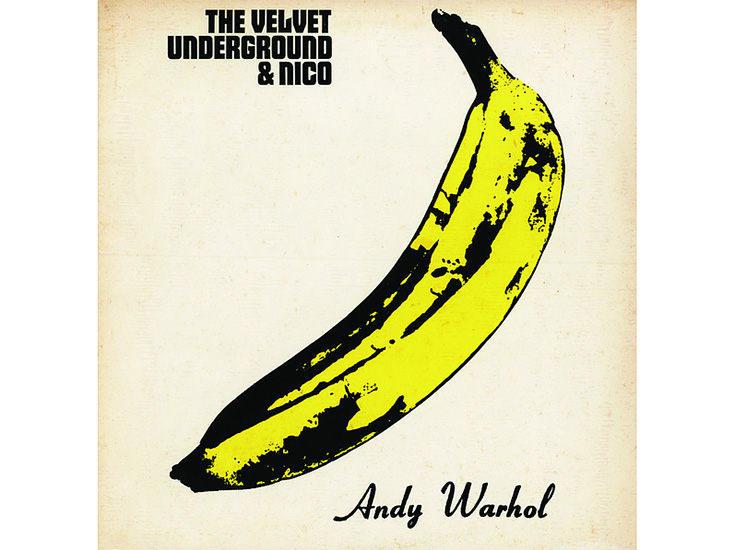
Many of the key concepts in On a Roll are thematically linked to the pop art movement of the 1960s. At that time, artists Andy Warhol and Roy Lichtenstein depicted ordinary objects like Coca-Cola bottles and soup cans, painted in a simple, flat style that mimicked the look of newspaper and magazine ads. Warhol also famously depicted a banana in his work, when he created the album cover for The Velvet Underground & Nico in 1967, which featured a peel-off banana sticker.
The banana has also appeared in Lichtenstein’s paintings and the work of pop artist Claes Oldenburg. More recently, the contemporary artist Maurizio Cattelan created an artwork that solely consisted of a single banana that he duct-taped to a wall. Cattelan understood the power of humor to galvanize audiences. He titled the work simply “Comedian.”
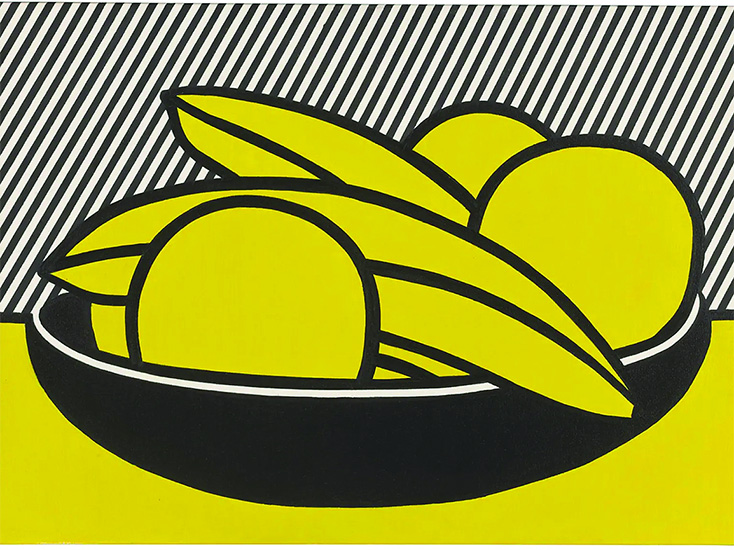
(b. 1946)
Jack Hill
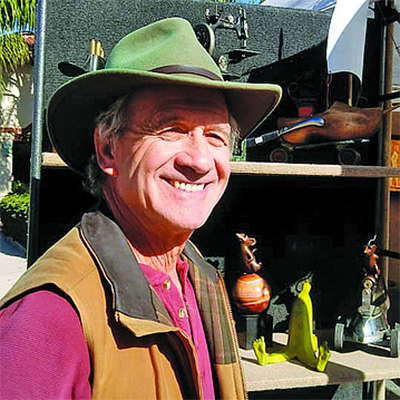 Originally trained as a mime, magician and ventriloquist, the sculptor Jack Hill arrived at art-making after a lengthy career in the entertainment industry. He trained in New York City and Paris, at one time even studying under, and performing with, the famous French artist Marcel Marceau. As a mime, Hill was particularly adept at defining and shaping space. His career spanned twenty-two years and three continents.
At the beginning of his career, Hill worked primarily in wood carving, puppet making and boat building. He later had an epiphany when he visited the studio of Randolph Johnson in the Bahamas. Hill also spent time working in a foundry, where he learned the principles of the “lost wax” process, which he still uses today in creating his bronze sculpture.