By Robert Indiana
Location: Front of Southard Family Building
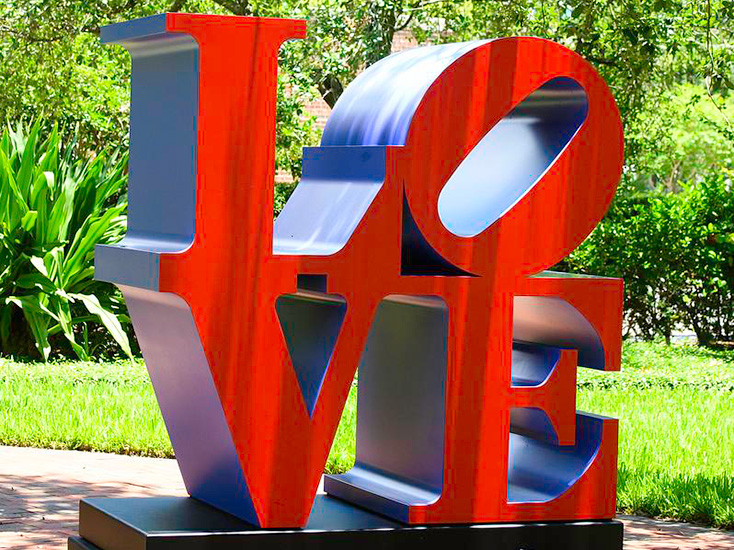
Representing the Positive Human Characteristic:
LOVE
 Universally recognized around the globe, Robert Indiana’s LOVE continues to be an iconic pop art emblem Depicting the four letters “L-O-V-E”in giant, life-sized proportions, LOVE takes the abstract concept of “love” and transforms it into three-dimensional sculpture. Robert Indiana created his first LOVE sculpture in 1966, in the middle of the Vietnam War. It soon became a symbol for peace and unity. “My goal is that LOVE should cover the world,” Indiana said. In the McNichols Sculpture Trail, there is no better signifier of the powerful concept of love than the present work.
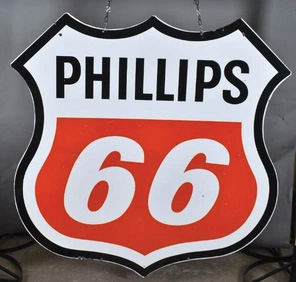 Now considered to be a quintessential pop art icon, LOVE was several years in the making for the artist Robert Indiana. He was a slightly unconventional pop artist, having filled his paintings with much more biographical and symbolic content than his colleagues, Andy Warhol and Roy Lichtenstein. Indiana grew up as a Christian Scientist, and he remembered seeing the “God is Love” signage at church. Colors and words held particularly profound symbolism for him. Red was a color from his childhood in Indiana, from the large red Phillips 66 sign at the gas station where his father worked. He also associated purple with the “autumn” of life, which is interesting considering he was 71 when he created the present LOVE in its current red and violet iteration.
Robert Indiana’s LOVE can be understood as an essential pop art emblem. Indiana lifted the word “love” from its source in poetry, books, magazines and greeting cards. He essentially took it out of context and enlarged it to life-sized proportions. The word “love” is then freed up to speak symbolically to the viewer, allowing them to complete its meaning based on their own personal understanding of the word.
(1928-2018)
Robert Indiana
Robert Indiana was a famous American pop artist. He became known for his paintings and sculptures that were painted in bright colors using a flat, sign-painters aesthetic. He painted words like EAT, DIE, HUG and LOVE in vivid colors. For Indiana, each word was imbued with personal symbolism. He often repeated a single word across different media. LOVE is undoubtedly the most recognizable, having first appeared in sculptural form in 1966. It is a universally recognized symbol that continues to inspire into the years after it was first created.
Robert Indiana was born Robert Clark in New Castle, Indiana in 1928. In 1954, he moved to New York in the hopes of becoming an artist. Around that time, he changed his name to Robert Indiana. Shortly thereafter, he met an artist, Ellsworth Kelly, who would change the course of his career forever, and who became one of his closest influences. It was Kelly who suggested that Indiana move to an area in Lower Manhattan called Coenties Slip.
 Coenties Slip was a popular neighborhood with artists because it was largely abandoned. Indiana took a studio at 25 Coenties Slip. Ellsworth Kelly, Agnes Martin and James Rosenquist all lived nearby. It was here that the word “LOVE” first appeared in Indiana’s work, dating to a poem he wrote in 1958 where the letters were stacked in the familiar 4 x 4 arrangement.
Indiana discovered his iconic pop art style in the early 1960s. One of his earliest works was The American Dream I (1961; Museum of Modern Art, New York), which consisted of symbols, stars, letters and numbers all stencilled onto the canvas in bright, simple colors. It was acquired by MoMA shortly after being painted. Indiana quickly rose to fame as one of the leading pop artists of his generation. He would continue to work in this style – painting in flat colors with stencils and sign-painters techniques – until his death in 2018. Many of his pop art paintings are now understood as anti-war statements, like Yield/Brother as well as LOVE, and the later Peace paintings.