Written by Holly Neumann | Photos by Jessica Leigh | Published on June 8, 2026
Course Unmasks the Mysteries of Stage Makeup
Behind the curtain, on the far side of the stage, around some discarded pieces of sets and up some narrow, metal stairs, there’s a cramped dressing room in Falk Theatre. Inside is where a half-dozen or so musical theatre majors and minors met once a week last semester to transform themselves into supernatural creatures, old people and animals, and create illusions of scars and bullet holes on their bodies (good for Gasparilla), all as part of a course about stage makeup.
“When I was registering, a friend asked me if I was taking this class,” said junior Liv Mollica. “I was, like, ‘Now I am!’
“I’ve always loved doing makeup designs for theater and for special effects. I would do it at my house with, like, toilet paper and water and a dream,” she continued. “But this class has really taught me how special-effects makeup works.”
The “special topics” theatre course was taught by Rosemary Orlando, an adjunct at UTampa with a long performance and backstage résumé. She’s an equity actress who has directed large-scale productions, and she’s been teaching the stage makeup course at UTampa, off-and-on, for 20 years.
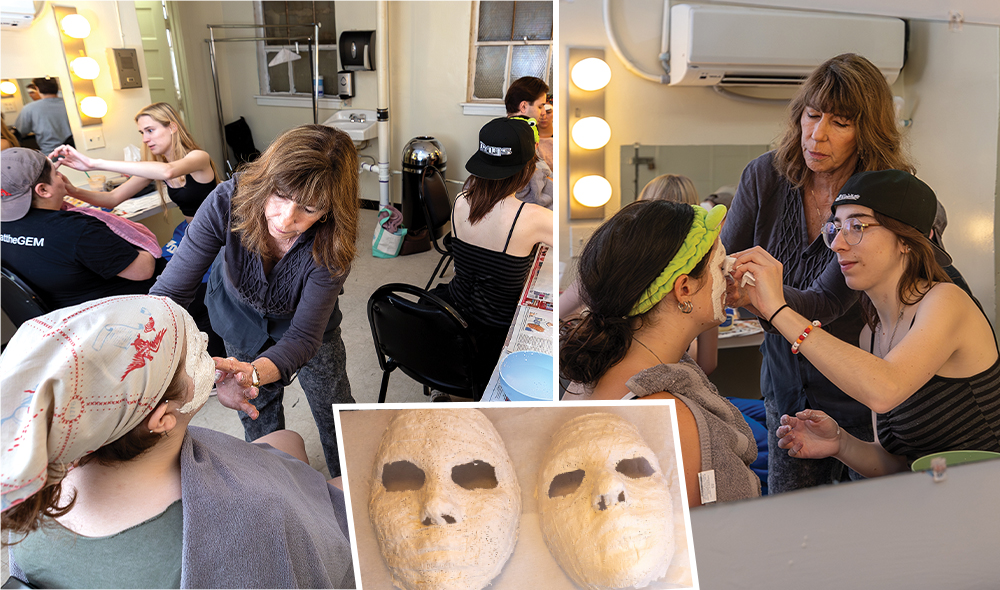
She says that many actors do their own makeup, so the skills learned in the class are crucial to the students’ future careers. During one meeting last semester, the students learned how to make a plaster face mask that, in practical use, could be the mold for a custom-fit costume piece — or serve as the base for designing perfect-fit prosthetic fairy ears, character-defining noses or other features.
That day, Mollica served as Orlando’s model, sitting stone-cold still as Orlando demonstrated the mask-making techniques, which students then practiced with partners.
They slathered on Vaseline to start, removing nose rings and other piercings and slicking up all the creases and crannies to keep them from being stuck and pulled later, when the mask-cast would be removed. Hair was held back in hats and bands, and as for eyebrows — “I don’t want to lose any eyebrows” — Orlando advised a good layer of grease.
Then, they went to work, soaking plaster strips that Orlando had cut the night before and pressing them to their partners’ faces in crisscross patterns.
“It’s giving spa,” one student said. Said another: “This looks like a horror film.”
“Keep the chatter down,” Orlando warned, as movement would threaten the integrity of the hardening masks. But the jokes kept coming, and she admitted, “These are theatre students. They can’t help themselves.”
Within 15 minutes, the students’ skin started to feel warm, the signal that the mask was ready. “It feels like it’s cooking,” a student said, risking her mask’s structure and her partner’s handiwork.
Orlando was there to provide some relief.
“Kiss the mask,” she told them. The push from the smooch released the plaster molds from their faces, and students admired each other’s results. Before long, plans for the next class were announced.
Bring your makeup kits, students were told. “We’re doing mythical creatures, and, no, you’re not going to look pretty.”
More UTampa News