Written by Madeline McMahon M.A. '24 | Illustrations by Frank Stockton | Published on June 8, 2026
A Firm Belief in the Future
UTampa’s moot court team, which receives donor support from renowned trial attorney Steve Yerrid, has had two of its best years back-to-back
“Chief Justice, your honors, and may it please the court,” Marcus O’Malley ’26 addressed the judges at moot court practice last fall.
“In this case,” he continued, “a student was discriminated against for one reason: his gender. The school, to address gender imbalance, implemented a quota of achieving a 75-25% male/female student body. Mr. Denolf was denied. He was academically well qualified —”
“Let me stop you,” interjected the judge, played by Joseph Jerome, a “recovering lawyer” and former visiting assistant professor of communication.
“You mentioned that he was subjected to a quota. Doesn’t look like there was a quota in place here. In fact, you mentioned the 75 to 25 numbers. That’s not at all close to what the admissions at the university actually looks like.”
“Is this actually a quota?” Colin Anderson, assistant professor of history and law, piled on.
“Yes, your honor, this is a quota.” O’Malley insisted, completely unfazed by the hostile interruptions.
O’Malley’s poise and preparation are likely part of why UTampa’s moot court team, led by Anderson, has recently had two standout years. The team finished in the top 25 out of more than 100 teams in the national rankings of the 2024-2025 school year, then sent two students to the national competition this past semester.
Moot court is offered as a course to students studying law, justice and advocacy, most of whom are using it as practice for real-life cases in their future careers. The course meets every week during the fall semester and has been getting increased interest, leading the group to split into two sections.
LEARNING FROM THE BEST
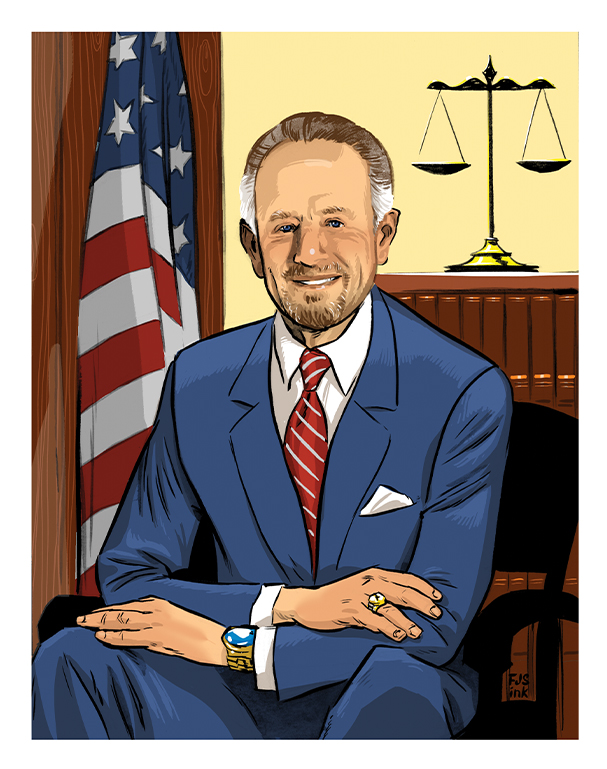
For the last few years, UTampa’s moot court team has received support from Steve Yerrid, one of the most prominent lawyers in Tampa and Florida. Yerrid has been involved in dozens of high-profile cases and has won more than 350 settlements worth over $1 million.
The first time Yerrid made international headlines was in the 1980s when he defended Captain John Lerro in the Sunshine Skyway Bridge disaster, one of the world’s largest maritime tragedies. Lerro received full exoneration after piloting a large freight ship that lost control during a storm and crashed into the bridge, resulting in 35 deaths.
Yerrid was the youngest appointee to a “dream team” of lawyers to lead Florida’s historic lawsuit against the cigarette industry. The case resulted in the biggest monetary settlement U.S. history at the time, ultimately topping $17 billion. In addition, he and his fellow lawyers permanently prevented tobacco advertisements targeted to children, eliminating billboards, vending machines and mascots like Joe Camel and the Marlboro Man, and established youth tobacco prevention programs across the United States.
Yerrid has a reputation for fighting for the underdog. Through all the years of triumphing in “unwinnable” cases for pediatric cancer patients and their families, domestic violence survivors, medical negligence victims and more, his greatest joy comes from helping others. In addition to the University, he has supported hundreds of other causes through The Yerrid Foundation, such as endangered rhinos in South Africa and refugee children in Lebanon.
Two of the biggest lessons he’s learned in both his personal and professional life are that 1) giving is better than getting and 2) “You don’t take anything with you when you leave this life,” he said. He ties that into why he chose to support the moot court team, as he’s hopeful that today’s students will also help change the world for the better.
“In my world, hope is everything,” he said.
THE LAWYER-HOPEFULS OF TODAY
Many in this year’s cohort are there due to Anderson’s encouragement.
Tahmina Emu ’26, an international studies major, and Sofia Marrero ’26, a psychology major, were both hesitant at first to take the moot court course. But both had requirements for their minor in law, justice and advocacy, and when they were tapped by Anderson, they decided to take the stand.
“Knowing that he had confidence in my abilities pushed me to step outside of my comfort zone,” said Emu.
Anderson has been teaching moot court for four years, ever since UTampa restarted the team in 2022 after the pandemic. He said that when it comes to coaching and mentorship, his view is that moot court should be a competitive, but enjoyable, experience for the students.
“As the coach, I try and put the students in the best position to win the tournaments, but I’m more concerned with making sure each student is learning the fundamentals of the constitutional issue we’re dealing with, and how to think like a lawyer,” said Anderson. “It’s always exciting to see them come up with really interesting and unexpected arguments, and I’m constantly impressed with the work they put in and their ability to see the fact pattern in new and different ways.”
Both Emu and Marrero plan on attending law school and agree that moot court has given them a major advantage during the application process. Emu said that she had never spoken in a formal courtroom-style setting before, where she had to maintain a composed demeanor even when being questioned under pressure, just like in practice when Anderson and rotating guest judges will aggressively interrupt, as an opposing attorney would do in a real case.
Marrero attended the Empire State Regional tournament in Albany, New York in November, where she competed against the top moot court programs in the country.
“(I) learned so much from our opponents,” she said. “It was surreal to be arguing in an actual law school in front of real judges, law professors and practicing attorneys.”
Madison Rodriguez ’26 competed on a team with Brett Lance ’26 at another regional tournament in the fall at University of Central Florida, where they advanced to the elimination round as the No. 1 seed.
Before Rodriguez joined moot court, she considered public speaking one of her biggest fears. But when Anderson recommended it to her after she took his legal research and writing course, she knew she had to face that fear if she truly wanted to fulfill her litigious career aspirations.
“I went from barely being able to say a few sentences before my voice would start to shake, to actually earning a top speaker award at the regional tournament,” said Rodriguez. “I’m extremely grateful to Dr. Anderson for encouraging me and believing that I could do it.”
Rodriguez and Lance then advanced to the national tournament, which was held at Liberty University in Virginia in January. She said that it was intimidating yet exciting, and that even though they didn’t place, they still appreciated the opportunity to compete at that level.
“Plus,” she added, “we got to see the exact remake of the Supreme Court of the United States at Liberty. I was totally nerding out.”
THE VERDICT IS IN
Yerrid has visited the real U.S. Supreme Court many times and has even appeared before it once. As much as he believes in the students at UTampa, he believes in the four words carved in stone on the Supreme Court building: equal justice under law.
“That’s why I like the program at UT, because it’s funneling into a system which, taken on its best day, is remarkable,” he said. “It is like a bright star in an otherwise dark universe.”
Rodriguez is familiar with Yerrid’s cases and is amazed at how many individuals and families have earned justice with him on their side. She added that her experience in the moot court program would not have been the same without him, as his support allowed her and the team to travel to the tournaments and expand their professional network and skills.
“I don’t know if one of those future lawyers is going to change the world, but maybe there’s a ripple there that will turn into a tsunami,” said Yerrid. “I like my chances of a great school producing great talent.”
More UTampa News