Written by Pat Yasinskas | Illustrations by Sarah Krolik '20, M.A. '23 | Published on June 8, 2026
The 'Non-Varsity'
Club Sports athletes up their game, and everybody wins
John Rempe came to UTampa to focus on academics and escape the grind of playing high-level hockey. Olivia Sheridan ’26 arrived on campus and quickly reimagined her dream of swimming at the National Collegiate Athletic Association Div. II level.
But Rempe and Sheridan weren’t ready to walk away from their sports. Each found the perfect solution in UTampa’s club sports program. In many ways, their stories are representative of many of the more than 900 students who compete in the 20 different club sports that fall somewhere in between the NCAA level and intramurals.
“In intramurals, it’s all students, faculty and staff from within the University that compete only against one another,” director of campus recreation Chris Gottlick said. “In club sports, they compete against students from other schools. Club sports are more organized and comprehensive, but they don’t have the demands and time commitments that NCAA sports do.”
“It’s a pretty high level of competition,” said Jack Walsh ’19, who coaches one of the University’s two men’s ice hockey club teams. “We prefer to call them non-varsity sports.”
Whatever moniker you choose, the club sports program works quite nicely for the students involved, and the all-around benefits of the experience extend well beyond the pool, pitch or rink.
Take the case of Rempe, a senior data science major from Frederick, Maryland. A good high school and travel ice hockey player, Rempe spent his high school senior year living in New Hampshire and playing in an 18-and-under juniors Triple A league while finishing high school online.
“That was a grind,” Rempe said. “I was at the rink all day almost every day, and we played a lot of games at night.”
That season was enough to convince Rempe that he didn’t want to continue his career at the NCAA level. He chose to come to UTampa because of its campus, strong academics and the warm weather. That the school had club hockey was a bonus.
“It’s given me a chance to keep playing,” said Rempe, who serves as president of men’s ice hockey. “But I don’t have to spend all my time on hockey. We practice once or twice a week, and we only play about 25 or 30 games a year. That’s enough for me.”
That formula also worked well for Sheridan, president of the club swimming team for the past two seasons. She said she came to UTampa “on the cusp” of making the Spartans’ NCAA team.
“That didn’t quite work out,” said Sheridan, who majored in communication and minored in sport management. “I said, ‘OK, I'm going to swim for the club team, and I’m going to make it memorable.’”
Sheridan did exactly that. In her first year, she won national club titles in two events. She spent the last two summers training with UTampa’s NCAA women's swimming team.
“I’ve proven to myself that I can do it at that level,” Sheridan said. “That’s good enough for me. I love swimming, and at the club level, I can do it in a stress-free environment.”
MORE THAN THE GAMES
In addition to the men’s ice hockey teams and men’s and women’s swimming, UTampa also has clubs for women’s ice hockey, baseball, men’s basketball, equestrian, field hockey, men’s and women’s flag football, golf, men’s and women’s lacrosse, roller hockey, men’s and women’s soccer, spikeball (roughly a combination of volleyball and four square), tennis, track, and men’s and women’s volleyball.
But club sports are about much more than competing.
Unlike NCAA sports, club sports operate independently of the Athletic Department and don’t have full-time coaches. Each club is a member of some form of national governing body for its sport. The clubs are student-run with guidance from the Office of Campus Recreation. The hockey and equestrian clubs have paid coaches, and some clubs have volunteer coaches.
“Most of the coaches went to school here and want to give something back and stay involved,” said Joshua Pullens, assistant director of campus recreation. “The clubs don’t have to reach out too far to find coaches. Most of them come to us as volunteers.”
Walsh, who works as a recruiting manager at Pepin Distributing, is in his sixth season of coaching. “I played club hockey here for four years, and I loved every minute of it,” he said. “It was a wonderful experience, and coming back to it as a coach keeps me part of it.” Some clubs, though, rely on members to handle the coaching duties, adding a level of responsibility to those students. That’s the case in men’s volleyball, where club president Tanner Garner and the club’s three other officers act as coaches.
“We have to decide who makes the team and who gets to play,” said Garner, a junior psychology major. “We run the practices, and that’s a lot of fun. I really enjoy interacting with the players, and I want them to feel like they can come to me with any problems. I’m kind of in the middle between being a player and being a coach, and it has worked out very well.”
Structure varies greatly from club to club. In hockey and equestrian, the paid coaches handle many of the administrative duties. But, in other sports, club presidents and officers take care of things like scheduling for games and practices, travel, equipment and uniforms.
The common thread is that each club is responsible for its own finances, and Garner, Sheridan and Rempe said that is, by far, the most challenging part of their jobs. Each club receives a financial allotment from the University, but that doesn’t cover all the expenses.
In a sport like hockey, the cost for ice time (the teams practice and play home games at the Clearwater Ice Arena), travel for away games and national tournaments, uniforms and equipment is steep. In sports like volleyball, the overhead is much less. Membership dues, which vary from club to club, cover a substantial amount of expenses for all the clubs.
“This year we took the step of having everyone pay dues for the first time," said Sheridan last semester. “We have a competitive team, and we have the practice squad. The swimmers on the practice squad don’t have to pay as much in dues. That wouldn’t be fair because the expenses for them aren’t as high.”
Sheridan said that formula has worked, and the dues have brought an unexpected benefit to her club: “I think everyone takes it more seriously now.”
Some clubs still face financial challenges in balancing their budgets. That’s led to creativity, with most clubs also holding fundraisers throughout the year. Some clubs also receive donations from alumni, parents, boosters and local businesses.
The volleyball club earns money by breaking down the court after UTampa’s NCAA volleyball team plays home games.
WE’RE NO. 1
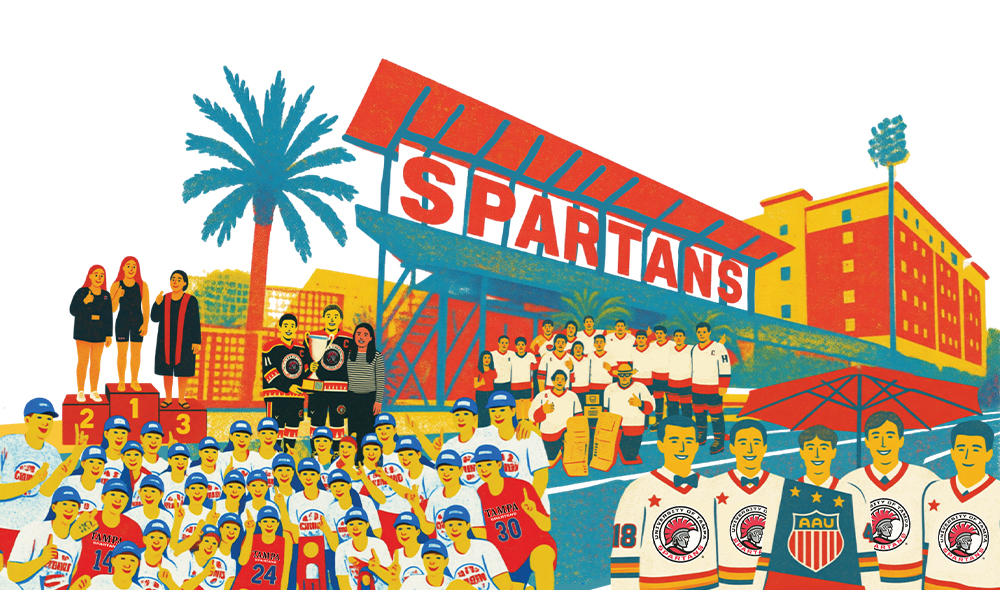
Even with the extras to learn and manage, club sport athletes and teams are thriving. The women’s ice hockey team won the national championship in the AAU College Hockey Tournament in Jacksonville in March and also won the championship of the College Hockey South Conference, placing six players on the all-conference team. Last year, one of the men’s teams won its first-ever national title in the 2025 AAU College Hockey Tournament, and that led to a move up to the more competitive American Collegiate Hockey Association in 2026.
“I think a lot of our players could compete at the NCAA Division II or Division III level,” Walsh said. “Most of them chose to come here and focus on academics, but they’re still getting to play hockey at a pretty high level.”
But it’s not just the ice hockey clubs. The roller hockey team was ranked No. 1 in the nation for much of the 2026 season. The men’s and women’s club lacrosse teams have been nationally ranked, and 13 club swimmers qualified for their national meet.
The University wins with club sports, too. Students who participate in club sports stick around — 87% of first-year students who play a club sport come back to UTampa as sophomores. That’s higher than the University’s overall first-to-second-year retention rate of 85%. Plus, a majority of club members stay with their sports for all four years.
With that type of return, the University has made an intentional investment in the program.
“We’ve had club sports here for a long time,” Gottlick said. “But, in 2010, we probably only had about six clubs. Since about 2017, the program has grown exponentially. We put in a new staffing structure, and we’ve added a lot more resources.
“When high school students are looking at colleges, they see Tampa and all the club sports we offer and realize they can go to a school with great academics and still be involved in their sports at a competitive level they’re comfortable with.”
Sometimes, without really trying, the club members help bring widespread attention to UTampa, like when the national champion women’s hockey team and its big win were recognized on the Jumbotron at a recent Tampa Bay Lightning game.
Rempe has experienced this firsthand.
“When I go home and wear my Spartans hockey stuff, or even when I wear it around Tampa, people are surprised to hear that there’s college hockey in Florida, and that brings a lot of attention to the school,” he said.
“Who wouldn’t want to come to a great school in a place with great weather and still be able to play hockey?”
More UTampa News