Written by Madeline McMahon M.A. '24 | Illustration by Dan Williams | Published on June 8, 2026
A Mambí and a Spartan, Connected a Century Later
Uncovered family history led longtime staff member Edesa Scarborough to create an annual gift for outstanding ROTC cadets
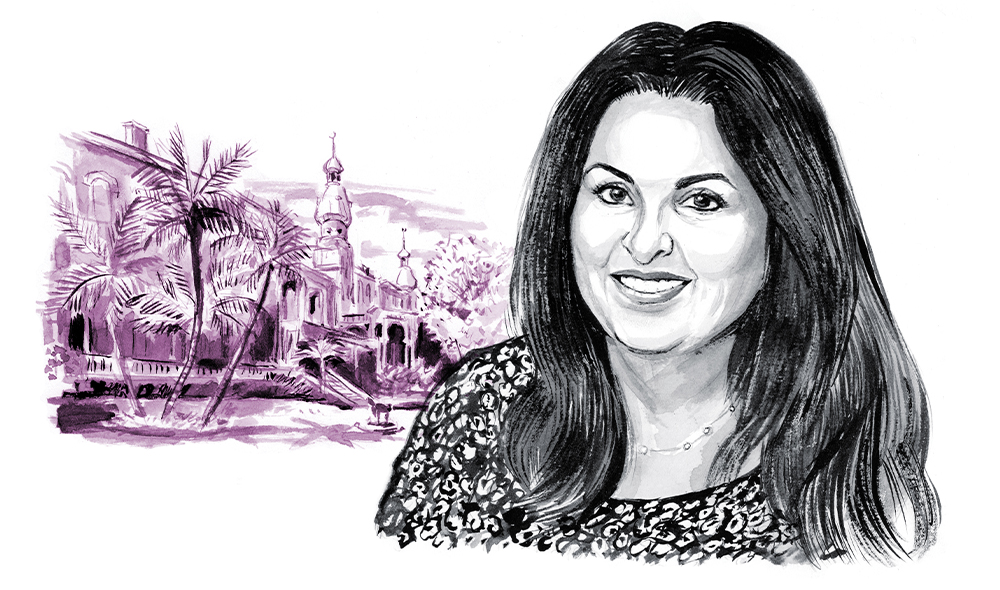
When Edesa Scarborough was going through inherited documents after her father passed away, she discovered new information that brought her closer to the grandfather who died before she was born.
Scarborough, senior director of first-year studies, already knew that her grandfather Gen. Baldomero Acosta was a Cuban rebel mambí, or scout, during the Spanish-American War. Mambises helped American soldiers navigate Cuba when they arrived to intervene in the Cuban War for Independence. What she didn’t know before was that her grandfather came to the Tampa Bay Hotel in 1898 to accompany Teddy Roosevelt’s Rough Riders shortly before they deployed to Cuba.
Ninety-nine years later, Scarborough started working in Plant Hall as the director of admissions. Though her roles and room numbers changed through the years, her office has always been in the same building that her grandfather once roamed.
“When I first found out, I kind of got teary eyed,” said Scarborough. She wondered, Did my grandfather want me to be here?
Scarborough’s father died in 2016, and she was left with stacks of photos and written records of her family’s military history. She enlisted the help of Col. John Farnham '80, who was a retired professor of military history at UTampa and knew of a book, In Darkest Cuba, about the Rough Riders’ experiences traveling to and fighting in Cuba.
The book mentions Baldomero Acosta by name and describes him as he was sitting on the verandah of the Tampa Bay Hotel. Gonzales wrote, “Acosta, in a suit of store clothes and a Panama hat pulled down over his eyes, is the most unmilitary of men in appearance, but he is a famous guerrilla and knows every trail in Western Cuba.”
After the war ended, Acosta was hailed as a hero of Cuban freedom. When his youngest son and Scarborough’s father, Carlos, was old enough, he was inspired to pursue a military career of his own in the U.S. Army. Carlos Acosta received American citizenship after his service, and he was exiled from Cuba when the revolution started. He moved to Miami with his wife, where Scarborough was born and raised.
When Scarborough was left with some inheritance money after her father’s passing, she wanted to honor her family history with a donation to UTampa’s ROTC program. She noticed that most of the annual ROTC awards go to graduating seniors, so as the director of first-year studies, she wanted to do something for a first-year cadet. She found an opportunity in an introductory military history course.
Students in that class write a paper every year on the Spanish-American War and how it connects to UTampa. The instructor now shares the top papers with Scarborough, who then chooses which student will receive a gift and award in her father’s name at the ROTC awards ceremony every April.
This year’s recipient was Parker Mitchell ’29, a biology major. He said he was fascinated by the different, yet equally effective leadership styles between Roosevelt and the mambises and, in his paper, connected their strategies to modern leaders of today.
“Since this is my first year, it was an honor to be recognized,” he said. “It makes me even more motivated to continue growing within the program.”
The timing of the first award Scarborough gave coincided with the construction of the Schoomaker ROTC and Athletics Building, so once Scarborough had set aside enough for the cadet awards, she donated the rest to the building.
“Few people know that my name is on the building,” said Scarborough. “I did that to honor my grandfather’s legacy and our mutual connection to Tampa and the University.” Scarborough ended up donating most of her father’s documents to the Cuban Heritage Collection at University of Miami, the largest repository of materials on Cuba outside of the island. But there’s one item she kept hanging on the wall of her Plant Hall office — a framed newspaper article from the ’40s that detailed Baldomero Acosta’s role in Cuba’s fight for independence.
“It doesn’t make sense with anything else in my office,” she observed. But that doesn’t matter to her. The important thing: “He’s back here.”
More UTampa News