Written by Holly Neumann | Photos by Jessica Leigh | Published on Feb. 23, 2026
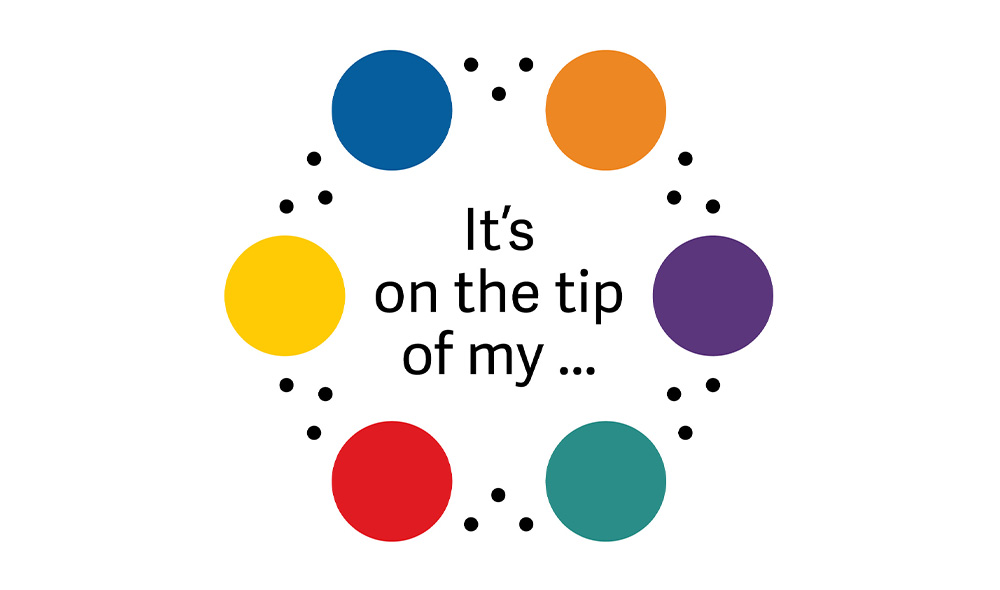
It's On the Tip of My ...
Can’t remember the new person’s name? Retaining fresh information may come down to how high it ranks
Sara Festini wants you to remember your password.
And, if after being prompted to change it, you later try to log in with an outdated password, and — for the life of you! — you cannot remember the new one, Festini, associate professor of psychology, wants to know why.
That’s the gist of Festini’s current research question into prioritization within working memory — or it’s at least a relatable way to remember what it’s about.
Working memory is the front-of-mind, day-to-day information people use to make decisions, from updating a password to remembering a new person’s name. Festini’s research is sponsored by a three-year, $277,536 grant from the U.S. National Science Foundation to investigate interference and incentivization in working memory, to understand how people can remember better what is most important to them in the here-and-now.
For example, imagine being introduced to six people at your company’s holiday party, and one of them is the darling daughter of the CEO, but the others you might never see again. How will you remember the daughter’s name when you bump into her at the punchbowl later? Will you accidentally call her by one of the others’ names? Or did you think to yourself, Just smile and nod … no need to remember these people … and deliberately forget the others’ names from the get-go?
“I wanted to find out with this NSF grant how people naturally prioritize information,” Festini said. “If we tell them that certain information is more or less important, what types of differences or what types of factors influence if somebody is going to actually remove the information from working memory?”
In the lab, Festini and undergraduate student researchers test and study participants’ working memory using words with point values attached. People tend to be faster and more accurate at recalling words with higher point values. Conversely, if a word is assigned a negative point value, it is more likely “thrown out” of peoples’ minds, and therefore it is less likely to clutter working memory — making the other high-value words easier to remember.
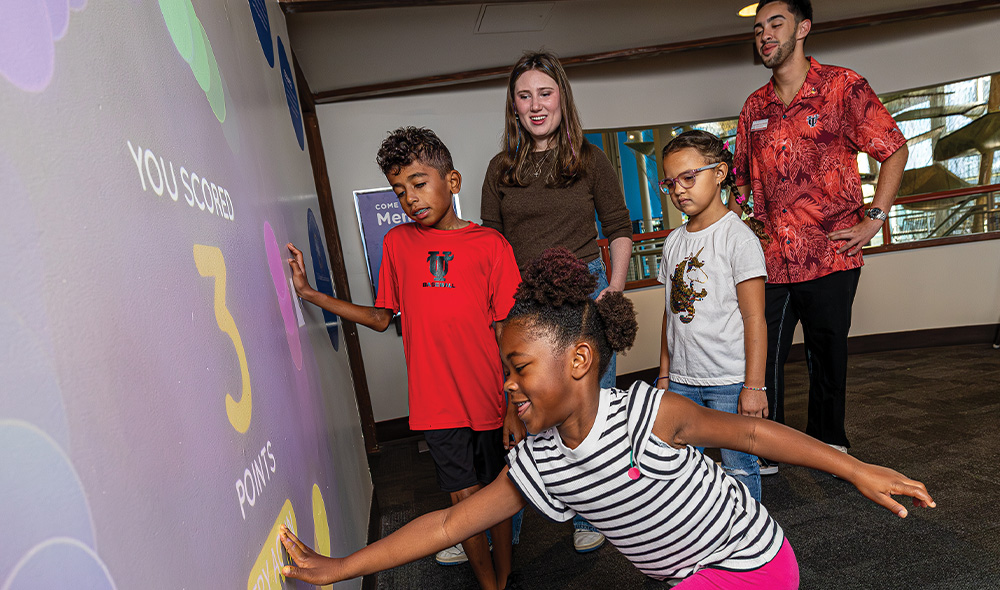
UTampa’s memory research project includes an exhibit and community education component at the Glazer Children’s Museum.
Interestingly, Festini has found that low- or no-value words tend to be retained, too, suggesting that “people aren’t as aware that to have optimal performance, it’s actually beneficial to remove the low value or less important information,” Festini said.
Like an obsolete password or the names of five interlopers at the company party.
Festini’s project also includes NSF funds for a community partnership with Glazer Children’s Museum, across the river from campus. Psychology students are employed through the grant as museum assistants, interacting with children and their caregivers to teach concepts like memory and executive function through an exhibit based on the colored-button, beeping, batteries-not-included Simon memory game. (Reach into your long-term memory for this one.)
The object is to remember the order the colored lights appear as they are projected on a wall. Players tap the wall to repeat back the patterns. Each successful repetition results in a longer, more challenging next sequence that builds upon the last. Red. Red-Green. Red-Green-Blue. Red-Green-Blue-Green. And so on.
“To play this game, you have to remember the order of the lights in your working memory, and you’re using executive functioning to strategically plan and sequence the order of your behaviors,” Festini explained. “Those are similar executive skills that we’re using when we’re prioritizing information in working memory.”
The exhibit exposes children to psychological science at an early age. What’s a good score? It depends.
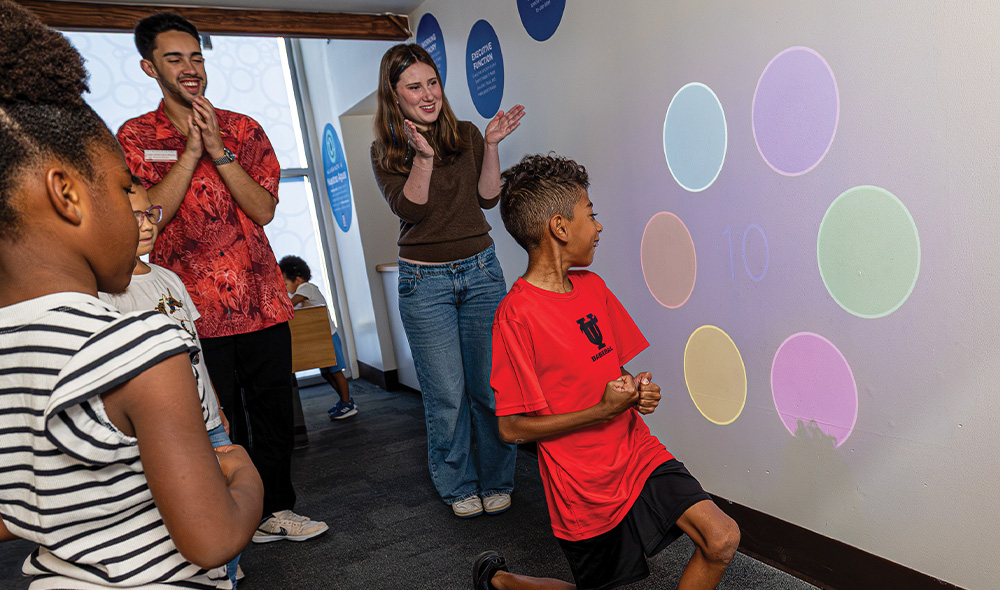
Older children tend to remember better the sequences of the Simon-like game at the museum exhibit.
Maggie Hayes ’26, a psychology major and museum assistant, explained that older children, like 7- or 8-year-olds, and adults tend to do better, which makes sense, given psychological development.
“Little kids don’t have well-developed executive functioning,” she said. “They can’t grasp the concept of having to wait or having to do it in order. So even if you kind of tell them, ‘Wait, wait,’ they don’t. Even if you explain that they need to do it in order, they’ll just press whichever one flashed most recently.”
Psychology major Juan Diego Cela Rivera ’27, also a museum assistant, notices the same, with some older children’s sequences reaching double-digits. Occasionally, a preschooler will surprise him, though.
“Sometimes, you might see a 3-year-old, and they do better than a 7-year-old,” he said. “That’s impressive. I tell them, ‘You're almost gonna break my record.’ And, I mean, I’m 20 years old!”
His record? 17.
Seventeen?
“It’s the highest score I’ve seen,”
he said.
His secret, he says, is “super focus” and tapping fast — and not letting his fellow museum assistant distract him with talking or telling jokes, strategies Festini calls “heightened attention” and “inhibition of distractors,” types of executive functioning skills.
In the future, applied research from the current project could investigate how to develop better study strategies for students or initiate interventions for individuals who have difficulty with focusing, like people with attention deficit hyperactivity disorder. Those with post-traumatic stress disorder might benefit, as well, Festini said, by learning ways to remove information from their minds.
But right now, determining the basic science and understanding of how working memory works is the priority. That, and community education.
“The broader impacts of the NSF grant are to share our knowledge and expertise about this field and have (families) get excited about the mind,” Festini said.
Hayes said she’s seeing this firsthand.
“I like when the parents play the game themselves. I like when the parents ask about the concepts, and I get to talk about psychology with them. They ask about what we’re doing, and they’re interested in the University. It’s part of the community.”
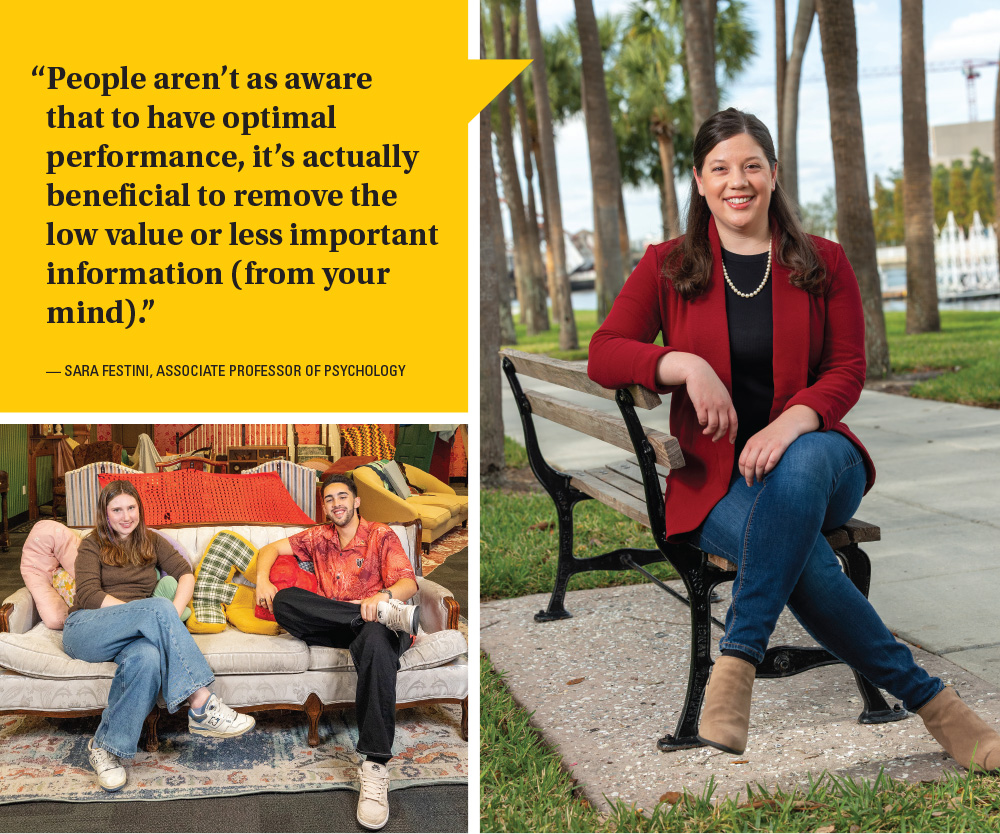
Maggie Hayes ’26 and Juan Diego Cela Rivera ’27 (left), Sara Festini, associate professor of psychology (right)
More UTampa News