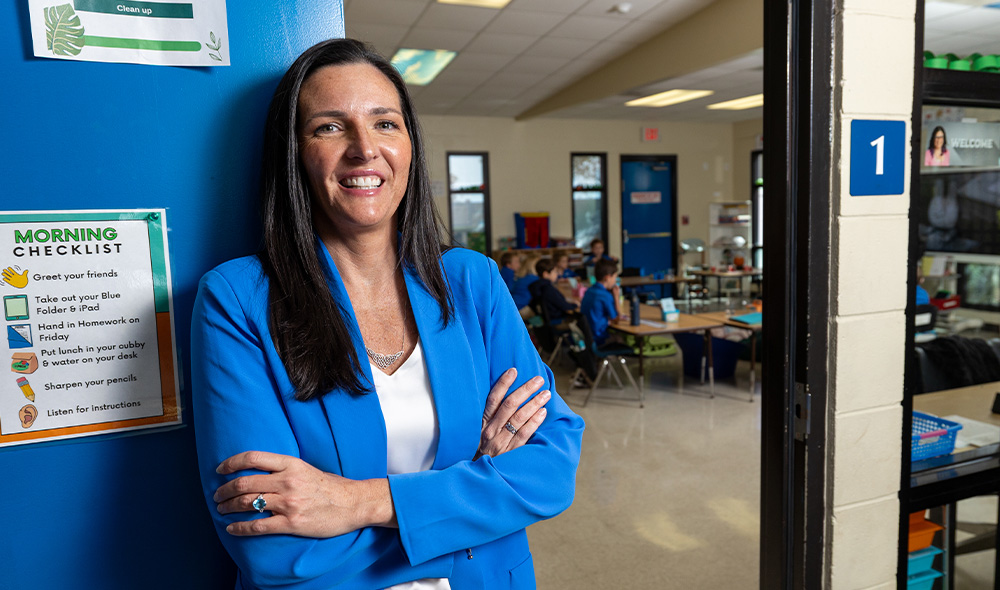
Written by Brian Hudgins | Photo by Jessica Leigh | Published on Feb. 23, 2026
School Head Learns, Leads from the Inside
SPARTAN SPOTLIGHT: Annmarie McEwan ’06
A few years before Annmarie McEwan became executive director and head of school at The dePaul School for Dyslexia, she learned a lot sitting in the driver’s seat.
The driver’s seat was not a lofty staff position. She lived about an hour away from the Clearwater school when her son, James, was a student there. So rather than making two roundtrips a day, McEwan would wait in her car. She had worked at Citibank prior to James receiving a dyslexia diagnosis, and she soon found herself applying her professional experience.
“I would do (the school’s) bank reports while I was waiting for my son,” McEwan said. “Then they needed a secretary. That was how I became involved at a junior level.”
Then COVID hit. The students did not work well remotely. McEwan jumped into the effort to secure a second building to help keep learning on schedule. Since August 2021, she has been head of school.
The challenges before her appointment served a purpose. McEwan had forged relationships with fellow parents and students. They had her cell number. She was able to incorporate their feedback and feelings into administrative plans because “I was one of the parents before I was head of school and making decisions,” she said.
The school recently started a kindergarten program — the first in the school’s 43 years. “It’s almost impossible to be diagnosed with dyslexia in kindergarten because you haven’t been exposed to education,” McEwan said. “But you still may have red flags or a (family) history of dyslexia.”
The school typically has about 100 students a year from kindergarten to eighth grade. Once strictly brick and mortar, it is branching out into the St. Petersburg, Tampa and Clearwater communities to assist students who can’t afford to come to the school, can’t travel to the school or have other barriers to entry.
The Orton-Gillingham method links letters to sounds by touch, sight and movement. The dePaul School utilizes those mechanics, and “right now, UTampa education students are at dePaul learning how to teach dyslexic students,” McEwan said.
Working with students on self-confidence is also a major part of the lesson plan. “We have kids come to us in the sixth, seventh or eighth grade, and they read at a second- or third-grade level,” McEwan said. “They have high anxiety because they went six years in an education program where they weren’t taught how they learn.”
The goal is to help those students get to grade level and celebrate who they are with confidence. McEwan has seen the process work hundreds of times in the last several years. Methods to remediate dyslexia have existed since roughly 1960. McEwan said the key is having the whole community support.
“I didn’t come through education,” she said. “But I came through the right path to get where I need to be because these kids are the ones making decisions in 10 or 15 years for our community. It’s our responsibility that they have the tools to do so.”
More UTampa News