Written by Mark Ray | Photography by Thomas Downes | Published on Feb. 23, 2026
Going on a Snake Hunt
Martin Pollak ’15, M.A. ’26, a Tampa police officer, hunts the Everglades’ most unwanted species
As darkness envelops their nondescript vehicle, a ragtag band of heroes pushes down an arrow-straight, two-lane highway. All around them looms a foreboding jungle. Through their open windows they hear … nothing. It’s deathly quiet. Too quiet.
Suddenly, the headlights illuminate the lethal enemy they’ve come here to conquer. They stop quickly, but not quickly enough. Their prey escapes. The hunt must go on.
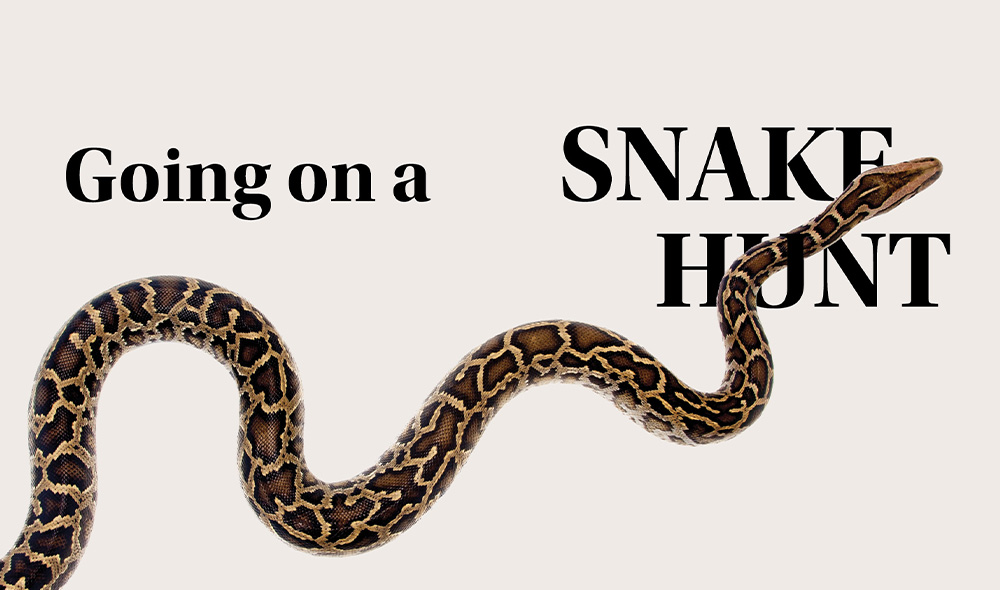
That moment could be a scene from a thousand different war movies, but it’s not. Instead, it’s a moment from a trip to the Florida Everglades that Martin Pollak ’15, M.A. ’26 participated in in October 2024. Sponsored by Tampa-based Walking with Warriors, the trip brought together veterans and first responders to track down invasive Burmese pythons, which are decimating native bird and animal populations.
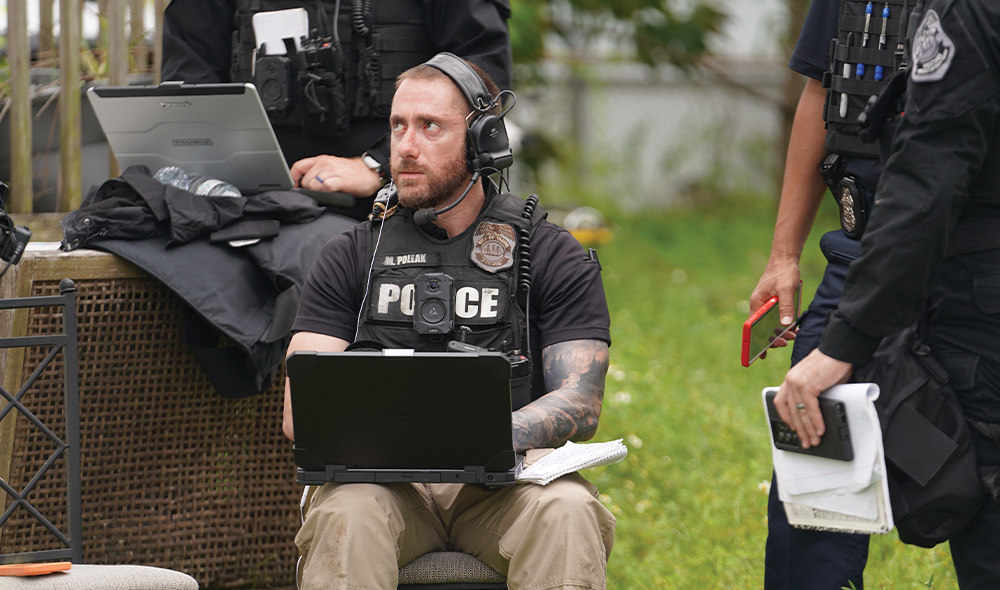
Pollak checked both the veteran and first-responder boxes for the four-day hunt. He served in the U.S. Navy from 2006 to 2011 and has been with the Tampa Police Department since 2017.
He also checked the outdoorsman box. An avid camper, hiker, hunter and fisherman, he’s seen his share of predators, including alligators. “When I was a kid, we’d kayak right over them,” he said. “They’d bring the kayak up out of the water a little bit.” Given that background, he didn’t worry when a facilitator reminded the group that everything in the Everglades that flies, crawls or walks can kill you, or when the group encountered its first water moccasin.
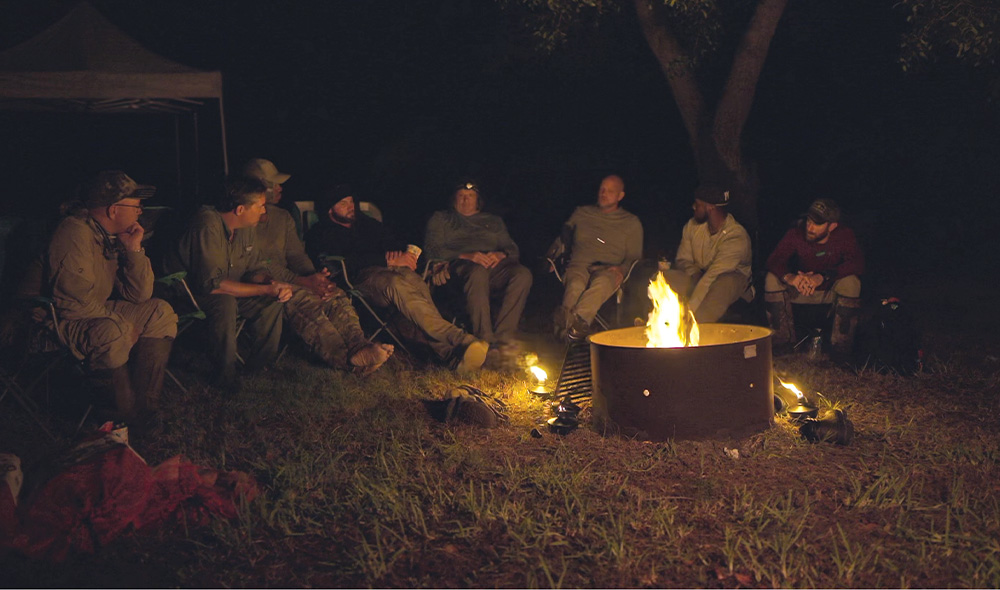
Still, the trip lay a little outside Pollak’s comfort zone. “I hang out with vets, and we go and do things similar to that, but I’d never done a veteran-specific trip where the conversations at night around the campfire were guided towards the experiences and how they affected you,” he said. “It’s always cool to see not just the camaraderie aspect, but the growth that can come out of it.”
Growth is very much the goal of Walking with Warriors, according to Michael Harris, the retired U.S. Army colonel who led the trip. “Our tagline is ‘Connect. Encourage. Strengthen’,” he said. “It’s giving guys the opportunity to have those connections, to be encouraged, and to be strengthened so that they can thrive in their calling.”
Harris and his wife, Bren, founded Walking with Warriors in 2018. She’s the president and CEO; he’s the chief operating officer. The organization works with people from several high-risk professions — military, police and fire service — to provide support, including for those who may experience negative personal outcomes, like high stress or post-traumatic stress disorder, from their careers. The group is a trusted partner of the Tampa Police Department, honored in 2023 with TPD’s Citizen Appreciation Award. In 2022, it was named TPD’s Community Partner of the Year.
From Florida to Africa and Back
Pollak, a native of St. Petersburg, says he wasn’t ready for college out of high school. Instead, like many young people influenced by the 9/11 attacks, he joined the Navy in 2006.
His first duty station was Naval Air Station Sigonella in Sicily, where he worked in base security and broke up the occasional bar fight. He then re-upped and joined Maritime Expeditionary Security Squadron 3 (now Coastal Riverine Squadron 3). Deployed to Djibouti, he and his colleagues handled antiterrorism force protection in the Gulf of Aden and the Indian Ocean, freeing up Navy SEALs for other missions.
Pollak didn’t come home with the problems some of his fellow service members did, but his time in a war zone did weigh on him. “The stuff that got to me was never the stuff that bothers other people,” he recalled. “It was the poverty, the people living in just abhorrent conditions.”
After his Navy service ended, Pollak attended community college in San Diego for two years. “I was studying international business,” he said, adding, “I have no business being in international business.”
An internship with New York Life in Tampa brought him home. Then, in January 2014, he started at the University of Tampa in criminology. “If you want to work in the Tampa Bay area and you want a good job, University of Tampa is where you need to go, right?” he said.
In fact, his UTampa experience led to his current role with the Tampa Police Department, where he’s the corporal of a field training squad and a member of the hostage negotiation team. He applied for and won an internship with the U.S. Marshals Service through UTampa, then got hired by TPD because of that internship. “What UT did and the opportunities that it afforded me were the reason I’m at where I am now,” he said.
Today, Pollak is pursuing a master’s degree in professional communication at UTampa. He believes the degree will help him become more effective on the hostage negotiation team, since deescalation requires good communication.
SWAMPY CIRCUMSTANCES
Pollak’s mentor at TPD volunteers with Walking with Warriors, and it was he who told Pollak about the upcoming hunt, which would be the subject of a planned documentary. After meeting with Harris, Pollak quickly agreed to participate.
“I felt a way that I hadn’t felt since I was still in the Navy,” Pollak said. “It’s a group of people, and you have a mission, and it’s, ‘here we go.’”
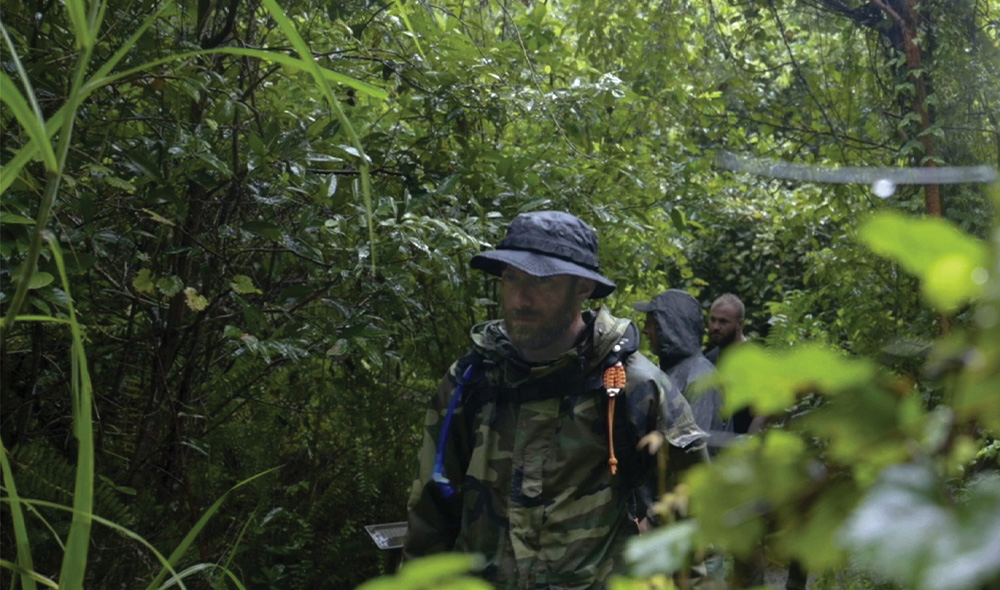
On Day One, the group gathered in a half-empty Tampa parking lot for the drive to the Everglades. Pollak thought they looked like “a flash mob advertisement for bearded outdoor fitness and fixed-blade knives.”
The 10-man group included a range of participants, from a young Army officer to a New York City firefighter who’d helped rescue World Trade Center victims on 9/11. That mix was intentional. In addition to uniting people from several high-risk professions, Walking with Warriors strives to include all ages. “At almost all of our events, there’s a few veterans, there’s a few currently serving, and then there’s a few either new in service or thinking about serving,” Harris said. “You’ve got all three different groups benefiting from each other.”
At night, pythons stretch out on warm pavement to absorb residual heat, so the hunters set out about 11 p.m. For most of the night, they searched a 40-mile stretch of highway, but the only snake they encountered was a water moccasin.
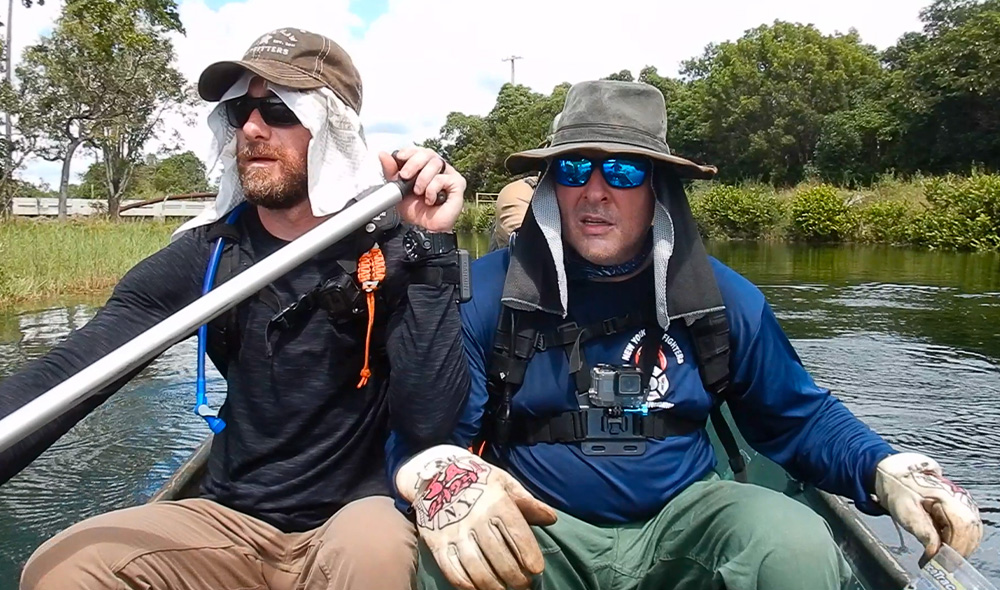
On the second day, the group loaded into small boats and headed to the abandoned Aerojet Dade Rocket Facility. Perhaps the boats should have been abandoned as well. Several had cracks patched with insulating foam, and one soon sank, destroying some of the film crew’s equipment. Pollak’s stayed afloat, but they had to use a discarded cup from a gas station as a bailing bucket. As he later joked, “Fellowship and adventure call men to do great and stupid things.”
“I purposely make it suck, because then there’s the camaraderie of coming together,” said Harris, who holds a doctorate in conflict resolution. “It’s also a way for guys to use their tactical skills and their ability to endure the suck for a good cause.”
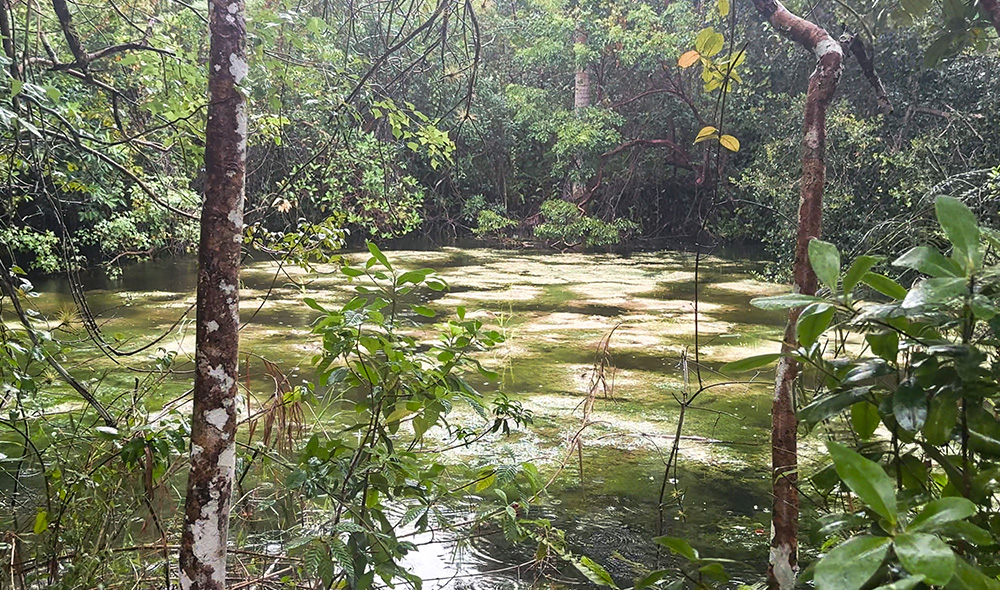
Finding no snakes at the rocket facility, the group moved on to a small island where pythons have been known to lurk. They poked around among tree roots, hoping to scare up a snake, but all they earned for their efforts were rashes from poisonwood trees. (These trees, which grow to 25-35 feet, produce the same irritant as poison ivy and poison oak.)
Around the fire back at camp, the hunters reflected on their experiences, both that day and throughout their careers. Harris guided the group in a discussion of how suffering can lead to growth, noting that “iron sharpens iron.” Pollak said he didn’t worry about the ever-present mosquitoes after that.
The next day looked much like day before. The only dangerous creatures the hunters saw were a few water moccasins and an alligator or two.
For Pollak, the day’s highlight was a deep conversation he had with Harris during their drive time. Harris described recent research into PTSD that has begun to shift the narrative around the challenges some veterans face. He believes many people mistakenly label veterans with PTSD as “broken toys” who are helpless victims.
UTampa Associate Professor of Psychology Meredith Elzy explained that even though many
people associate PTSD with military service, anyone
can experience it.
“In any given year, the adult prevalence of PTSD is about 3.5%,” she said, and while estimates vary, she said, for veterans, the number can be significantly higher.
That’s where groups like Walking with Warriors can help. “In general, social support is a protective factor from people developing PTSD after they experience a traumatic event,” Elzy said.
On Day Four, the group packed up and headed home. They hadn’t seen, much less captured, a python. “There’s no period at the end of my sentence,” Pollak said. “But maybe it wouldn’t have been as special if we’d actually gotten one. (He’s hoping for a better result during the next hunt, tentatively scheduled for this spring.)
As the group got back into cell-phone range, Pollak’s phone started lighting up. Category 3 Hurricane Milton was headed toward Tampa — the area’s second hurricane in two weeks — and the TPD was activating all its officers. Reflecting on the trip would have to wait. Back home, Pollak made sure his house was hurricane-ready and his wife and sons were safe.
Then, he grabbed his go bag and went to work.
More UTampa News