Written by Holly Neumann | Photo by Jessica Leigh | Published on Feb. 23, 2026
From Unassuming to Aerospace
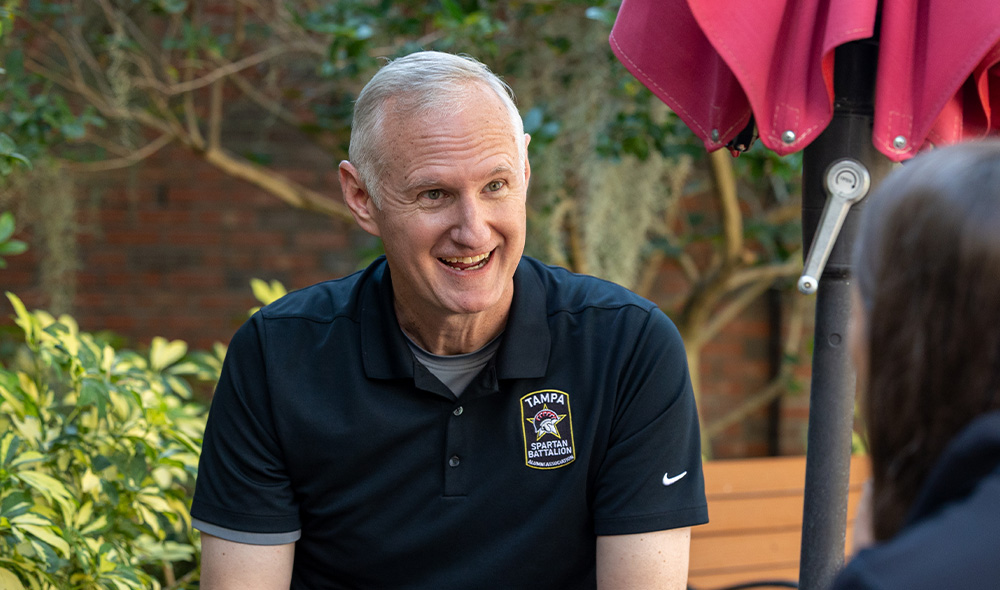
SPARTAN SPOTLIGHT: Bascom Bradshaw '97
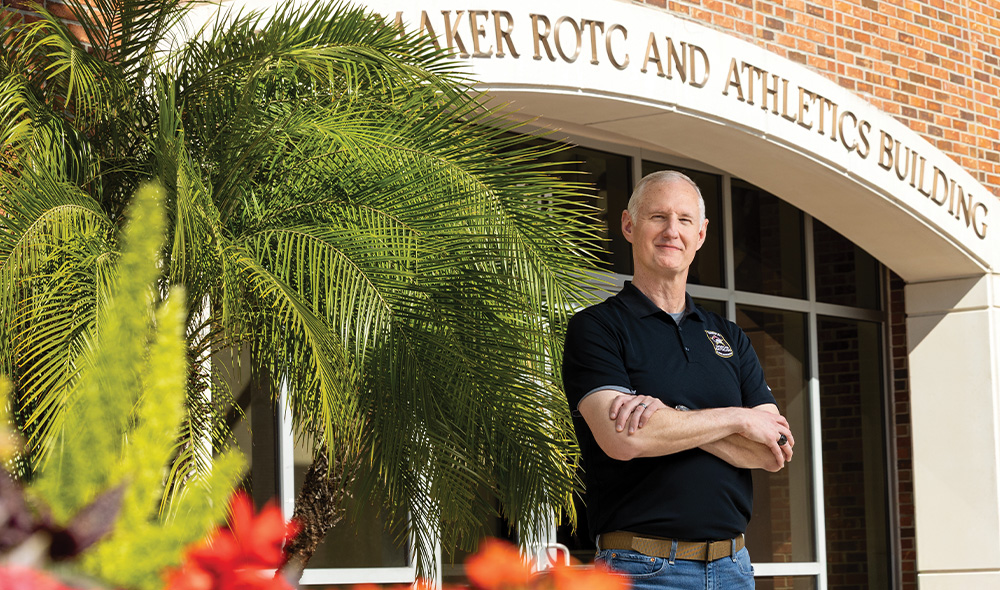
Bascom Bradshaw ’97 was once down to his last 37 cents.
He was flunking out of college, hanging out with punk rockers in North Texas, a pizza-delivery guy who thought being a radio DJ might be cool, when one night, he got punched in the face by the cousin of a friend and landed in the emergency room.
Stitched up, he paid his bill — and walked out with three dimes, a nickel and two pennies to his name.
Now what? he asked himself, and as he stood there, maybe a little concussed, he remembered recently having seen a military recruitment flyer.
What happened next is a life journey that took him from Texas to Europe to the Middle East, Hawaii, Florida, Alabama and other locales — not necessarily in that order or even just once in each spot. What became a distinguished service career led him from that hospital ER sidewalk to a conference table inside NASA Johnson Space Center.
And today, Bradshaw is an aerospace medicine specialist and psychiatrist who evaluates pilots and astronauts for fitness to fly, a career that took off partly thanks to the notice and encouragement of a UTampa biology professor.
Bradshaw was a combat medic when he first enlisted, an accidental assignment (he had signed up for something called “health care specialist” — What’s this combat stuff? he remembers thinking), but he ended up liking it, and before long, he set his sights on nursing. He’d have to go back to school.
But that first, failing academic go-round proved an anvil on his aspirations, and even with straight A’s in his pre-nursing classes, completed while he worked a night shift driving trucks at Fort Sam Houston in San Antonio, when it came time to apply to nursing school, his overall GPA was too low. He didn’t get in.
Enter another flyer, this one a trifold from the University of Tampa, the first university to recruit him after he applied for the Army’s Green to Gold program. UTampa didn’t have a nursing bachelor’s degree then, but it did have biology. Figuring that was close enough, Bradshaw boarded a ValuJet to Florida.
The Green to Gold program is for enlisted servicemen and women who seek higher education. They administratively separate from the Army while in school and join ROTC on their campuses. Once a degree is earned, they recommission as officers and fulfill a new service commitment.
Bradshaw exceled in his biology classes, and one day, his adviser, Dana Professor Fred Punzo, pulled him aside.
“We need to talk,” he said.
This was strange, Bradshaw remembers, because the only notable conversation they’d ever had was when Bradshaw had told Punzo about not getting into nursing school.
“I've been looking at your transcripts,” Punzo told him. “Have you thought about professional school? I think you could get into medical school.”
Bradshaw explained his requirement to return to service — and again how he’d already been rejected by nursing schools.
“Oh, no, no, no, it’s different,” Bradshaw remembers him saying. “The pathway is much different.”
So began a new trajectory, and it would be too easy to just say he passed the entrance exam, got into a medical school, became a flight surgeon, specialized in aerospace medicine, then public health, then psychiatry, commissioned as an officer, was sent to Germany, got deployed to Iraq, Afghanistan, Qatar, fell in love and married (twice), adopted a child from China, wrote a children’s book, blended a family, had more kids, worked with NASA to recommend astronaut candidates — maybe not in that order or even just once.
No, first, he had to buy some socks.
There was an ROTC camp to attend in the summer before Bradshaw’s senior year at UTampa, and he needed socks for it. A girlfriend drove him to Sears, and when the salesperson told him he could get the socks for free if he opened a Sears account, it was an offer too good to pass up.
Then, he maxed out his credit applying to medical school. When it came time to pack up and move back to Texas to attend, he literally had no way to get there. Not even 37 cents to call a taxi from a pay phone.
But he had that Sears card. And, using the Yellow Pages, he found a car rental agency that would take it. So that’s how he actually got to medical school after getting in, thanks to a free pair of socks.
Bradshaw left active duty after 18 years in the Army. Six years later, he commissioned in the Navy Reserve, and today, in an independent consultancy role, he sees around 200 pilots and aspiring pilots a year, evaluating stress levels and making recommendations for pilot fitness. Sometimes, he assists NASA with astronaut selection.
“I recognize that there is a ‘gee-whiz’ element about things like helping out with NASA,” he said. “But really, compared to some of my classmates, my career has been remarkably unremarkable. I’m just trying to keep treading water here.”
Some of those “more remarkable” fellow ROTC alums, along with Bradshaw, recently started a scholastic award for current ROTC students.
“There’s been quite a few of us that are starting to peel back and go, ‘You know what? Maybe it’s time to reconnect,’” he said. “Maybe it’s time to lay the groundwork for those cadets who would make great future leaders, not just in the Army, but in their communities and as parents and things like that.”
The award provides three $5,000 awards to help with academic expenses, just a little more than 37 cents.
More UTampa News